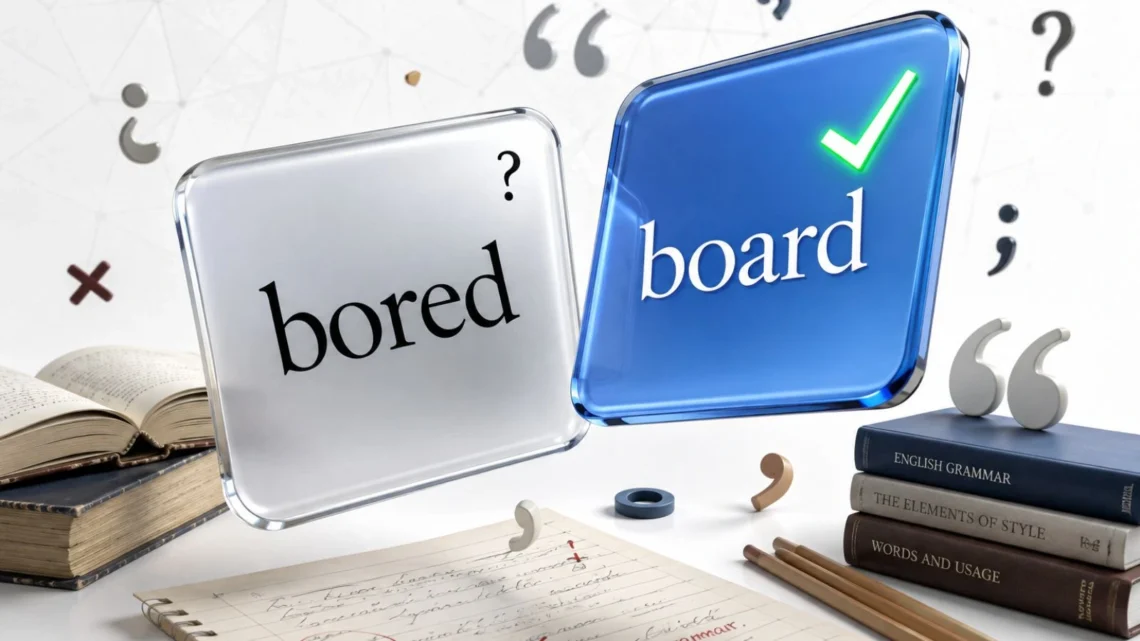
If you have ever wondered whether to write bored or board, you are not alone.
These two words sound exactly alike, but they have completely different meanings, making them a common source of confusion in everyday writing.
The good news is that choosing the right one is simple once you understand when each word should be used.
In this guide, you shall discover the difference between bored and board, learn the correct usage for different situations, and see clear sentence examples that make the grammar rule easy to remember.
We shall also cover common mistakes, pronunciation, and practical tips so you can use both words confidently in conversations, emails, schoolwork, and professional writing.
Quick Answer
Bored means feeling uninterested, tired, or lacking excitement. It is usually an adjective describing a person’s emotional state. Board is most often a noun referring to a flat piece of wood or a group of people, but it can also be a verb meaning to get onto a vehicle such as a bus, train, or airplane. Use bored for feelings and board for objects, groups, or boarding transportation.
Bored vs. Board Comparison Table
| Feature | Bored | Board |
| Correct Word | ✅ Yes | ✅ Yes |
| Incorrect Word | ❌ When referring to wood or transportation | ❌ When referring to feelings |
| Meaning | Feeling uninterested or tired | A flat piece of wood, a committee, or to enter a vehicle |
| Definition | Lacking interest or excitement | A plank, governing group, writing surface, or the act of entering transportation |
| Part of Speech | Adjective | Noun or Verb |
| Grammar Rule | Describes a feeling | Names an object/group or shows an action |
| Correct Usage | I was bored during the lecture. | We boarded the plane on time. |
| Incorrect Usage | I was board in class. | We were bored the airplane. |
| Pronunciation | /bɔːrd/ | /bɔːrd/ |
| Common Mistake | Using “board” for emotions | Using “bored” for objects or travel |
| Memory Tip | -ed often describes feelings | Think of a wooden board or boarding a plane |
| Example | She felt bored after waiting an hour. | The board approved the proposal. |
What Does “Bored” Mean?
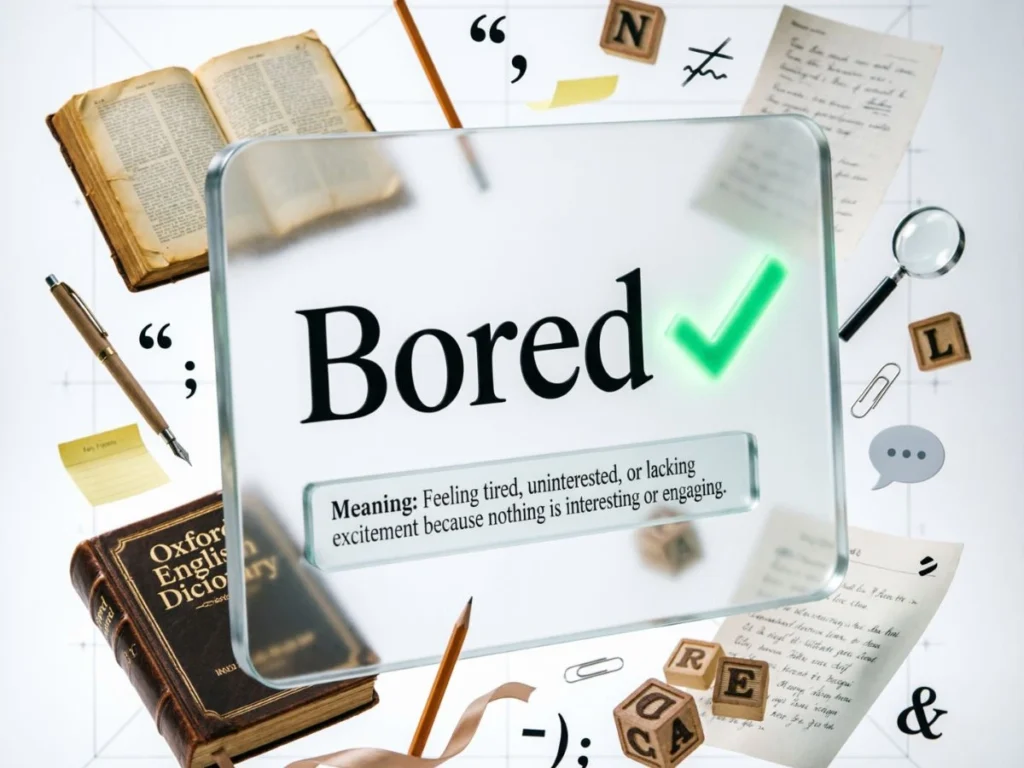
Bored is an adjective that describes someone who feels uninterested, restless, or tired because nothing is engaging them.
Grammar Role
- Adjective
- Describes a person’s emotional or mental state
Pronunciation
Bored: /bɔːrd/
Examples
- I felt bored during the long meeting.
- The children became bored after playing the same game all afternoon.
- She is bored because there’s nothing to watch.
- He looked bored while waiting in line.
- We were bored by the repetitive presentation.
What Does “Board” Mean?
Board has several meanings depending on how it is used.
As a Noun
It can mean:
- A flat piece of wood
- A writing surface
- A group of people who manage an organization
- Meals provided as part of housing (less common in modern US English)
As a Verb
It means:
- To get onto a bus, train, ship, or airplane
- To cover something with boards (less common)
Pronunciation
Board: /bɔːrd/
Examples
- The carpenter cut the board into two pieces.
- She wrote the answer on the whiteboard.
- The board of directors approved the budget.
- Passengers should board the train now.
- We boarded the flight thirty minutes before departure.
Key Differences Between Bored and Board
- Bored describes a feeling.
- Board usually refers to an object, a group, or the action of entering transportation.
- Bored is only an adjective.
- Board can be both a noun and a verb.
- If you are talking about emotions, use bored.
- If you are talking about wood, meetings, directors, signs, or transportation, use board.
Compare These Examples
✔ I am bored at home.
✔ I painted the board blue.
✔ We boarded the airplane.
✔ The school board announced new policies.
Grammar Rules
Understanding the grammar makes choosing the correct word much easier.
Use “Bored” When
- Describing someone is feelings
- Explaining a lack of interest
- Talking about emotions
Examples:
- She was bored by the movie.
- I am bored with this game.
- They became bored after lunch.
Use “Board” When
- Referring to a physical object
- Talking about a committee or governing group
- Describing getting onto transportation
Examples:
- The teacher wrote on the board.
- The board voted unanimously.
- Please board the aircraft now.
Are There Any Exceptions?
There are no grammar exceptions that make bored and board interchangeable. They always have different meanings despite sounding identical.
When to Use Each Word
Academic Writing
Use bored when discussing emotions.
- Students appeared bored during the lecture.
Use board for educational equipment or organizations.
- Write your answer on the board.
Professional Writing
- Employees seemed bored during the training session.
- The board approved the companys annual report.
Formal English
- Several attendees looked bored after the lengthy discussion.
- The board will review the proposal next week.
Informal English
- I am bored. Let is go outside.
- Grab that board from the garage.
Business Writing
- The board of directors meets every quarter.
- Employees should not feel bored during training programs.
Emails
Correct:
- I became bored waiting for the meeting to begin.
- Please board the shuttle at Gate 4.
Daily Conversation
- Are you bored?
- We should board the bus before it leaves.
Common Mistakes
Mistake 1
❌ I am board.
✔ I am bored.
Why?
you are describing a feeling, so use the adjective bored.
Mistake 2
❌ The bored of directors met yesterday.
✔ The board of directors met yesterday.
Why?
A governing group is called a board.
Mistake 3
❌ We bored the airplane early.
✔ We boarded the airplane early.
Why?
The verb is board, and its past tense is boarded.
Mistake 4
❌ The carpenter bought a bored.
✔ The carpenter bought a board.
Why?
A piece of wood is a board, not bored.
20 Original Example Sentences
School
- I became bored halfway through the history lesson.
- The teacher erased the board before class began.
Workplace
- Nobody looked bored during the interactive workshop.
- The board discussed the company’s expansion plans.
Business
- The board approved a new hiring policy.
- Investors listened carefully while the board presented its report.
Conversation
- I am bored because everyone canceled their plans.
- Please do not sit on that loose board.
Books
- The main character felt bored with village life.
- The author sketched a map on a wooden board.
News
- The school board introduced updated safety guidelines.
- Travelers boarded the rescue ship before sunset.
Social Media
- People say they are bored whenever the internet goes down.
- Someone balanced a surfboard on a wooden board for a funny photo.
Everyday English
- My dog gets bored when it rains all day.
- We boarded the subway just before the doors closed.
- She leaned the picture against a board.
- I was bored while waiting for customer support.
- The board meets every Monday morning.
- The children quickly became bored after the power outage.
Memory Trick
Remember this simple tip:
- Bored = Feeling → The ending -ed often describes emotions or conditions.
- Board = Wood, Committee, or Transportation → Think of a wooden board or boarding a plane.
Easy reminder:
If you can feel it, you are bored. If you can stand on it, write on it, or board it, it’s board.
Mini Quiz
1. Which sentence is correct?
A. I was board all afternoon.
B. I was bored all afternoon.
C. I was boarding all afternoon.
Answer: B
2. Which word refers to a governing group?
A. Bored
B. Board
C. Boring
Answer: B
3. Which sentence is correct?
A. We were bored by the train.
B. We boarded the train.
C. We board the feeling.
Answer: B
4. Which word describes a feeling?
A. Board
B. Bored
C. Boarding
Answer: B
5. Complete the sentence:
“The school _____ approved new rules.”
A. bored
B. board
C. boring
Answer: B
Frequently Asked Questions
Is it “I am bored” or “I am board”?
The correct phrase is “I am bored.” The word bored is an adjective that describes feeling uninterested or lacking excitement. Board is a noun or verb and cannot describe an emotional state.
What is the difference between bored and board?
Bored refers to a feeling of having little interest or excitement. Board refers to a flat piece of wood, a governing committee, a writing surface, or the act of entering a vehicle such as a plane or train.
Is “board” ever used as an adjective?
Generally, board is used as a noun or verb. It may appear before another noun in compound expressions, such as board meeting or board member, but it does not function as an adjective meaning uninterested.
Why do people confuse bored and board?
People confuse them because they are homophones. They sound exactly the same in spoken English, but they have different spellings, meanings, and grammatical functions.
Is “boarded” related to “bored”?
No. Boarded is the past tense of the verb board, meaning entering a vehicle or covering something with boards. It is unrelated to the adjective bored, which describes an emotional state.
Does British English use bored and board differently?
No. Both American and British English use bored and board with the same meanings and grammar rules. The spelling and usage remain consistent across both varieties of English.
Key Takeaways
- Bored describes a feeling of lacking interest.
- Board refers to an object, committee, writing surface, or entering transportation.
- Bored is an adjective.
- Board is a noun or verb.
- These words sound the same but have different meanings.
- If you are talking about emotions, choose bored.
- If you are talking about wood, directors, classrooms, or transportation, choose board.
Conclusion
Understanding the difference between bored and board is straightforward once you know their roles.
Bored always refers to a feeling of being uninterested, while board refers to an object, a governing group, or the action of entering transportation.
Since these homophones sound alike, they are easy to confuse, but remembering that bored relates to emotions and board relates to things or actions will help you choose the correct word every time.

Alexander Reed is an American author at WordsSign. He writes clear and well-researched articles on symbols, meanings, culture, and spiritual insights.