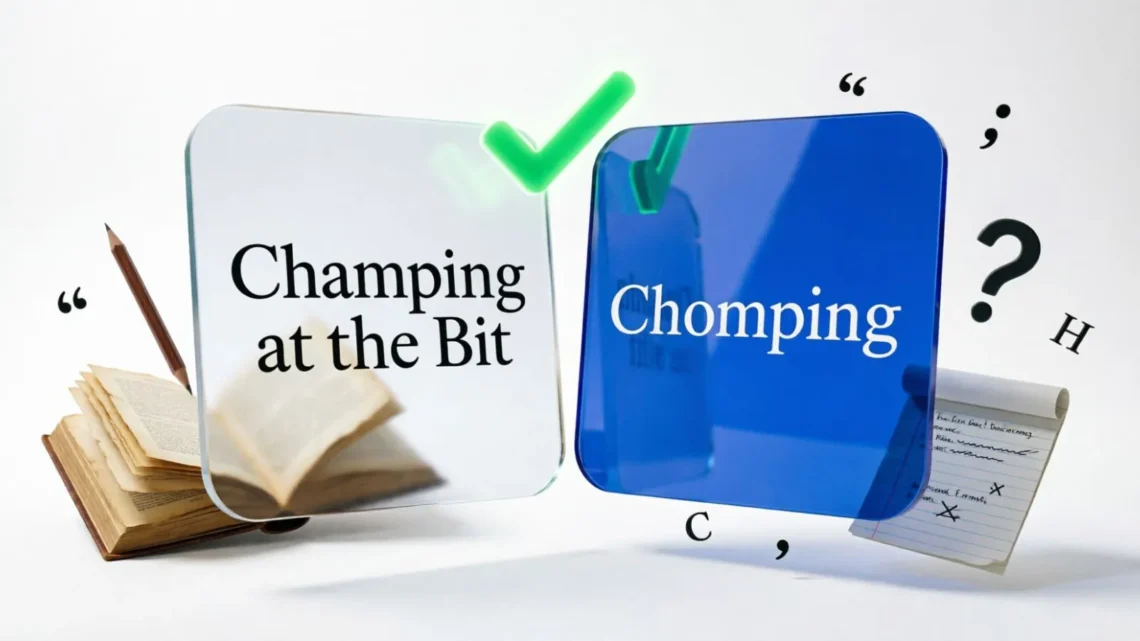
Confused about “champing at the bit or chomping”? You are not alone.
Both forms are commonly used, but they are not equally traditional or preferred in every context.
This guide explains the difference between the two expressions, what they mean, when to use each one, and which form is considered standard.
You shall also find clear examples to help you use the expression confidently and avoid common mistakes in everyday writing.
Quick Answer
“Champing at the bit” is the traditional form, while “chomping at the bit” is a widely accepted modern variant, especially in American English. Both mean being impatient or eager to do something. For formal or traditional usage, choose “champing at the bit”; in everyday American English, “chomping at the bit” is also perfectly natural.
Champing at the Bit or Chomping: Comparison Table
| Feature | Champing at the Bit | Chomping at the Bit |
| Status | Traditional and standard idiom | Widely accepted modern variant |
| Meaning | Being impatient or eager to act | Being impatient or eager to act |
| Definition | Originally describes a horse biting or working against its bit | Modern expression based on the same image of impatient biting |
| Part of Speech | Idiomatic phrase | Idiomatic phrase |
| Grammar Rule | Usually used with at the bit | Usually used with at the bit |
| Correct Usage | Yes | Yes |
| Incorrect Usage | Not incorrect | Not inherently incorrect |
| Pronunciation | CHAMP ing at the bit | CHOMP ing at the bit |
| Common Mistake | Assuming champing is a spelling error | Assuming chomping is always wrong |
| Memory Tip | Champ = traditional form | Chomp = common modern American variant |
| Example | “The players were champing at the bit to begin.” | “The players were chomping at the bit to begin.” |
What Does “Champing at the Bit” Mean?
“Champing at the bit” means being very eager, impatient, or excited to do something.
The expression comes from horse riding. A bit is a piece of equipment placed in a horse’s mouth and connected to the reins. An impatient or excited horse may bite, chew, or work against the bite while waiting to move.
The word champing refers to biting or chewing repeatedly. Over time, the literal image of a horse working against its bit developed into the figurative expression we use today.
Examples of “Champing at the Bit”
- The children were champing at the bit to open their presents.
- The new employees were champing at the bit to start their first project.
- After months of training, the athletes were champing at the bit to compete.
- She was champing at the bit to tell everyone the good news.
- The audience was champing at the bit for the concert to begin.
In each example, nobody is literally biting a horse’s bit. The phrase means that someone is impatiently eager to act.
Is “Champing” a Real Word?
Yes. Champing is a real English word and is not a misspelling of chomping.
The verb champ can mean to bite or chew, particularly in the traditional expression involving a horse and its bit. The present participle is champing.
For example:
The horse was champing at the bit.
The same word appears in the figurative idiom:
The students were champing at the bit to begin the experiment.
What Does “Chomping at the Bit” Mean?

“Chomping at the bit” has the same basic meaning as “champing at the bit”: being very eager or impatient to do something.
The verb chomp means to bite or chew noisily or vigorously. Because chomp is a familiar modern English word, speakers naturally began using “chomping at the bit” as a variation of the traditional expression.
Today, “chomping at the bit” is widely used and understood, particularly in American English.
Examples of “Chomping at the Bit”
- The team was chomping at the bit to get back on the field.
- The children were chomping at the bit to see their new classroom.
- Investors were chomping at the bit for the company to announce its plans.
- He was chomping at the bit to start his new job.
- The fans were chomping at the bit for the season to begin.
These sentences communicate the same general idea as their versions with champing.
What Is the Difference Between “Champing at the Bit” and “Chomping at the Bit”?
The main difference is history and usage preference, not meaning.
- Champing at the bit is the traditional form of the idiom.
- Chomping at the bit is a modern variant that has become especially common in American English.
- Both expressions mean being impatient or eager to do something.
- Champ and chomp are different verbs, but both can evoke the image of biting or chewing.
- Choosing champing gives your writing a more traditional or idiomatic feel.
- Choosing chomping sounds very natural in contemporary American conversation.
- Neither form should automatically be treated as a grammatical error.
Traditional vs. Modern Usage
Consider these two sentences:
The students were champing at the bit to begin.
The students were chomping at the bit to begin.
Both sentences mean that the students were extremely eager to begin.
The first follows the traditional form. The second uses the modern variant.
Which Is Correct: Champing at the Bit or Chomping at the Bit?

Both are acceptable, but “champing at the bit” is the traditional form.
If you are writing in a formal, literary, historical, or deliberately traditional style, “champing at the bit” is the safest choice.
If you are writing ordinary American English, “chomping at the bit” is also widely accepted and will not normally confuse readers.
The important point is that “chomping at the bit” is not simply an incorrect spelling of “champing at the bit.” It has developed into an established variant of the idiom.
Grammar Rules for “Champing at the Bit” and “Chomping at the Bit”
The expression normally follows this pattern:
Subject + be + champing/chomping + at the bit + to + verb
For example:
Maria is champing at the bit to leave.
Or:
Maria is chomping at the bit to leave.
You can also use the expression with different forms of be:
- I am champing at the bit.
- He was champing at the bit.
- They are chomping at the bit.
- We were chomping at the bit.
- She has been champing at the bit.
Use “to” When Naming the Desired Action
The idiom is often followed by to + base verb:
- The students were chomping at the bit to begin.
- She was champing at the bit to respond.
- The company is chomping at the bit to expand.
Do Not Change “at the Bit” to “on the Bit”
The established idiom is:
champing at the bit
and:
chomping at the bit
Although horses can interact with a bit in various physical ways, the figurative expression uses at the bit.
Can You Use the Expression Literally?
Yes, although literal use is much less common in ordinary modern conversation.
For example:
The nervous horse was champing at the bit.
This can describe an actual horse biting or working against its bit.
The expression is far more common in its figurative sense:
The rookie was champing at the bit to make his professional debut.
Here, the person is not literally biting anything. The phrase describes eagerness and impatience.
When Should You Use “Champing at the Bit”?
Academic Writing
“Champing at the bit” can work in academic writing when the tone permits an idiomatic expression. However, highly technical or formal academic prose may benefit from a more precise expression such as “eager,” “impatient,” or “highly motivated.”
Instead of:
The researchers were champing at the bit to publish the findings.
A more neutral academic version might be:
The researchers were eager to publish the findings.
Professional Writing
Both versions can appear in professional writing.
Champing may sound slightly more traditional:
The sales team was champing at the bit to launch the new product.
Chomping sounds especially natural in contemporary American business communication:
The sales team was chomping at the bit to launch the new product.
For a formal report, however, “eager to” may be more concise and professional.
Formal English
For formal or traditional English, “champing at the bit” is generally the preferred form.
For example:
The delegates were champing at the bit to begin negotiations.
Still, using an idiom in formal writing depends on the context and the desired tone.
Informal English
Both forms work well in informal English:
i am chomping at the bit to see the new movie.
Or:
i am champing at the bit to see the new movie.
The chomping version may sound more conversational to many American speakers.
Business Writing
Both forms are possible, but consider your audience.
Investors are chomping at the bit to see the company’s next move.
This sounds natural and energetic.
For a formal financial report:
Investors are eager to see the company’s next move.
The second version communicates the idea without relying on an idiom.
Emails
In friendly or informal professional emails, either expression can work:
We’re chomping at the bit to get started on the project.
In a highly formal email, a simpler expression may be better:
We’re eager to get started on the project.
Daily Conversation
“Chomping at the bit” is especially natural in everyday American speech:
i am chomping at the bit to get home.
However, “champing at the bit” remains completely understandable and established.
Why Do People Confuse “Champing” and “Chomping”?
The confusion exists partly because chomp is much more familiar to modern speakers than champ.
Most English speakers immediately recognize chomp as meaning to bite or chew vigorously. By contrast, champ in the relevant sense is relatively uncommon outside the expression “champing at the bit.”
As a result, people sometimes assume that champing must be an old fashioned spelling of chomping. That assumption is incorrect.
The two words have different histories, but their meanings overlap enough for “chomping at the bit” to become a well established variant.
Common Mistakes to Avoid
Mistake 1: Saying “Champing” Is Wrong
Incorrect assumption:
“Champing at the bit” is a mistake. It should always be “chomping.”
Correct understanding:
Champing is the traditional form and remains standard English.
Mistake 2: Saying “Chomping” Is Always Wrong
Incorrect assumption:
Only “champing at the bit” is acceptable.
Better understanding:
“Chomping at the bit” is a widely accepted modern variant, especially in American English.
Mistake 3: Changing “At” to “On”
Avoid:
She was chomping on the bit to leave.
For the idiom, use:
She was chomping at the bit to leave.
Mistake 4: Taking the Idiom Literally
When someone says:
The players were champing at the bit.
They usually do not mean that the players were literally chewing something.
The phrase normally means:
The players were extremely eager or impatient to begin.
Mistake 5: Using the Idiom When “Eager” Is Clearer
Idioms are useful, but they are not always the best choice.
Instead of:
The committee was chomping at the bit to approve the proposal.
You could write:
The committee was eager to approve the proposal.
The second sentence is more direct and may work better in highly formal contexts.
18 Original Examples of “Champing at the Bit” and “Chomping at the Bit”
- The students were champing at the bit to see the results of their science experiment.
- After weeks of practice, the players were chomping at the bit to play their first game.
- The marketing team was champing at the bit to present its new campaign.
- My brother was chomping at the bit to open his birthday gift.
- The young author was champing at the bit to see her first novel in bookstores.
- The company was chomping at the bit to enter the rapidly growing market.
- The reporter was champing at the bit to ask the mayor about the announcement.
- After finishing the training program, the new employees were chomping at the bit to begin their assignments.
- The audience seemed to be champing at the bit for the speaker to reveal the final result.
- The children were chomping at the bit to start the outdoor adventure.
- The director was champing at the bit to begin filming the next scene.
- Our neighbors were chomping at the bit to move into their newly renovated home.
- The entrepreneur was champing at the bit to launch the business.
- In the novel, the young captain was chomping at the bit to prove himself in battle.
- The newsroom was champing at the bit for confirmation of the developing story.
- I was chomping at the bit to tell my friends about the surprise.
- The interns were champing at the bit to contribute ideas during the meeting.
- After a long winter, the gardeners were chomping at the bit to begin planting.
These examples show that the idiom can describe eagerness in school, work, business, entertainment, literature, news, social situations, and everyday life.
Is “Champing at the Bit” More Correct Than “Chomping at the Bit”?
If by “more correct” you mean traditional, then yes: “champing at the bit” is the traditional form of the idiom.
If by “correct” you mean acceptable in contemporary English, then both forms can be correct.
This distinction matters because language changes over time. A traditional expression can develop a newer form that becomes common enough to be recognized as a legitimate variant.
Therefore, it is too simplistic to label “chomping at the bit” as an error.
American English vs. British English
The distinction is often especially noticeable in American English.
“Chomping at the bit” is very common in contemporary American usage, while “champing at the bit” retains the traditional form.
British English also uses “champing at the bit,” and the traditional form remains well established. However, usage can vary among individual speakers, publications, and contexts.
If you are writing for an international audience and want the historically established form, “champing at the bit” is an excellent choice.
If you are writing natural, contemporary American English, “chomping at the bit” is also a safe and familiar option.
Memory Trick: Champ = Classic, Chomp = Common
Here is an easy way to remember the difference:
CHAMP = the traditional CHOICE.
CHOMP = the modern, conversational VARIANT.
Think of it this way:
Champ = classic.
Chomp = modern.
Both lead to the same idea:
“I am very eager to get started.”
If you are unsure which one to choose, use “champing at the bit” when you want the traditional form. Use “chomping at the bit” when writing natural contemporary American English.
Mini Quiz
1. Which is the traditional form of the idiom?
A. Chomping at the bit
B. Champing at the bit
C. Chumping at the bit
D. Champing on the bit
Answer: B. Champing at the bit
2. What does “champing at the bit” usually mean?
A. Feeling tired
B. Feeling confused
C. Being eager or impatient to act
D. Being physically uncomfortable
Answer: C. Being eager or impatient to act
3. Which sentence uses the idiom correctly?
A. She was champing on the bit to leave.
B. She was chomping at the bit to leave.
C. She was chomping in the bit to leave.
D. She was champing over the bit to leave.
Answer: B. She was chomping at the bit to leave.
4. Is “chomping at the bit” always grammatically incorrect?
A. Yes
B. No
C. Only in American English
D. Only in conversation
Answer: B. No
5. Which form is best if you want the traditional version?
A. Chomping at the bit
B. Champing at the bit
C. Chomping on the bit
D. Champing on the bit
Answer: B. Champing at the bit
FAQs
Is “champing at the bit” or “chomping at the bit” correct?
Both “champing at the bit” and “chomping at the bit” are accepted in contemporary English. “Champing at the bit” is the traditional form of the idiom, while “chomping at the bit” is a widely used modern variant, particularly in American English. Both mean being very eager or impatient to do something.
What does “champing at the bit” mean?
“Champing at the bit” means being extremely eager, excited, or impatient to do something. The expression comes from the image of a horse biting or working against the bit in its mouth because it wants to move. Today, the phrase is normally used figuratively for people who are eager to act.
Is “chomping at the bit” grammatically correct?
Yes. “Chomping at the bit” is a widely accepted modern variant of the traditional idiom. It is especially common in American English. Although “champing at the bit” has the longer established history, “chomping at the bit” should not automatically be treated as a grammatical error.
Why do people say “chomping at the bit”?
People say “chomping at the bit” because chomp is a familiar English verb meaning to bite or chew vigorously. Over time, speakers began using it in place of the less familiar champ in the traditional expression. The newer version became common enough to establish itself as a recognized variant.
Is “champing at the bit” old fashioned?
“Champing at the bit” can sound somewhat more traditional than “chomping at the bit,” but it is not obsolete or incorrect. It remains a standard and recognizable English idiom. Writers who prefer a traditional, literary, or historically established style may choose “champing at the bit.”
Can I use “chomping at the bit” in formal writing?
You can, because “chomping at the bit” is an established expression. However, if you want a more traditional idiomatic style, “champing at the bit” may be preferable. In highly formal or technical writing, a direct expression such as “eager to” or “impatient to” may be clearer.
Key Takeaways
- “Champing at the bit” is the traditional form of the idiom.
- “Chomping at the bit” is a widely accepted modern variant.
- Both expressions mean being very eager, excited, or impatient to act.
- The idiom comes from the image of a horse working against or biting its bit.
- “Champing” is not a misspelling of “chomping.”
- “Chomping” is especially common in contemporary American English.
- The established expression uses “at the bit,” not “on the bit.”
- Use “champing at the bit” when you want the traditional form.
- Use “chomping at the bit” freely in natural contemporary American English.
- In highly formal writing, “eager to” or “impatient to” may sometimes be more direct.
Conclusion
When deciding between “champing at the bit or chomping,” the key is to understand that both forms are used correctly in modern English.
“Champing at the bit” is the traditional expression, while “chomping at the bit” has become a widely accepted variant, particularly in American English.
Both mean that someone is very eager or impatient to do something.
If you prefer the traditional form, choose “champing at the bit.” If you are writing natural, contemporary American English, “chomping at the bit” is also perfectly acceptable.
The important thing is to use the complete idiom “at the bit” and match your choice to the tone and audience.

Alexander Reed is an American author at WordsSign. He writes clear and well-researched articles on symbols, meanings, culture, and spiritual insights.