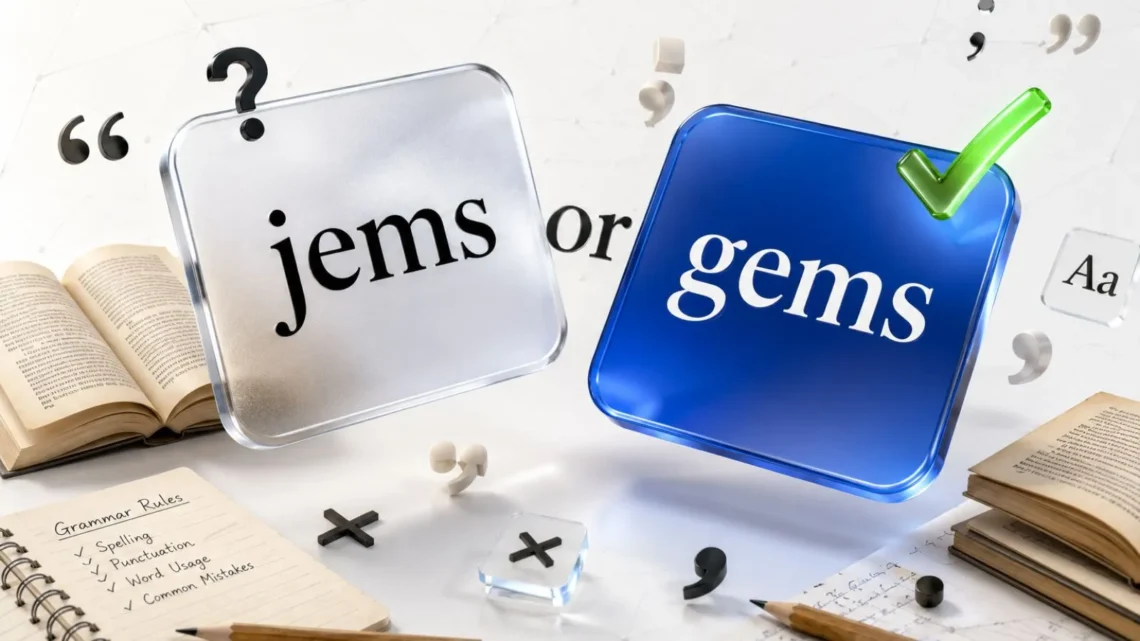
Have you ever wondered whether Jems or Gems is the correct spelling when writing about valuable stones or precious items?
This common spelling confusion can lead to mistakes in everyday writing, especially because the two forms look and sound similar.
In this guide, you will learn the correct usage, meaning, and difference between Jems and Gems, along with the grammar and spelling rule behind the correct form.
You shall also discover why this mistake happens, how to avoid it, and see clear sentence examples that make the proper spelling easier to remember.
If you are improving your English grammar or simply want to write with confidence, this explanation will help you use the right word every time.
Quick Answer
Gems is the correct English word.
Jems is not a standard English word and is considered a spelling mistake.
Examples:
- ✅ She wore beautiful gems in her necklace.
- ❌ She wore beautiful jems in her necklace.
Jems vs Gems: Main Difference
| Word/Phrase | Meaning | Correct? | Best Used For | Example |
| Jems | No standard English meaning | ❌ No | Not used | ❌ I bought colorful jems. |
| Gems | Precious stones or something valuable | ✅ Yes | Everyday, academic, and professional writing | ✅ The museum displayed rare gems. |
What Does Jems Mean?
Jems is not a standard English word.
People usually write jems by mistake because the G in gems sounds like the letter J.
Since jems is a misspelling, it should be avoided in all types of writing.
Incorrect Examples
- ❌ She collects shiny jems.
- ❌ These jems are expensive.
- ❌ I found beautiful jems in the shop.
- ❌ The ring has three blue jems.
- ❌ His collection includes rare jems.
What Does Gems Mean?
Gems is the plural form of gem.
A gem is usually a precious or semi precious stone used in jewelry. It can also describe something or someone that is especially valuable, beautiful, or impressive.
Correct Examples
- She bought a necklace with colorful gems.
- The crown was decorated with rare gems.
- This guide is full of helpful gems of advice.
- We saw beautiful gems at the jewelry store.
- Hidden gems can often be found in small towns.
How to Use Jems or Gems
Always use gems in your writing.
Use it when talking about:
- Precious stones
- Jewelry
- Valuable ideas
- Excellent people or things
- Hidden treasures
Avoid using jems, as it is simply a spelling mistake.
Correct
- ✅ These gems are worth a lot of money.
- ✅ She shared some real gems of wisdom.
Incorrect
- ❌ These jems are worth a lot of money.
- ❌ She shared some real jems of wisdom.
Where to Use Jems or Gems
Use gems in every type of communication.
School Writing
- Correct: The king’s crown contained many gems.
Formal Writing
- Correct: The exhibition displayed ancient gems.
Emails
- Correct: Thanks for sharing those helpful gems of advice.
Everyday Conversation
- “Those earrings have beautiful gems.”
Messages
- “I found some hidden gems while shopping.”
Professional Communication
- “The report contains several useful gems for future planning.”
Regional Usage
There is no American vs British spelling difference.
- American English: gems
- British English: gems
- Canadian English: gems
- Australian English: gems
- Indian English: gems
- Pakistani English: gems
The spelling is the same in all major English varieties.
Why People Get Confused
People often confuse jems and gems because:
- The G in gems is pronounced like a J.
- They spell the word based on its sound instead of its correct spelling.
- The word is commonly heard before it is seen in writing.
- Fast typing can also lead to mistakes.
Common Mistakes to Avoid
Wrong:
I bought expensive jems yesterday.
Correct:
I bought expensive gems yesterday.
Explanation: Gems is the correct spelling.
Wrong:
The museum has ancient jems.
Correct:
The museum has ancient gems.
Explanation: Always spell it gems.
Wrong:
She loves collecting jems.
Correct:
She loves collecting gems.
Explanation: Jems is not an English word.
Wrong:
These jems sparkle beautifully.
Correct:
These gems sparkle beautifully.
Explanation: Use gems in all situations.
Real Life Examples
Meeting
“We discovered some real gems during today is discussion.”
School
“The science museum displayed beautiful gems.”
Travel
“We visited a market selling handmade jewelry with colorful gems.”
Work
“Her presentation included several gems of practical advice.”
Message
“I found some hidden gems while shopping online.”
Conversation
“That old bookstore is a hidden gem.”
Shopping
“The ring contains genuine gems.”
Social Situation
“She always shares little gems of wisdom.”
Easy Trick to Remember
Think of G for Gold and Gem.
Since gems are often found in valuable jewelry, remember that a gem starts with G, not J.
Mini Quiz
1. Which spelling is correct?
Answer: Gems
2. Is “jems” a standard English word?
Answer: No.
3. Which sentence is correct?
A. The ring has beautiful jems.
B. The ring has beautiful gems.
Answer: B.
4. Can “gem” also mean something valuable besides a stone?
Answer: Yes.
5. Which word should you use in formal writing?
Answer: Gems
6. Do British and American English spell this word differently?
Answer: No.
Related Confusing Words
- gray or grey
- canceled or cancelled
- traveling or travelling
- your or you are
- its or it is
- there or their
- affect or effect
- stationery or stationary
FAQs
Is jems correct?
No. Jems is a misspelling.
Are jems correct?
Yes. Gems is the correct spelling.
What is the difference between jems and gems?
Gems is the correct English word. Jems is simply a spelling mistake.
Which one should I use?
Always use gems.
Are gems formal or informal?
Gems are correct in both formal and informal English.
Conclusion
Gems is the only correct spelling in English.
Jems is a common misspelling caused by pronunciation
Whether you are writing for school, work, or everyday communication, always use gems.
Remember: although it sounds like it starts with J, it is always spelled with a G.
Discover More Post
- Pavilion or Pavillion: Which Spelling Is Correct(2026)?
- Jems or Gems: Which Spelling Is Correct(2026)?
- Creat or Create: Which Spelling Is Correct(2026)?

Jack Ellison is an American author at WordsSign. He writes clear and well-researched articles on symbols, meanings, culture, and spiritual insights.