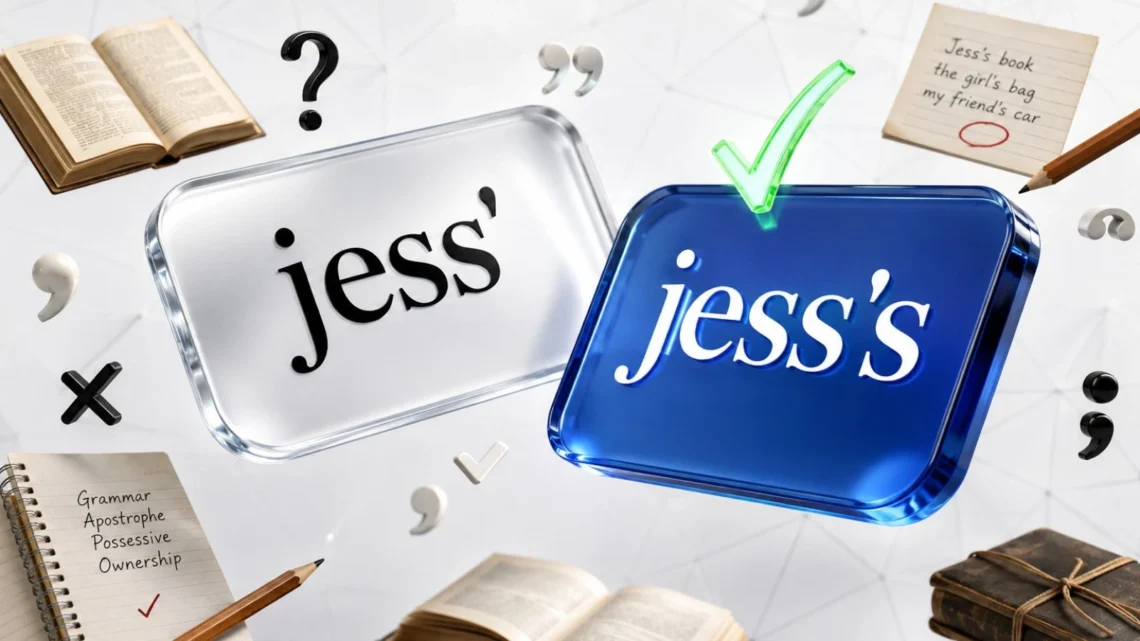
If you have ever wondered whether Jess’ or Jess’s is the correct possessive form, you are not alone.
This is a common English grammar question because names ending in s often create confusion in everyday writing.
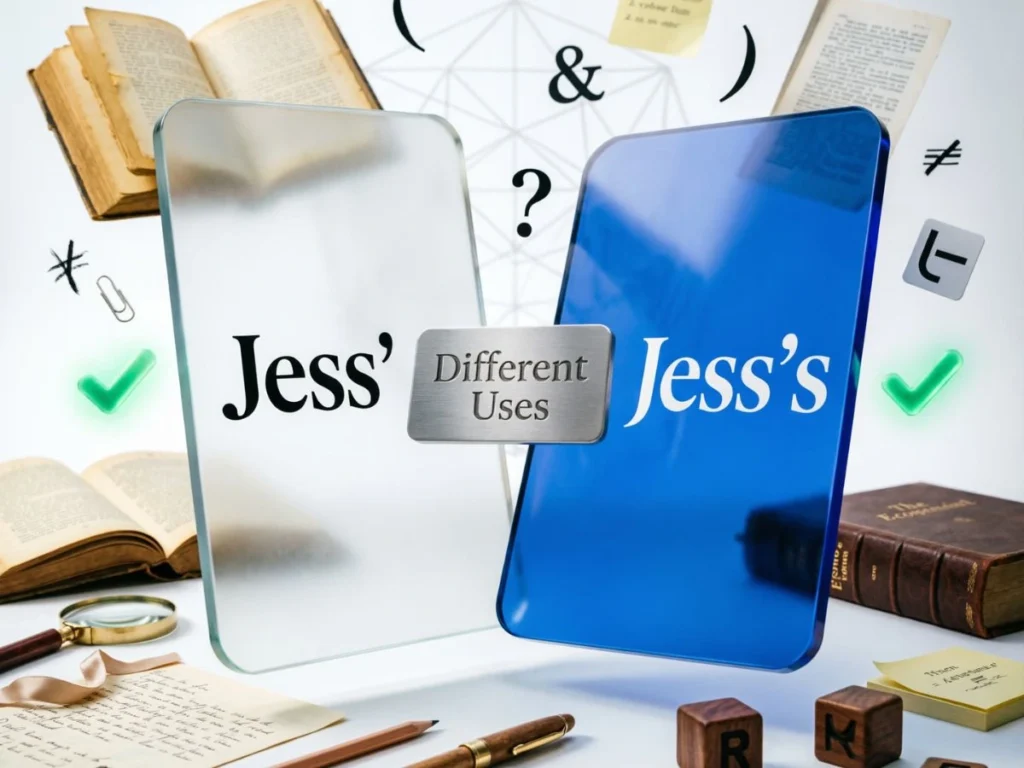
The short answer is that both Jess’ and Jess’s can be correct, depending on the style guide or context you’re following.
In this article, you shall learn the difference between these two forms, when each is appropriate, and which one is preferred in modern English.
We shall also explain the grammar rule behind possessive nouns, highlight common mistakes, and provide clear sentence examples so you can use the correct form with confidence in any type of writing.
Quick Answer
Both Jess’s and Jess’ can show that something belongs to Jess.
- Jess’s is the most common choice in modern English and is recommended by many grammar guides.
- Jess’ is also accepted by some style guides, especially for names ending in s.
Examples:
- Jess’s backpack is on the chair.
- Jess’ backpack is on the chair.
Jess’ vs Jess’s: Main Difference
| Word/Phrase | Meaning | Correct? | Best Used For | Example |
| Jess’s | Something belongs to Jess | Yes | General, school, everyday, and most formal writing | Jess’s notebook is missing. |
| Jess’ | Something belongs to Jess | Yes | Some style guides and personal preference | Jess’ notebook is missing. |
What Does Jess’ Mean?
Jess’ is the possessive form of the name Jess using only an apostrophe after the final s.
Some writing styles allow this because the name already ends in s.
Examples
- Jess’ phone is ringing.
- I borrowed Jess’ pen.
- Jess’ office is on the second floor.
- We visited Jess’ apartment yesterday.
- Jess’ presentation was excellent.
Although correct in some styles, it is less common than Jess’s in everyday writing.
What Does Jess’s Mean?
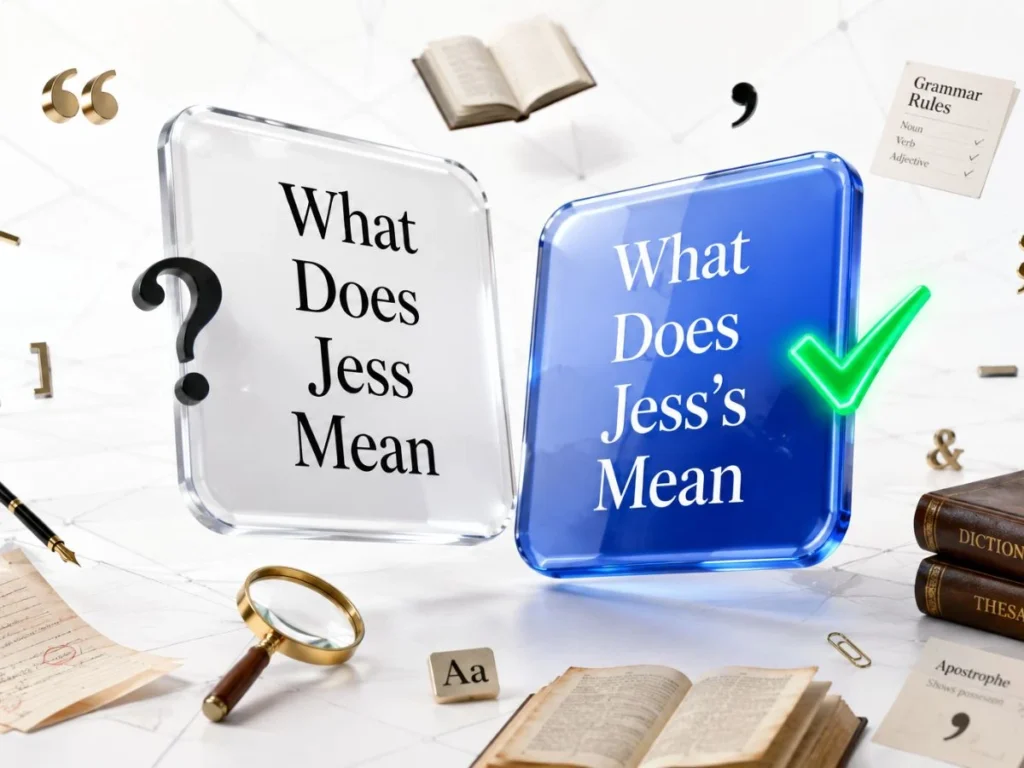
Jess’s is also the possessive form of Jess, but it adds ‘s after the name.
Many grammar books and style guides recommend this form because it matches how most people naturally pronounce it.
Examples
- Jess’s laptop needs charging.
- I enjoyed Jess’s speech.
- Jess’s dog loves playing outside.
- We parked near Jess’s house.
- Jess’s project won first prize.
This is the form most students and writers will see and use.
How to Use Jess’ or Jess’s
Both forms show ownership.
Use Jess’s when:
- Writing school assignments.
- Writing emails.
- Writing reports.
- Following modern grammar rules.
- You pronounce the extra -iz sound in speech.
Correct:
- Jess’s jacket is hanging by the door.
- I read Jess’s article yesterday.
Use Jess’ when:
- Your chosen style guide prefers only an apostrophe for names ending in s.
- You want to stay consistent with that style.
Correct:
- Jess’ schedule changed this morning.
Avoid Mixing Styles
If you choose Jess’s, use it throughout your document.
If you choose Jess’, stay consistent from beginning to end.
Where to Use Jess’ or Jess’s
School Writing
Jess’s is usually the safest choice.
Formal Writing
Many organizations prefer Jess’s, although some publications use Jess’ according to their style guide.
Emails
Either form is acceptable, but Jess’s is more common.
Everyday Conversation
People usually say Jess’s when speaking.
Messages
Both forms work, but Jess’s is more familiar.
Professional Communication
Follow your company’s or publisher’s style guide. If there is no guide, Jess’s is generally preferred.
American English
Most modern American writing uses Jess’s.
British English
British English also commonly uses Jess’s, although some publishers prefer Jess’.
Other English-Speaking Regions
Countries such as Canada, Australia, New Zealand, India, and Pakistan generally accept both forms. The choice often depends on the school’s, publisher’s, or organization’s preferred style.
Why People Get Confused
There are several reasons for the confusion.
- Different grammar books teach different rules.
- Different style guides recommend different forms.
- The name already ends with the letter s.
- Many people are unsure whether another s should be added after the apostrophe.
- Both forms appear in books, newspapers, and online writing.
Common Mistakes to Avoid
Wrong:
Jesss backpack is new.
Correct:
Jess’s backpack is new.
Explanation: The possessive needs an apostrophe.
Wrong:
Jess backpack is missing.
Correct:
Jess’s backpack is missing.
Explanation: The apostrophe shows ownership.
Wrong:
Jess’s backpack is here, but later writing Jess’ notebook.
Correct:
Use Jess’s throughout or Jess’ throughout.
Explanation: Stay consistent.
Wrong:
The backpack belongs to Jesss.
Correct:
The backpack belongs to Jess.
Explanation: The extra s is incorrect.
Real-Life Examples
Meeting
Jess’s presentation answered everyone’s questions.
School
I borrowed Jess’s calculator for the math test.
Travel
Jess’ passport was checked at the airport.
Work
Jess’s manager approved the report.
Message
Can you bring Jess’s charger with you?
Conversation
I think Jess’s idea will work.
Booking
Jess’ reservation has been confirmed.
Social Situation
Everyone enjoyed Jess’s birthday party.
Easy Trick to Remember
If you’re unsure, choose Jess’s. It is the form most people learn first and the one commonly recommended in modern English.
Mini Quiz
1. Which form is more commonly recommended today?
Answer: Jess’s
2. Can Jess’ also be correct?
Answer: Yes, depending on the style guide.
3. Which sentence is correct?
A. Jess backpack is ready.
B. Jess’s backpack is ready.
Answer: B
4. Should you mix Jess’s and Jess’ in the same document?
Answer: No.
5. What does the apostrophe show?
Answer: Ownership or possession.
6. Which form is usually the safest choice for school writing?
Answer: Jess’s
Related Confusing Words
- its or it’s
- your or you’re
- there or their
- whose or who’s
- affect or effect
- gray or grey
- canceled or cancelled
- bear with me or bare with me
FAQs
Is Jess’s correct?
Yes. It is widely accepted and commonly recommended in modern English.
Is Jess’ correct?
Yes. Some style guides accept this form for names ending in s.
What is the difference between Jess’ and Jess’s?
Both show possession. The difference comes from the grammar or style guide being followed.
Which one should I use?
If you do not have a required style guide, Jess’s is usually the best choice.
Is Jess’s formal or informal?
It is appropriate for both formal and informal writing.
Conclusion
Both Jess‘ and Jess’s are correct possessive forms of the name Jess.
However, Jess’s is the form most commonly recommended in modern English and is the safest choice for school, work, emails, and everyday writing.
If you follow a style guide that prefers Jess’, that is also acceptable.
The most important rule is to choose one style and use it consistently.

Alexander Reed is an American author at WordsSign. He writes clear and well-researched articles on symbols, meanings, culture, and spiritual insights.