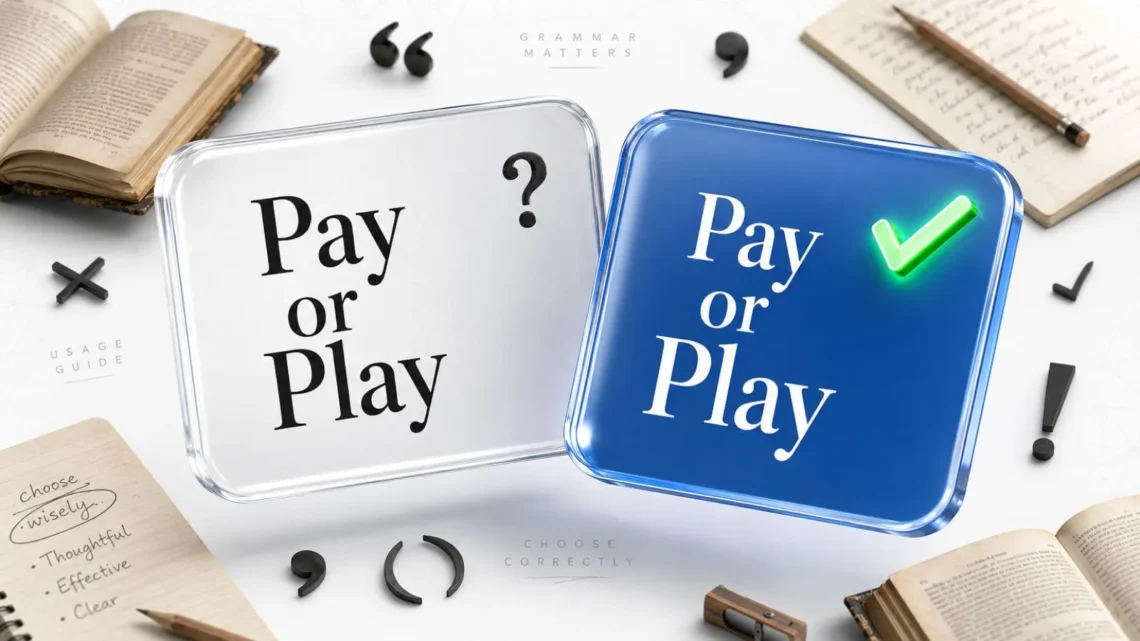
The short answer is that “pay or play” is a correct phrase, not a choice between two different words. It is a fixed expression that means someone must either pay for something or allow the other person to take part as agreed.
Many people get confused because the phrase joins two common words with or, making it look like you have to choose one word over the other.
In this guide, you shall learn what pay or play means, where it is used, how to use it correctly, common mistakes to avoid, and an easy way to remember it.
Quick Answer
Pay or play is a correct English phrase.
It usually describes an agreement where someone must either pay what is owed or let the other person perform, work, or participate.
Examples:
- The actor signed a pay-or-play contract.
- The company must pay or play under the terms of the agreement.
Pay vs Play: Main Difference
| Word/Phrase | Meaning | Correct? | Best Used For | Example |
| Pay | To give money for something | Yes | Money, bills, wages, costs | Please pay the invoice today. |
| Play | To take part, perform, or engage in an activity | Yes | Games, sports, acting, music | The children play outside every evening. |
| Pay or Play | A fixed phrase meaning someone must either pay or allow the agreed performance or work | Yes | Contracts, business, entertainment | She has a pay-or-play agreement. |
What Does Pay Mean?
Pay means to give money in exchange for goods, services, work, or something you owe.
Examples
- I need to pay my electricity bill.
- She paid for dinner.
- Please pay before leaving the store.
- The company will pay employees every Friday.
- He forgot to pay the parking fee.
What Does Play Mean?
Play usually means to take part in a game, perform music, act in a movie, or enjoy an activity.
In the phrase pay or play, play means allowing someone to perform or carry out the agreed work rather than stopping them.
Examples
- The children play in the park.
- She plays the piano beautifully.
- Our team will play tomorrow.
- The actor will play the main character.
- The theater agreed to let the performers play despite the delay.
How to Use Pay or Play
Use pay or play when talking about contracts or agreements where one side has two choices:
- Pay the agreed amount.
- Allow the agreed work or performance to happen.
This phrase is common in business and the entertainment industry.
Correct Examples
- The producer signed a pay-or-play contract with the actor.
- The company must pay or play according to the agreement.
- Even if filming is canceled, the actor may still receive payment under a pay-or-play contract.
Avoid These Mistakes
❌ The contract says pay and play.
✅ The contract says pay or play.
Where to Use Pay or Play
You can use this phrase in several situations.
School Writing
Useful when discussing business law, contracts, or the entertainment industry.
Formal Writing
Common in legal documents, reports, and professional discussions.
Emails
Suitable when discussing agreements or contract terms.
Everyday Conversation
Less common, but people may use it when talking about movie contracts or business deals.
Messages
Fine if the conversation is about agreements or payments.
Professional Communication
Frequently used by lawyers, agents, producers, employers, and business professionals.
American English
Very common, especially in entertainment and legal contracts.
British English
Also understood and used, particularly in business and legal contexts.
Other English-Speaking Regions
Countries such as Canada, Australia, India, Pakistan, and New Zealand generally use the same expression when discussing contracts.
Why People Get Confused
People often think pay or play is asking them to choose between two unrelated words.
The confusion also comes from the fact that both pay and play are common verbs with very different meanings.
In reality, pay or play is a single fixed expression with its own meaning.
Common Mistakes to Avoid
Wrong:
The agreement is pay and play.
Correct:
The agreement is pay or play.
Why: The expression always uses or, not and.
Wrong:
The actor has a pay or paid contract.
Correct:
The actor has a pay-or-play contract.
Why: This is the standard name of the contract.
Wrong:
The company chose to play the money.
Correct:
The company chose to pay the money.
Why: Pay is used for money, not play.
Wrong:
Every game is pay or play.
Correct:
Every game requires players to register.
Why: Pay or play refers to agreements, not ordinary games.
Real-Life Examples
Meeting
“Our contract is pay or play, so payment is required even if the event is canceled.”
School
“The teacher explained what a pay-or-play agreement means in business law.”
Travel
“The tour company discussed its cancellation policy and pay-or-play terms.”
Work
“The consultant’s contract included a pay-or-play clause.”
Message
“Please check whether the agreement is pay or play.”
Conversation
“I learned that many actors sign pay-or-play contracts.”
Booking
“The performer received payment because the booking was pay or play.”
Social Situation
“My friend explained how pay-or-play contracts protect performers.”
Easy Trick to Remember
Think of it this way:
Either you PAY, or you let them PLAY.
If someone cannot perform because of your decision, you may still have to pay.
Mini Quiz
1. Is pay or play a correct English phrase?
Answer: Yes.
2. What does pay mean?
Answer: To give money.
3. What does play usually mean?
Answer: To perform or take part in an activity.
4. Which phrase is correct?
- Pay and play
- Pay or play
Answer: Pay or play.
5. Is pay-or-play contract a real legal term?
Answer: Yes.
6. Is the phrase mainly used in contracts?
Answer: Yes.
Related Confusing Words
- affect or effect
- your or you’re
- its or it’s
- there or their
- gray or grey
- canceled or cancelled
- bare with me or bear with me
- insure or ensure
FAQs
Is pay correct?
Yes. Pay is a standard English verb meaning to give money.
Is play correct?
Yes. Play is also a standard English verb, usually meaning to perform or take part in an activity.
What is the difference between pay and play?
Pay relates to money, while play relates to participation or performance. Together, pay or play forms a fixed expression used in contracts.
Which one should I use?
If you’re talking about the contract phrase, use pay or play. If you’re talking only about money or only about an activity, use the individual word that fits your meaning.
Is pay or play formal or informal?
It is most commonly used in formal, business, and legal contexts.
Conclusion
Pay or play is a correct and well-established English phrase used mainly in contracts and business agreements.
It means one party must either pay the agreed amount or allow the agreed work or performance to take place.
Use the complete phrase when discussing legal or professional agreements, and use pay or play separately only when talking about money or activities on their own.
Read More Post
- Calender or Calendar: Which Spelling Is Correct(2026)?
- Skiddish or Skittish: Which Spelling Is Correct(2026)?
- Siked or Psyched: Which Spelling Is Correct(2026)?

Jack Ellison is an American author at WordsSign. He writes clear and well-researched articles on symbols, meanings, culture, and spiritual insights.