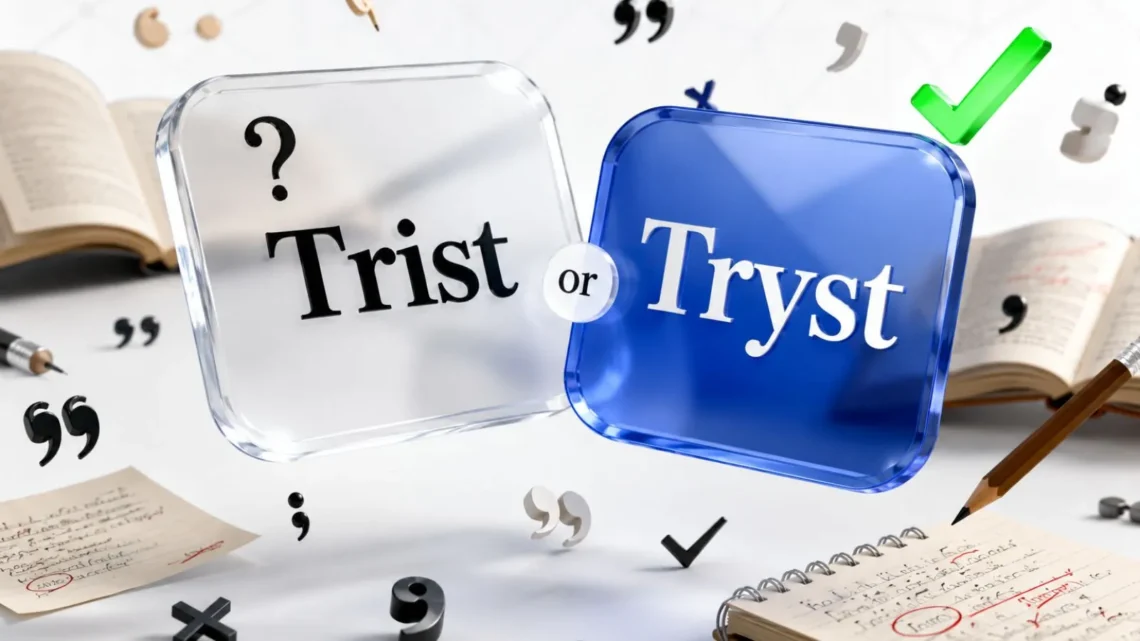
If you are unsure whether Trist or Tryst is the correct spelling, you are not alone; these words can easily be confused because they look and sound similar.
In standard English, tryst is the established word, while “trist” is generally considered a misspelling in this context.
A tryst refers to a private or romantic meeting, often one that is secret or arranged between two people.
Understanding this difference can help you avoid an embarrassing spelling mistake in your writing, especially when discussing relationships, literature, or romantic encounters.
In this guide, you shall learn what tryst means, why “trist” causes confusion, how to use the correct spelling, and see clear sentence examples that make the distinction easy to remember.
Quick Answer
Tryst is the correct English word. It means a planned meeting, especially a private or romantic one.
Trist is not the correct spelling in standard modern English. In most cases, if you mean a secret or planned meeting, you should write tryst.
Examples:
- They arranged a tryst in the park.
- ❌ They arranged a trist in the park.
Trist vs Tryst: Main Difference
| Word/Phrase | Meaning | Correct? | Best Used For | Example |
| Trist | Not a standard modern English word | ❌ Usually No | Avoid in normal writing | ❌ We planned a trist. |
| Tryst | A planned meeting, often private or romantic | ✅ Yes | Books, stories, conversations, and formal writing | They met for a tryst after sunset. |
What Does Trist Mean?
In modern English, trist is not considered a standard word. Most dictionaries do not list it as the correct spelling for the meaning of a planned meeting.
People usually write trist because they:
- Mistype tryst
- Mishear the pronunciation
- Assume the spelling is simpler
Example Sentences
These examples show incorrect modern usage:
- ❌ They planned a trist after work.
- ❌ We read about their trist in the novel.
- ❌ She canceled the trist.
- ❌ They kept their trist a secret.
- ❌ I accidentally wrote trist instead of tryst.
What Does Tryst Mean?
A tryst is a planned meeting between two people. It often refers to a private, secret, or romantic meeting, but it can also mean any arranged meeting in literary or historical writing.
Example Sentences
- They arranged a tryst at a quiet café.
- The novel tells the story of a secret tryst.
- The couple met for a tryst every Friday.
- Their midnight tryst remained a mystery.
- He hurried to his tryst before sunset.
How to Use Tryst
Use tryst whenever you mean a planned or secret meeting.
Simple Rules
- Use tryst for private or romantic meetings.
- It often appears in novels, poetry, and storytelling.
- Avoid using trist unless you are discussing spelling mistakes or historical language.
Correct Examples
- We planned a tryst for next weekend.
- The story begins with a secret tryst.
Incorrect Examples
- ❌ We planned a trist for next weekend.
- ❌ Their trist was unforgettable.
Where to Use Tryst
You can use tryst in many types of writing when it fits the meaning.
School Writing
Suitable when discussing literature or writing stories.
Formal Writing
Acceptable if you are describing a planned or secret meeting.
Emails
Rarely used unless talking about literature or creative writing.
Everyday Conversation
Less common but still understood by many English speakers.
Messages
Can be used when talking about a planned private meeting.
Professional Communication
Usually avoid it unless discussing fiction, history, or literature.
American English
Tryst is the standard spelling.
British English
Tryst is also the standard spelling.
Other English Speaking Regions
Countries such as Canada, Australia, New Zealand, India, and Pakistan also use tryst as the standard spelling.
Why People Get Confused
There are several reasons why people mix up trist and tryst.
- They sound almost the same.
- The letter y is unexpected in the spelling.
- Many people have only heard the word and never seen it written.
- Typing mistakes can easily change tryst into trist.
Common Mistakes to Avoid
Wrong:
We had a trist at the beach.
Correct:
We had a tryst at the beach.
Explanation: Use tryst for a planned meeting.
Wrong:
Their trist was kept secret.
Correct:
Their tryst was kept secret.
Explanation: Tryst is the standard English word.
Wrong:
She missed the trist.
Correct:
She missed the tryst.
Explanation: Replace trist with tryst.
Real Life Examples
Meeting
They arranged a tryst after the conference.
School
The students discussed a secret tryst in the novel.
Travel
The couple planned a tryst during their vacation.
Work
The detective discovered evidence of a secret tryst.
Message
“Are we still meeting for our tryst tonight?”
Conversation
“The book’s main characters have a secret tryst.”
Booking
They booked a quiet hotel for their romantic tryst.
Social Situation
The film tells the story of an unexpected tryst between two strangers.
Easy Trick to Remember
Remember this simple phrase:
“A trYst needs a Y for ‘You and me.'”
If You are talking about two people meeting, think of the Y in tryst.
Mini Quiz
1. Which spelling is correct in modern English?
Answer: Tryst
2. What does “tryst” usually mean?
Answer: A planned or private meeting.
3. Is “trist” the standard modern spelling?
Answer: No.
4. Which sentence is correct?
A. They planned a trist.
B. They planned a tryst.
Answer: B
5. Is “tryst” commonly used in stories and novels?
Answer: Yes.
6. Should you use “trist” in everyday English writing?
Answer: No.
Related Confusing Words
- gray or grey
- canceled or cancelled
- your or You are
- its or it’s
- affect or effect
- there or their
- bear with me or bare with me
- compliment or complement
FAQs
Is trist correct?
No. Trist is not the standard modern English spelling for a planned meeting.
Is tryst correct?
Yes. Tryst is the correct English word.
What is the difference between trist and tryst?
Tryst is the accepted English word. Trist is usually a spelling mistake.
Which one should I use?
Use tryst whenever you mean a planned, private, or romantic meeting.
Is tryst formal or informal?
It can be used in both formal and informal writing, but it is most common in literature, storytelling, and descriptive writing.
Conclusion
Tryst is the correct spelling in modern English, while trist is generally incorrect.
If you are referring to a planned or private meeting, always choose tryst.
Remember the Y in tryst, and you shall avoid one of the most common spelling mistakes with this word.

James Holloway is an American author at WordsSign. He writes clear and well-researched articles on symbols, meanings, culture, and spiritual insights.