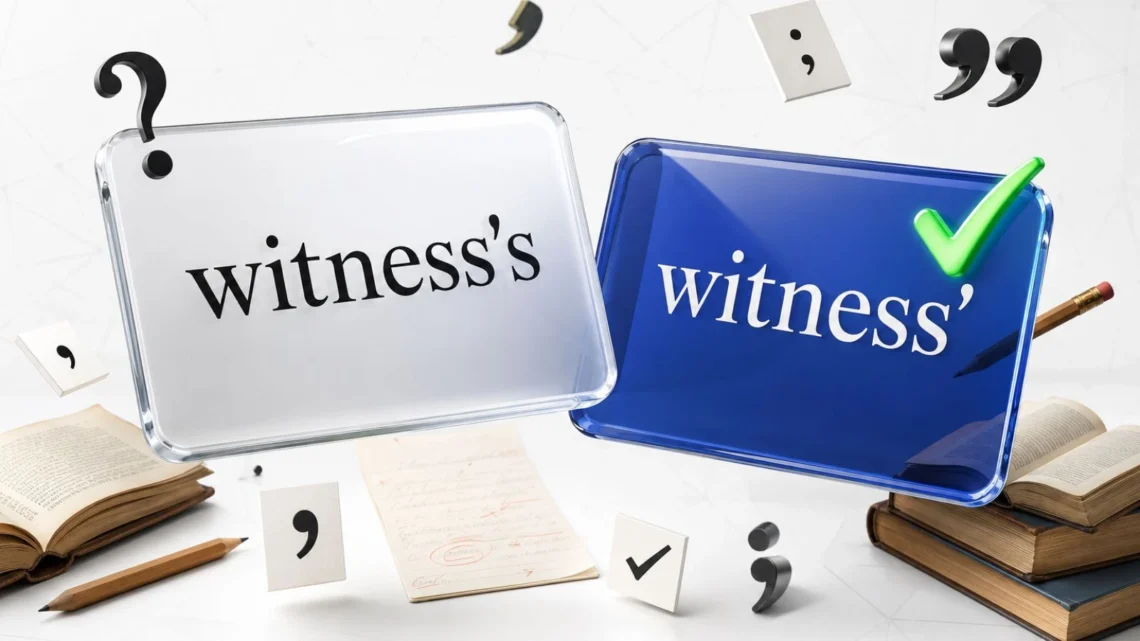
If you have ever paused while writing witness’s or witness’, you are not alone.
Both forms appear in books, newspapers, and style guides, which makes the choice confusing.
The good news is that both spellings can be correct, depending on the style guide you follow.
Understanding the grammar behind singular possessive nouns will help you use the right form with confidence.
In this guide, you shall learn when to use witness’s and witness’, the grammar rules behind each form, practical examples, common mistakes to avoid, and an easy trick to remember the difference.
Quick Answer
Both witness’s and witness’ can be correct. In modern US English, witness’s is the preferred singular possessive form because most style guides recommend adding ‘s to singular nouns ending in s. Some style guides, especially in journalism, allow witness’ instead. Choose one style and use it consistently.
Witness’s vs. Witness’: Comparison Table
| Feature | Witness’s | Witness’ |
| Correct Word | ✅ Yes | ✅ Yes (in some style guides) |
| Incorrect Word | No | No |
| Meaning | Belonging to one witness | Belonging to one witness |
| Definition | Singular possessive noun | Singular possessive noun (alternative style) |
| Part of Speech | Possessive noun | Possessive noun |
| Grammar Rule | Add ‘s to singular nouns | Some style guides omit the extra s after nouns ending in s |
| Correct Usage | Preferred in most US writing | Accepted in AP Style and some publications |
| Incorrect Usage | Not incorrect | Not incorrect when used according to style |
| Pronunciation | Usually pronounced with an extra -iz sound | Often pronounced the same as witness’s |
| Common Mistake | Assuming it is always wrong | Thinking it is the only correct form |
| Memory Tip | Most singular nouns take ‘s | Use only if your style guide prefers it |
| Example | The witness’s testimony changed the case. | The witness’ testimony changed the case. |
What Does “Witness’s” Mean?
Witness’s is the singular possessive form of witness. It shows that something belongs to or is associated with one witness.
Grammar Role
- Singular possessive noun
- Formed by adding ‘s to the noun witness
Pronunciation
Usually pronounced:
WIT-ness-iz
Examples
- The witness’s statement was detailed.
- Everyone trusted the witness’s memory.
- The lawyer questioned the witness’s credibility.
- We reviewed the witness’s notes before the trial.
- The witness’s description matched the suspect.
What Does “Witness'” Mean?
Witness’ is also a singular possessive form used by certain style guides, particularly those that omit the extra s after singular nouns ending in s.
Its meaning is exactly the same as witness’s.
Grammar Role
- Singular possessive noun
- Alternative style spelling
Examples
- The witness’ testimony surprised everyone.
- The witness’ account remained consistent.
- The jury carefully examined the witness’ evidence.
- The attorney challenged the witness’ recollection.
Key Differences Between Witness’s and Witness’
Although both forms express possession, their difference is based on style, not meaning.
- Witness’s is preferred in most American English writing.
- Witness’ is accepted by some style guides, especially in journalism.
- Both refer to one witness.
- The meaning never changes.
- Academic writing generally favors witness’s.
- Consistency matters more than switching between both forms.
Compare
Preferred in most writing:
- The witness’s testimony was convincing.
Alternative style:
- The witness’ testimony was convincing.
Both sentences mean exactly the same thing.
Grammar Rules for Singular Possessives Ending in S
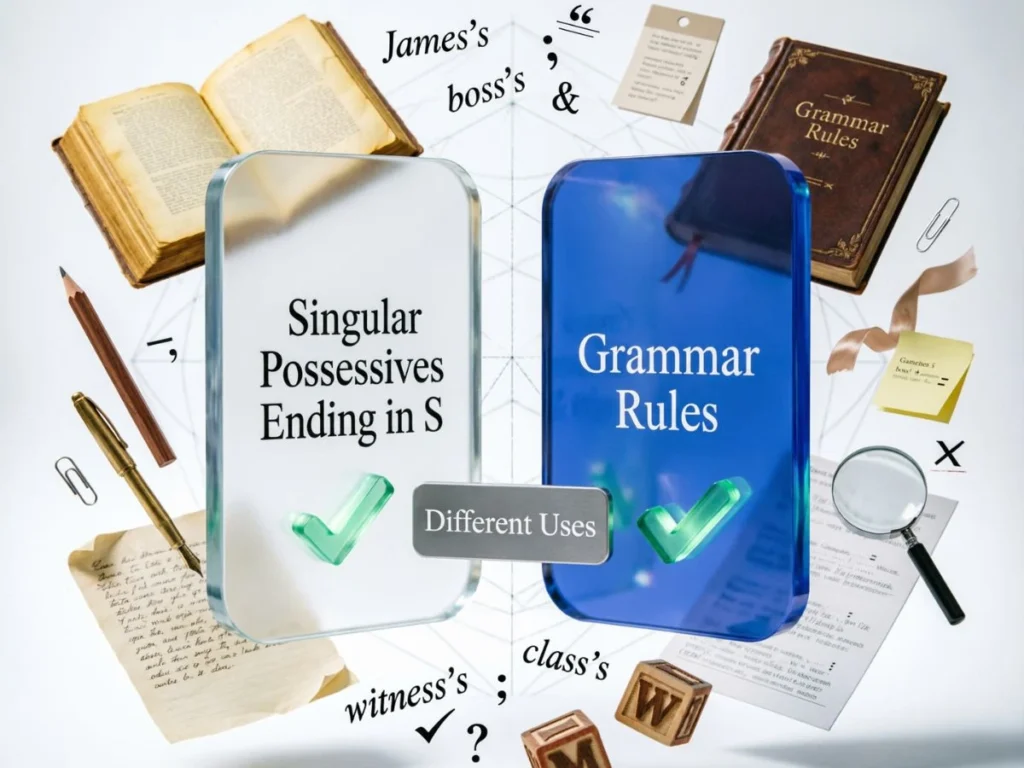
The noun witness is singular.
To make most singular nouns possessive in American English:
Add apostrophe + s (‘s).
Examples:
- boss → boss’s
- class → class’s
- princess → princess’s
- witness → witness’s
Exception
Some editorial and newspaper style guides recommend using only an apostrophe after certain singular nouns ending in s.
Example:
- witness’
This is a matter of editorial style rather than grammar.
What About Plural Witnesses?
Plural noun:
- witnesses
Plural possessive:
- witnesses’
Example:
- The witnesses’ statements agreed with one another.
Notice the difference:
- witness’s = one witness
- witness’ = one witness (alternative style)
- witnesses’ = multiple witnesses
When to Use Each Word
Academic Writing
Use witness’s because most academic style manuals favor ‘s for singular nouns.
Example:
- The witness’s testimony supported the research findings.
Professional Writing
Choose witness’s unless your organization’s style guide specifies otherwise.
Example:
- The report included the witness’s observations.
Formal English
Formal writing generally prefers:
- witness’s
Example:
- The judge evaluated the witness’s credibility.
Informal English
Most people naturally write:
- witness’s
Example:
- I believed the witness’s story.
Business Writing
Use the style required by your company.
Most businesses choose:
- witness’s
Example:
- Please attach the witness’s signed statement.
Emails
Consistency is the key.
Example:
- I have attached the witness’s written account.
Daily Conversation
When writing casually, witness’s is the easiest and most widely accepted choice.
Example:
- Did you read the witness’s version of events?
Common Mistakes
Mistake 1: Thinking Only One Form Is Correct
❌ Witness’ is always wrong.
✅ Both forms are acceptable depending on the style guide.
Mistake 2: Mixing Styles
❌ The witness’s testimony…
Later: the witness’ statement…
Choose one style and use it throughout the document.
Mistake 3: Confusing Singular and Plural
❌ The witnesses testimony
✅ The witness’s testimony
✅ The witnesses’ testimony (if there were multiple witnesses)
Mistake 4: Forgetting the Apostrophe
❌ witnesss testimony
✅ witness’s testimony
Original Example Sentences
- The witness’s notebook contained valuable evidence.
- Every juror listened carefully to the witness’s explanation.
- The teacher discussed the witness’s role in a courtroom.
- A reporter quoted the witness’ statement according to newsroom style.
- The detective verified the witness’s timeline.
- We compared the witness’s description with the security footage.
- The author’s novel centered on a witness’s secret.
- The business investigation relied on the witness’s report.
- Everyone respected the witness’s honesty.
- The editor changed witness’s to witness’ to match publication style.
- The police recorded the witness’s interview immediately.
- The student’s essay analyzed the witness’s testimony.
- Social media users debated the witness’s claims.
- The news article summarized the witness’ account.
- The attorney highlighted the witness’s credibility during closing arguments.
- We reviewed the witness’s written declaration together.
- The judge questioned the witness’s recollection of the event.
- The documentary explored the witness’s perspective in detail.
Memory Trick
Remember this simple rule:
One witness = usually add ‘s
- witness → witness’s
If you are writing for a newspaper or following a style guide that drops the extra s, then use:
- witness’
Otherwise, witness’s is the safest choice in American English.
Mini Quiz
1. Which form is preferred in most US English writing?
A. witness’
B. witness’s
C. witnesses
D. witnesses’
Answer: B
2. Which form refers to multiple witnesses showing possession?
A. witness’s
B. witness’
C. witnesses’
D. witnesss
Answer: C
3. Which sentence follows the most common American style?
A. The witness’s testimony was clear.
B. The witness testimony was clear.
C. The witnesss testimony was clear.
D. The witnesses testimony was clear.
Answer: A
4. Is witness’ always incorrect?
A. Yes
B. No
C. Only in British English
D. Only in legal writing
Answer: B
5. What is the main difference between witness’s and witness’?
A. Different meanings
B. Different pronunciations
C. Different style-guide preferences
D. Different parts of speech
Answer: C
FAQs
Is witness’s grammatically correct?
Yes. Witness’s is grammatically correct and is the preferred singular possessive form in most American English style guides. It follows the standard rule of adding ‘s to singular nouns, even when they already end in s.
Is witness’ also correct?
Yes. Witness’ is accepted by some editorial and journalism style guides. It has the same meaning as witness’s. The choice depends on the writing style you are following rather than a difference in grammar or meaning.
Which is better in American English: witness’s or witness’?
In most cases, witness’s is the better choice in American English because it aligns with the standard grammar rule for singular possessive nouns. However, organizations following a specific editorial style may prefer witness’.
How do you make witness plural possessive?
The plural of witness is witnesses. To show possession, add an apostrophe after the plural noun:
witnesses’
Example:
The witnesses’ statements were consistent throughout the investigation.
Do witness’s and witness’ have different meanings?
No. Both forms mean exactly the same thing: something belongs to or is connected with one witness. The only difference is the writing style or editorial convention used by the author or publication.
Should I use witness’s in school assignments?
Yes. Unless your teacher requires a different style guide, witness’s is usually the best choice for school assignments, essays, research papers, and most academic writing because it follows the standard rule for singular possessives.
Key Takeaways
- Witness’s is the preferred singular possessive form in most American English writing.
- Witness’ is also correct under some editorial style guides.
- Both forms have the same meaning.
- Most academic and formal writing favors witness’s.
- Use witnesses’ for possession by more than one witness.
- Follow one style consistently throughout your document.
Conclusion
Choosing between witness’s and witness’ is mostly a matter of style rather than grammar.
In modern US English, witness’s is generally the preferred form because it follows the standard rule for singular possessive nouns.
However, witness’ is also accepted by some editorial style guides.
By understanding the difference and staying consistent, you can use the correct possessive form confidently in any type of writing.

Alexander Reed is an American author at WordsSign. He writes clear and well-researched articles on symbols, meanings, culture, and spiritual insights.