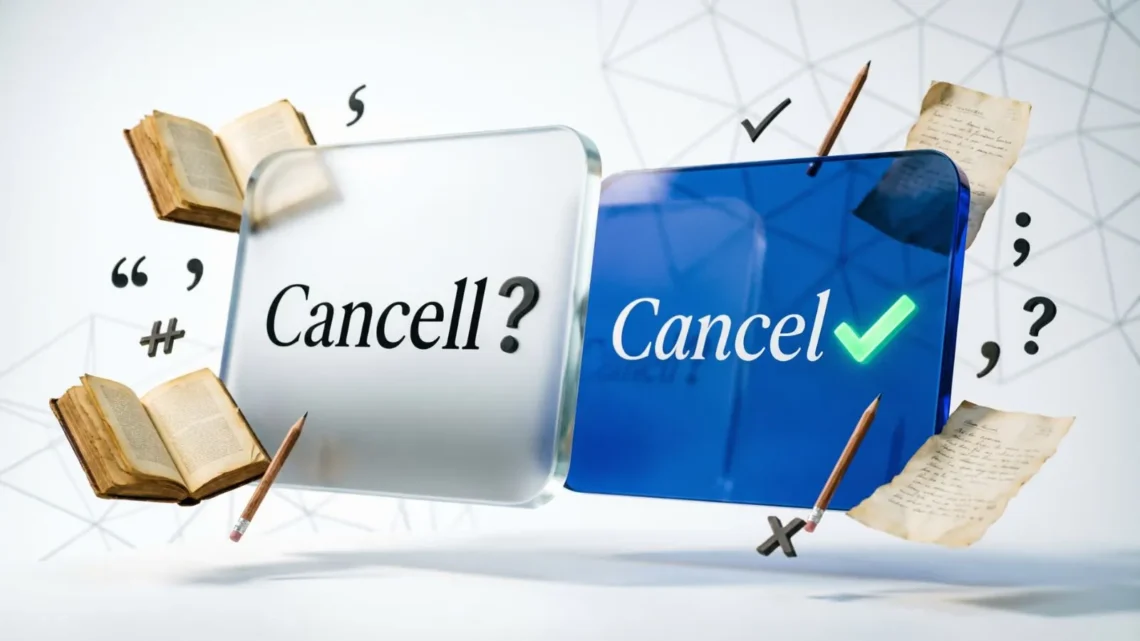
Many writers wonder, “Is It Cancell or Cancel?” when they come across this commonly confused spelling.
If you are unsure which form is correct, this guide will help you understand the proper spelling, meaning, and usage in English grammar.
You shall learn why people make this common mistake, whether “Cancell” is ever acceptable, and how to use the correct form confidently in your writing.
Through clear explanations and sentence examples, this article will show you the difference and help you avoid spelling errors in everyday communication.
If you are writing an email, article, or formal document, understanding the correct usage will make your English more accurate and professional.
Quick Answer
Cancel is the correct spelling.
Cancell is not a correct English word.
Examples:
- ✅ I need to cancel my appointment.
- ✅ They decided to cancel the meeting.
- ❌ I need to cancell my appointment.
Cancell vs Cancel: Main Difference
| Word/Phrase | Meaning | Correct? | Best Used For | Example |
| Cancel | To stop, call off, or end something | ✅ Yes | All writing and speaking | Please cancel my order. |
| Cancell | Misspelling of cancel | ❌ No | Never | ❌ Please cancell my order. |
What Does Cancell Mean?
Cancell does not have a meaning in modern English because it is not a correctly spelled word.
People usually write cancell by mistake because they confuse it with words such as:
- cancelled
- cancelling
- cancellation
Remember that the base verb is always cancel, not cancell.
Incorrect Examples
- ❌ I will cancell the reservation.
- ❌ Can you cancell my subscription?
- ❌ They had to cancell the trip.
- ❌ Please cancell this order.
- ❌ We might cancell the event.
All of these should use cancel instead.
What Does Cancel Mean?
Cancel means to stop something before it happens or to officially end it.
It is commonly used for events, appointments, orders, subscriptions, plans, and reservations.
Example Sentences
- I need to cancel my doctor’s appointment.
- They decided to cancel the concert.
- Please cancel my subscription today.
- We had to cancel our travel plans.
- She forgot to cancel her hotel booking.
How to Use Cancel
Use cancel whenever you are talking about stopping, ending, or calling something off.
Simple Rules
- Use cancel as the base verb.
- Never add an extra l to make cancell.
- Choose the correct past form depending on the English variety you use.
Correct Examples
- Please cancel my order.
- We must cancel today’s meeting.
- They will cancel the flight if the weather gets worse.
Incorrect Examples
- ❌ Please cancell my order.
- ❌ We will cancell the meeting.
Where to Use Cancel
The spelling cancel is correct in every type of communication.
School Writing
Use cancel in essays, homework, and assignments.
Formal Writing
Business reports, official letters, and documents should always use cancel.
Emails
Example:
Please cancel my appointment scheduled for Monday.
Everyday Conversation
- Let’s cancel dinner tonight.
- They had to cancel the game.
Messages
- Can you cancel my ticket?
- We should cancel the booking.
Professional Communication
Businesses, customer support teams, and organizations all use cancel.
American English
The base verb is cancel.
The past tense is usually canceled, and the present participle is canceling.
British English
The base verb is still cancel.
The past tense is usually cancelled, and the present participle is cancelling.
Other Regions
Countries such as Canada, Australia, New Zealand, India, and Pakistan often follow British spelling, so cancelled and cancelling are more common. However, the base verb remains cancel everywhere.
Why People Get Confused
There are several reasons why people write cancell instead of cancel.
- They see cancelled with two ls.
- They see cancelling with two ls.
- They assume the base word also has two ls.
- They type quickly and accidentally add an extra letter.
- American and British spelling differences create confusion.
The important thing to remember is that the base verb is always cancel.
Common Mistakes to Avoid
Wrong:
I need to cancell my appointment.
Correct:
I need to cancel my appointment.
The base verb has only one l.
Wrong:
Please cancell the reservation.
Correct:
Please cancel the reservation.
Never use cancell.
Wrong:
They will cancell the meeting tomorrow.
Correct:
They will cancel the meeting tomorrow.
Only cancel is correct.
Wrong:
Can you cancell my subscription?
Correct:
Can you cancel my subscription?
Use the correct base spelling.
Real-Life Examples
Meeting
We had to cancel today’s meeting.
School
The teacher decided to cancel the quiz.
Travel
The airline may cancel the flight because of bad weather.
Work
Please cancel tomorrow’s appointment.
Message
Can you cancel my order before it ships?
Conversation
We should cancel our picnic because it’s raining.
Booking
I forgot to cancel my hotel reservation.
Social Situation
They had to cancel the birthday party.
Easy Trick to Remember
Think of this simple sentence:
Cancel has one L before you stop something.
Only later forms like cancelled (British English) may have two ls.
Mini Quiz
1. Which spelling is correct?
Answer: Cancel
2. Is “cancell” a real English word?
Answer: No.
3. Which sentence is correct?
A. Please cancell my order.
B. Please cancel my order.
Answer: B
4. Which is the correct base verb?
Answer: Cancel
5. Which spelling is common in British English?
A. Cancelled
B. Canceled
Answer: A
6. Which spelling is usually preferred in American English?
A. Canceled
B. Cancelled
Answer: A
Related Confusing Words
- canceled or cancelled
- canceling or cancelling
- gray or grey
- your or You are
- its or it’s
- affect or effect
- there or their
- traveling or travelling
FAQs
Is cancell correct?
No. Cancell is an incorrect spelling.
Is cancel correct?
Yes. Cancel is the correct base verb in all forms of English.
What is the difference between cancell and cancel?
Cancel is the correct word. Cancell is simply a misspelling.
Which one should I use?
Always use cancel.
Is cancel formal or informal?
Cancel is appropriate in both formal and informal writing and speech.
Conclusion
The rule is simple: cancel is the correct spelling, and cancell is always incorrect.
Use cancel whenever you mean to stop, end, or call something off.
While past forms may differ between American English (canceled) and British English (cancelled), the base verb is always cancel.
Remember this simple rule, and you’ll never need to wonder If cancell is correct again.
Discover More Post
- Braut or Brat: Which Word Is Correct?
- Falter or Faulter: Which Spelling Is Correct?
- Yey or Yay: Which One Is Correct(2026)?

Jack Ellison is an American author at WordsSign. He writes clear and well-researched articles on symbols, meanings, culture, and spiritual insights.