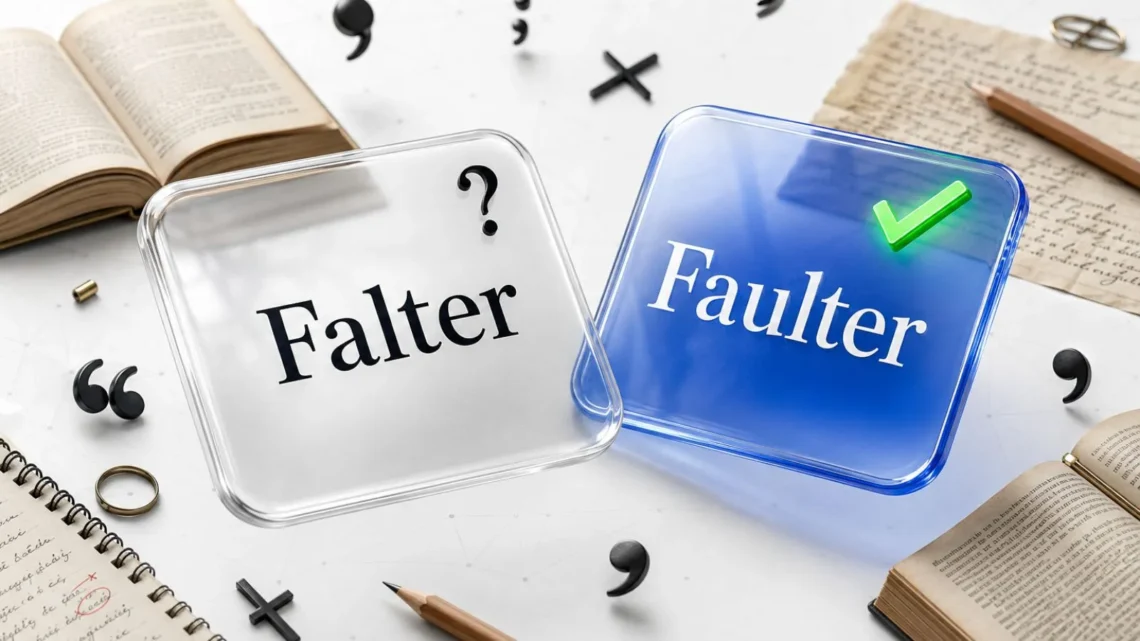
Many people wonder whether Falter or Faulter is the correct spelling, especially when writing quickly or relying on spellcheck.
If you’ve asked yourself the same question, you’re in the right place.
The short answer is that falter is the correct English word, while faulter is generally considered a misspelling.
However, understanding why people confuse the two can help you avoid making the same mistake in your own writing.
In this guide, you’ll learn the difference, the meaning of falter, common spelling mistakes, correct usage, and practical sentence examples.
By the end, you’ll know how to use the right word with confidence and avoid this common English grammar error in everyday writing.
Quick Answer
Falter is the correct spelling.
Faulter is not a standard English word and is considered a spelling mistake.
Examples:
- ✅ She began to falter during the presentation.
- ✅ His confidence never faltered.
- ❌ She began to faulter during the presentation.
Falter vs Faulter: Main Difference
| Word/Phrase | Meaning | Correct? | Best Used For | Example |
| Falter | To hesitate, lose confidence, or become weaker | ✅ Yes | All writing and speech | He did not falter under pressure. |
| Faulter | Misspelling of falter | ❌ No | Avoid using it | ❌ She started to faulter. |
What Does Falter Mean?
Falter is a verb that means to hesitate, stumble, lose strength, or become less confident. It can describe someone’s speech, actions, confidence, or performance.
Example Sentences
- She did not falter even when the task became difficult.
- His voice began to falter with emotion.
- The team refused to falter despite the challenges.
- Their support never faltered.
- Don’t falter when you are close to success.
What Does Faulter Mean?
Faulter is not a standard English word. It appears because people accidentally spell falter with an extra “u.”
The confusion may happen because English contains many words with “au,” such as fault, author, and cause. However, falter does not follow that spelling pattern.
Incorrect Examples
- ❌ I began to faulter during my speech.
- ❌ She never faultered under pressure.
- ❌ Don’t faulter now.
- ❌ His confidence faultered.
- ❌ They faulter when things become difficult.
Always replace faulter with falter.
How to Use Falter or Faulter
Always use falter when talking about hesitation, weakness, or losing confidence.
Use falter as a verb.
Correct
- She faltered for a moment.
- Don’t falter in your efforts.
- His smile never faltered.
Incorrect
- ❌ She faultered for a moment.
- ❌ Don’t faulter now.
- ❌ His smile never faultered.
Simple Rule
- Use: falter
- Avoid: faulter
Where to Use Falter or Faulter
The correct spelling falter can be used in every type of communication.
School Writing
- Use falter in essays, assignments, and exams.
Formal Writing
- Falter is appropriate for reports, articles, and official documents.
Emails
- Professional emails should always use falter.
Everyday Conversation
People often say:
- “Don’t falter now.”
- “She never faltered.”
Messages
Use falter in text messages and chats just as you would in formal writing.
Professional Communication
Business emails, presentations, and workplace documents should always use the correct spelling falter.
American and British English
There is no spelling difference between American and British English.
- American English: falter
- British English: falter
- Canada: falter
- Australia: falter
- New Zealand: falter
- India: falter
- Pakistan: falter
The spelling stays the same everywhere.
Why People Get Confused
People usually confuse these words because:
- Falter and faulter sound similar.
- Many English words contain “au,” such as fault, leading people to assume the same spelling.
- Typing mistakes and autocorrect can introduce the extra letter.
- The pronunciation does not clearly show the spelling.
Common Mistakes to Avoid
Wrong:
She began to faulter during the interview.
Correct:
She began to falter during the interview.
Explanation: The correct spelling is falter.
Wrong:
His confidence faultered.
Correct:
His confidence faltered.
Explanation: Never add the extra “u.”
Wrong:
Don’t faulter now.
Correct:
Don’t falter now.
Explanation: Use falter in commands and advice.
Wrong:
Our efforts will not faulter.
Correct:
Our efforts will not falter.
Explanation: Only falter is accepted in standard English.
Real-Life Examples
Meeting
“Our manager did not falter during the difficult discussion.”
School
“I almost faltered while giving my presentation.”
Travel
“The driver never faltered on the steep road.”
Work
“Our team refused to falter before the deadline.”
Message
“Stay confident and don’t falter.”
Conversation
“Even after several setbacks, she never faltered.”
Booking or Order
“The company’s service never faltered throughout the process.”
Easy Trick to Remember
Think of this:
“Falter has no ‘u,’ just like confidence shouldn’t have unnecessary doubts.”
If you see faulter, remove the “u.”
Mini Quiz
1. Which spelling is correct?
Answer: Falter
2. Is “faulter” a standard English word?
Answer: No.
3. Which sentence is correct?
A. She will faulter.
B. She will falter.
Answer: B
4. Can you use “falter” in formal writing?
Answer: Yes.
5. Which word means to hesitate or lose confidence?
Answer: Falter
6. Does British English spell it “faulter”?
Answer: No. It is falter.
Related Confusing Words
- gray or grey
- canceled or cancelled
- your or you’re
- its or it’s
- affect or effect
- there or their
- bear with me or bare with me
- loose or lose
FAQs
Is falter correct?
Yes. Falter is the correct English spelling.
Is faulter correct?
No. Faulter is a misspelling and should be avoided.
What is the difference between falter and faulter?
Falter is the correct word. Faulter is simply an incorrect spelling.
Which one should I use?
Always use falter.
Is falter formal or informal?
It works in both formal and informal English.
Conclusion
The rule is simple: falter is the correct spelling, and faulter is a misspelling.
Use falter whenever you mean to hesitate, lose confidence, or become weaker.
The spelling is the same in American, British, and other forms of English.
Remember this simple rule, and you’ll avoid a very common writing mistake.
Discover More Post
- Braut or Brat: Which Word Is Correct?
- Is It Cancell or Cancel? Learn the Correct Usage(2026)?
- Yey or Yay: Which One Is Correct(2026)?

James Holloway is an American author at WordsSign. He writes clear and well-researched articles on symbols, meanings, culture, and spiritual insights.