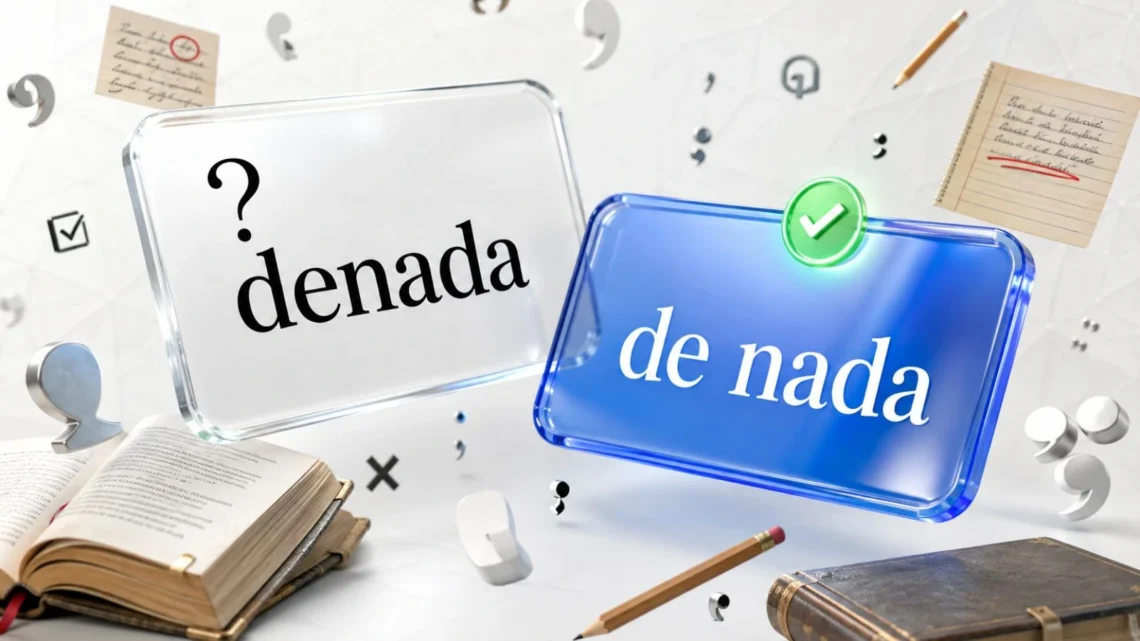
If you have ever wondered if denada or de nada is the correct spelling, you are not alone
The confusion usually comes from hearing the Spanish phrase pronounced as one flowing expression, even though it is normally written as two separate words.
De nada is the standard spelling and is commonly used to mean “ you are welcome” or “it is nothing” in response to thanks.
Understanding this small spelling difference can help you use the phrase confidently in writing and conversation.
In this guide, you shall learn what de nada means, why “denada” is commonly written incorrectly, how to use the phrase naturally, and see practical sentence examples.
We shall also clarify pronunciation and common usage mistakes so you can choose the proper form with confidence.
Quick Answer
De nada is the correct spelling, not denada, when writing the Spanish expression meaning “you are welcome” or “it was nothing.” The phrase consists of two separate words: de and nada. Although “denada” may appear in informal online writing, standard Spanish writes the expression as de nada.
Comparison Table
| Feature | De nada | Denada |
| Correct Word/Phrase | De nada | Denada |
| Spelling | Correct | Incorrect in standard Spanish |
| Meaning | “you are welcome,” “it was nothing” | Intended to mean “you are welcome” |
| Definition | A Spanish response to thanks | Nonstandard combined spelling |
| Part of Speech | Prepositional phrase / fixed expression | Not a standard Spanish expression |
| Grammar Rule | Written as two separate words | Should not normally be joined |
| Correct Usage | “Gracias.” “De nada.” | Not recommended in standard writing |
| Incorrect Usage | — | “Gracias.” “Denada.” |
| Pronunciation | Roughly deh NAH dah | Not a standard separate form |
| Common Mistake | Treating the phrase as one word | Combining de and nada |
| Memory Tip | Think of it as two building blocks: de + nada | Avoid joining them |
| Example | “Gracias por tu ayuda.” “De nada.” | “Gracias.” “Denada.” ❌ |
What Does “De Nada” Mean?
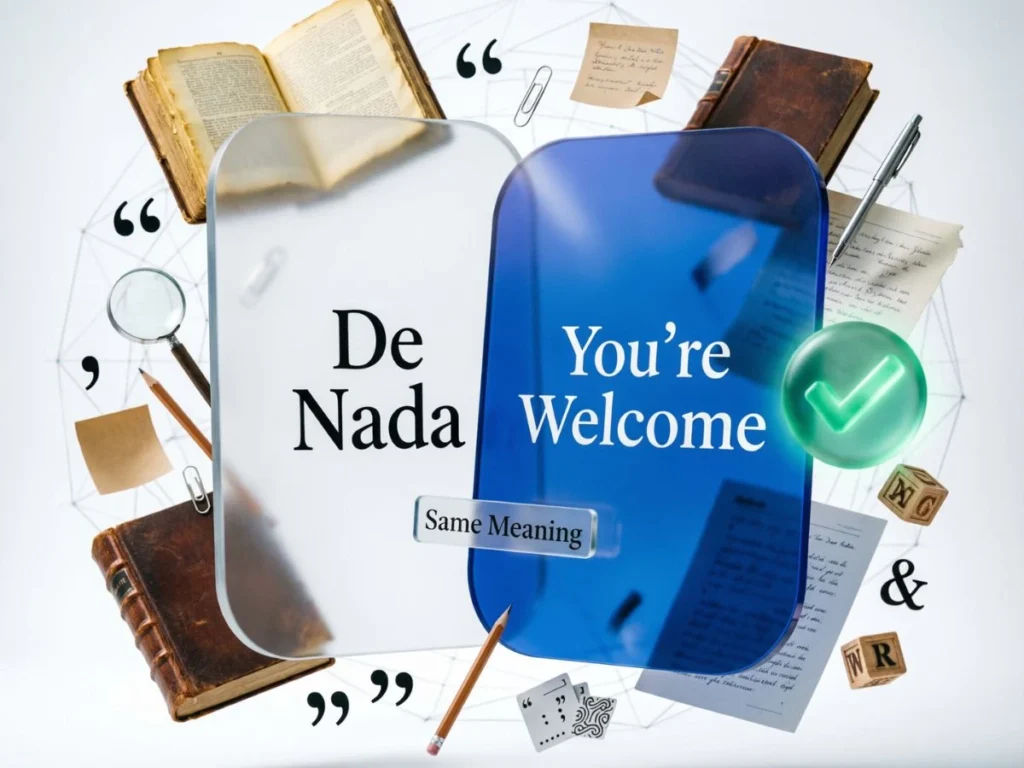
De nada is a Spanish expression commonly used in response to someone saying gracias (“thank you”).
Depending on the context, it can be translated as:
- You are welcome.
- You are very welcome.
- It was nothing.
- do not mention it.
- No problem.
For example:
Person A: Gracias por ayudarme.
Person B: De nada.
In English:
Person A: Thanks for helping me.
Person B: You are welcome.
What Does “De” Mean?
De is a Spanish preposition. Its meaning changes depending on context, but it can correspond to English words such as of, from, or about.
In the expression de nada, however, you should learn the phrase as a fixed expression rather than trying to translate every word literally.
What Does “Nada” Mean?
Nada generally means “nothing” in Spanish.
The expression de nada literally resembles “of nothing,” but its natural English equivalent is “you are welcome” when responding to thanks.
How Do You Pronounce “De Nada”?
For English speakers, de nada is commonly approximated as:
deh NAH dah
The exact pronunciation varies somewhat by Spanish speaking region. The important point is that it is pronounced as two words, not as a single word.
Examples With “De Nada”
- Gracias por la invitación. — De nada.
- Gracias por tu ayuda. — De nada.
- Muchas gracias. — De nada.
- Gracias por traerme el libro. — De nada.
- Gracias por esperar. — De nada.
What Does “Denada” Mean?
Denada is not the standard spelling of the Spanish expression de nada.
People may write denada because they hear the phrase as a single sound or because informal internet communication often removes spaces. However, standard Spanish spelling keeps de and nada separate.
Therefore:
- De nada ✅
- Denada ❌
If you are writing Spanish correctly, use de nada.
What Is the Difference Between “Denada” and “De Nada”?
The main difference is spelling and standard usage.
- De nada is the correct, standard Spanish expression.
- Denada incorrectly combines the two words.
- De nada means “you are welcome” when responding to thanks.
- Denada may be understood by Spanish speakers because the intended expression is obvious, but it is not the standard written form.
- The space between de and nada should remain.
A Simple Example
Correct:
Gracias por tu ayuda.
De nada.
Incorrect:
Gracias por tu ayuda.
Denada.
The meaning is usually understood in the second example, but the spelling is not standard.
Grammar Rules for “De Nada”
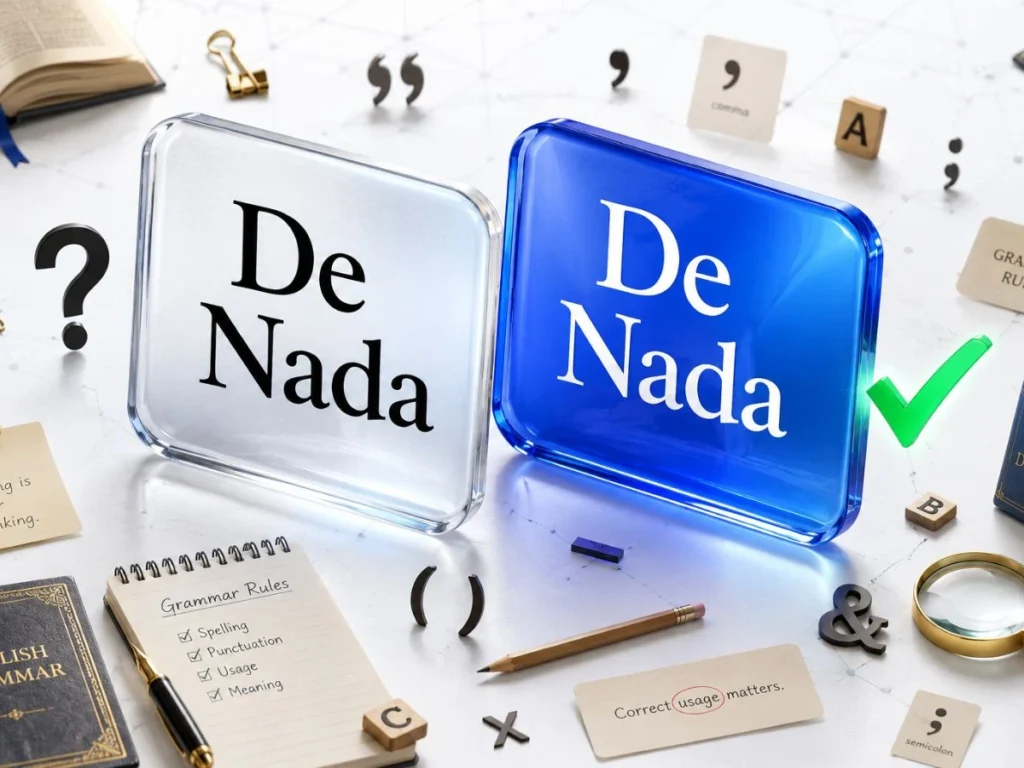
The most important rule is simple:
Write “de nada” as two separate words.
Spanish orthography does not normally combine these two words into denada.
Why Is There Space?
De and nada are separate Spanish words with their own grammatical functions. Together, they form the established expression de nada.
This is similar to other fixed expressions in which individual words remain separate even though they function together as a phrase.
Is “De Nada” One Word or Two?
It is two words:
de + nada = de nada
Do not remove the space in standard writing.
Is “De Nada” Capitalized?
Normally, de nada is lowercase when it appears in the middle of a sentence.
For example:
She smiled and said, “de nada.”
If it begins a sentence or appears as a standalone response where capitalization is appropriate, De nada may begin with a capital letter.
Is “De Nada” Hyphenated?
No. The standard form is:
de nada
Not:
- denada
- de nada
- de_nada
When Should You Use “De Nada”?
De nada is primarily used in Spanish when someone thanks you.
In Daily Conversation
It is very common in everyday Spanish.
Example:
Gracias por abrir la puerta.
De nada.
This means:
Thanks for opening the door.
you are welcome.
In Informal English Conversation
English speakers sometimes use de nada when speaking casually, especially when they know some Spanish or want to add a Spanish expression to a conversation.
For example:
“Thanks for grabbing my coffee.”
“De nada!”
This is understandable in an English speaking context, but the phrase itself remains Spanish.
In Professional Communication
If you are writing professional communication in Spanish, use the standard form de nada.
For example:
Gracias por su ayuda.
De nada. Ha sido un placer.
In a formal context, other Spanish responses such as con gusto or ha sido un placer may also be appropriate depending on the situation.
In Academic Writing
When discussing Spanish vocabulary or grammar in an English academic paper, write the expression as de nada, usually in italics if your style guide requires foreign language terms to be italicized.
For example:
The Spanish expression de nada is commonly used as a response to gracias.
In Emails
When writing a Spanish email, de nada can be appropriate when responding to thanks.
For example:
Gracias por enviarme los documentos.
De nada. Quedo atento a cualquier otra cosa que necesite.
The appropriate level of formality depends on your relationship with the recipient.
In Business Writing
Use de nada when the context is conversational or when responding directly to someone thanks in Spanish.
For more formal business communication, alternatives such as con mucho gusto (“with pleasure”) or ha sido un placer (“it has been a pleasure”) may sound more polished depending on the situation.
Common Mistakes With “Denada” and “De Nada”
Mistake 1: Writing “Denada” as One Word
Incorrect:
Gracias por tu ayuda. Denada.
Correct:
Gracias por tu ayuda. De nada.
The expression should retain the space.
Mistake 2: Assuming It Is One Word Because It Sounds Like One
In natural speech, words can run together. This can make de nada sound almost like a single unit to an English speaker.
However, pronunciation does not determine spelling.
Remember: hearing one connected phrase does not mean it should be written as one word.
Mistake 3: Treating “Denada” as an Alternative Spelling
Denada is not simply another standard spelling of de nada. It is a nonstandard combination created by removing the space.
If you want correct Spanish, use de nada.
Mistake 4: Translating It Too Literally
Although nada means “nothing,” translating de nada word for word does not give the most natural English expression.
In a response to gracias, the natural translation is usually:
you are welcome.
“De Nada” in American and British English
The spelling issue does not change between American and British English because de nada is a Spanish expression.
Both American and British English speakers may use the phrase when speaking or writing Spanish.
In English language writing, however, the expression may appear as a borrowed Spanish phrase:
She thanked him, and he replied, “de nada.”
The main distinction is not between American and British English. It is between standard Spanish spelling and the informal misspelling denada.
Is “Denada” Ever Acceptable?
In casual online communication, you may encounter denada because people sometimes omit spaces, shorten words, or type phonetically. A reader may still understand what the writer means.
However, being understandable does not make the spelling standard.
For schoolwork, professional writing, published content, formal communication, or careful Spanish writing, use:
de nada
Memory Trick: “De Nada” Needs a Space

Use this simple memory trick:
De nada = two words for “you are welcome.”
Think:
DE + NADA = DE NADA
Imagine a small space standing between the two words. If you see denada with no space, remember that the words have been pushed together incorrectly.
A second trick is to connect it with the common Spanish exchange:
Gracias → De nada
Just as gracias and de nada are separate expressions, de and nada remain separate words.
Mini Quiz
1. Which spelling is correct?
A. Denada
B. De nada
Answer: B. De nada
2. What does “de nada” commonly mean?
A. Hello
B. Goodbye
C. you are welcome
D. Good morning
Answer: C. you are welcome
3. Which sentence uses the standard spelling?
A. Gracias. Denada.
B. Gracias. De nada.
C. Gracias. De nada.
D. Gracias. Den ada.
Answer: C. Gracias. De nada.
4. Why do people sometimes write “denada”?
A. It is the formal Spanish spelling.
B. The expression can sound connected in speech, and informal writers may remove the space.
C. It is an American English spelling.
D. It is a British English spelling.
Answer: B. The expression can sound connected in speech, and informal writers may remove the space.
5. How many words are in “de nada”?
A. One
B. Two
C. Three
D. Four
Answer: B. Two
FAQs
Is “denada” correct or “de nada”?
De nada is the correct standard spelling. It is written as two separate Spanish words and commonly means “you are welcome” when responding to someone who says “gracias.” Denada may appear in informal messages or online writing, but it is not the standard written form. For correct Spanish, always write de nada.
What does “de nada” mean in English?
De nada commonly means “you are welcome” in English. It can also convey meanings such as “it was nothing” or “do not mention it,” depending on the context. It is typically used after someone says gracias, which means “thank you.” For example, “Gracias por ayudarme” can be answered with “De nada.”
Is “de nada” one word?
No. De nada consists of two separate words: de and nada. The standard Spanish expression is not written as denada. Although the words may sound connected during natural speech, their pronunciation does not change the standard spelling. When writing the expression, keep the space between de and nada.
Can I write “denada” in a text message?
People may understand denada in an informal text message because the intended expression is usually obvious. However, it is not the standard spelling. If you want to write accurate Spanish, especially in school, work, professional communication, or published writing, use de nada. Informal internet usage does not establish a standard spelling.
How do you pronounce “de nada”?
For English speakers, de nada can be approximated as “deh NAH dah.” The exact pronunciation varies among Spanish speaking regions and accents. The phrase contains two words, de and nada, even though they may sound closely connected in natural conversation. Listening to native Spanish speakers can help you develop more accurate pronunciation.
What do you say after “gracias” in Spanish?
A common response to gracias is de nada, meaning “you are welcome.” Depending on the situation and region, speakers may also use expressions such as con gusto, por nada, or ha sido un placer. The appropriate choice depends on the speaker, country, level of formality, and conversational context.
Key Takeaways
- De nada is the correct standard spelling.
- Denada is not the standard written form.
- De nada is written as two words.
- It commonly means “you are welcome.”
- It is often used in response to gracias (“thank you”).
- De and nada should not be joined.
- Informal online writing may contain denada, but that does not make it standard.
- The spelling is the same regardless of if the surrounding English is American or British.
- In professional, academic, and careful Spanish writing, always use de nada.
- A useful memory trick is “de + nada = de nada.”
Conclusion
When choosing between denada or de nada, the correct form is de nada.
It is a common Spanish expression meaning “you are welcome,” “it was nothing,” or “do not mention it.
”The key grammar and spelling point is simple: de and nada remain separate words.
Although denada may appear in informal online writing, use de nada whenever you want standard, accurate Spanish.

James Holloway is an American author at WordsSign. He writes clear and well-researched articles on symbols, meanings, culture, and spiritual insights.