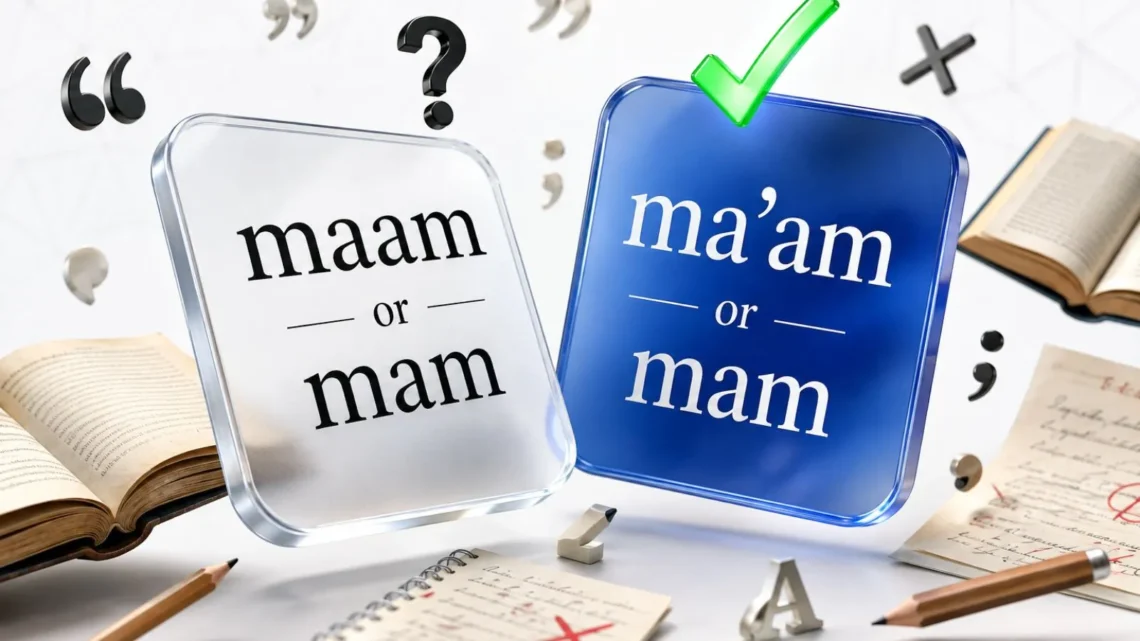
If you are unsure whether to write “ma’am or mam,” you are not alone.
These forms look similar, but they are not equally standard in English.
“Ma’am” is the widely accepted standard spelling of the shortened form of “madam,” while “mam” has different usage depending on regional English and context.
Choosing the right form can matter in polite conversation, formal writing, emails, and everyday communication.
In this article, you shall learn the meaning and correct usage of ma’am and mam, when each form is appropriate, how pronunciation and regional differences affect their use, and why people often confuse them.
You shall also see clear sentence examples and common mistakes to avoid, making it easier to choose the proper form confidently in your writing.
Quick Answer
Ma’am is the standard American English spelling of the polite form of address for a woman. It is a contraction of madam and normally includes an apostrophe. Mam is a regional form used mainly in British and Irish English, especially in some dialects, and is not the standard US spelling for polite address.
Ma’am or Mam: Comparison Table
| Feature | Ma’am | Mam |
| Standard US spelling | Correct | Usually incorrect for this meaning |
| Standard meaning | Polite form of address for a woman | Regional form of address; also means “mother” in some dialects |
| Definition | A shortened form of madam | A regional/informal form used in some varieties of English |
| Part of speech | Noun used as a form of address | Noun |
| Grammar rule | Use the apostrophe because it represents the shortened form of madam | No apostrophe when used as the regional word mam |
| Formal English | Appropriate | Generally not preferred in American formal English |
| Informal English | Common as a polite form of address | Common in certain British, Irish, and regional contexts |
| American English | Ma’am | Not the standard spelling for polite address |
| British/Irish English | Used, especially in formal address | Also used regionally, depending on dialect and context |
| Pronunciation | Usually /mæm/ | Usually /mæm/, though pronunciation can vary regionally |
| Common mistake | Omitting the apostrophe: mam | Using mam when standard US English requires ma’am |
| Memory tip | Ma’am = Madam shortened | Mam = regional word |
| Correct example | “Yes, ma’am.” | “Mam is waiting at home.” in a regional British/Irish context |
| Incorrect US usage | “Yes, mam.” | “Yes, mam.” when intended as standard American ma’am |
What Does “Ma’am” Mean?
Ma’am is a shortened form of madam. In American English, people use it as a polite and respectful way to address a woman.
For example:
- “Excuse me, ma’am, you dropped your phone.”
- “Yes, ma’am, I understand.”
- “Thank you, ma’am, for your help.”
- “Good morning, ma’am.”
The word can be used when speaking directly to a woman whose name you do not know. It can also express respect when addressing a customer, teacher, officer, supervisor, or another person in a position of authority.
Is “Ma’am” a Contraction?
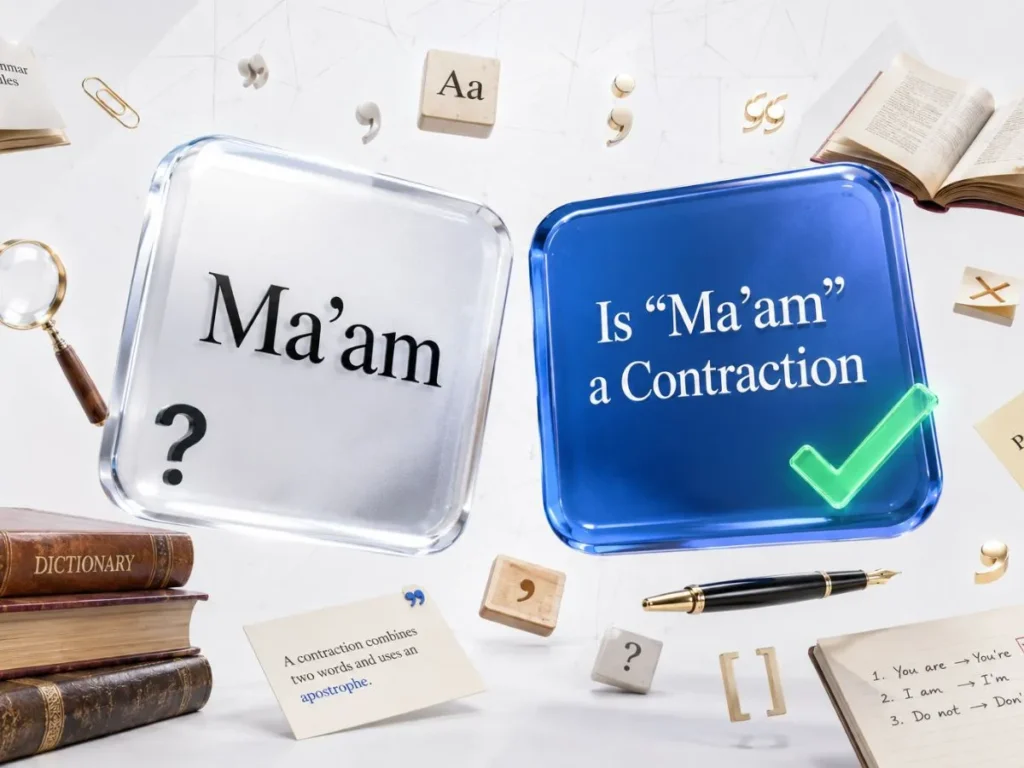
Yes. Ma’am represents the shortened form of madam.
The apostrophe signals that letters have been omitted:
madam → ma’am
This is why ma’am is the standard spelling in American English rather than mam when you mean the polite form of address.
How Is “Ma’am” Pronounced?
In most American English contexts, ma’am is pronounced approximately like “mam” or the vowel sound in ham, depending on the speaker and regional accent.
The spelling and pronunciation are therefore easy to confuse. Even though ma’am and mam may sound identical or nearly identical in some accents, their written forms and regional uses differ.
Examples With “Ma’am”
- “May I help you, ma’am?”
- “Yes, ma’am, I received your message.”
- “Excuse me, ma’am, is this your seat?”
- “The cashier asked, ‘Would you like a receipt, ma’am?’”
- “Thank you for your patience, ma’am.”
What Does “Mam” Mean?
Mam is a real word, but its meaning and usage depend heavily on regional English.
In some varieties of British and Irish English, mam is used as a term for mother or as a familiar form of address for a woman. It occurs particularly in certain regional dialects, including parts of Wales, Northern England, Northern Ireland, and Ireland.
For example, in a regional British or Irish context, someone might say:
- “I’m going to ask mam.”
- “Mam made dinner.”
- “I told mam about the trip.”
Here, mam does not represent the American abbreviation of madam. It is a separate regional word.
Is “Mam” Correct in American English?
Usually, no, if you mean the polite form of address ma’am.
In standard American English:
- Correct: “Yes, ma’am.”
- Not standard: “Yes, mam.”
However, mam can appear in American writing when someone is quoting a regional dialect, referring to a person’s name or nickname, or discussing another variety of English. So it is not accurate to say that mam is never a word.
The important distinction is meaning and context.
Ma’am vs. Mam: Key Differences
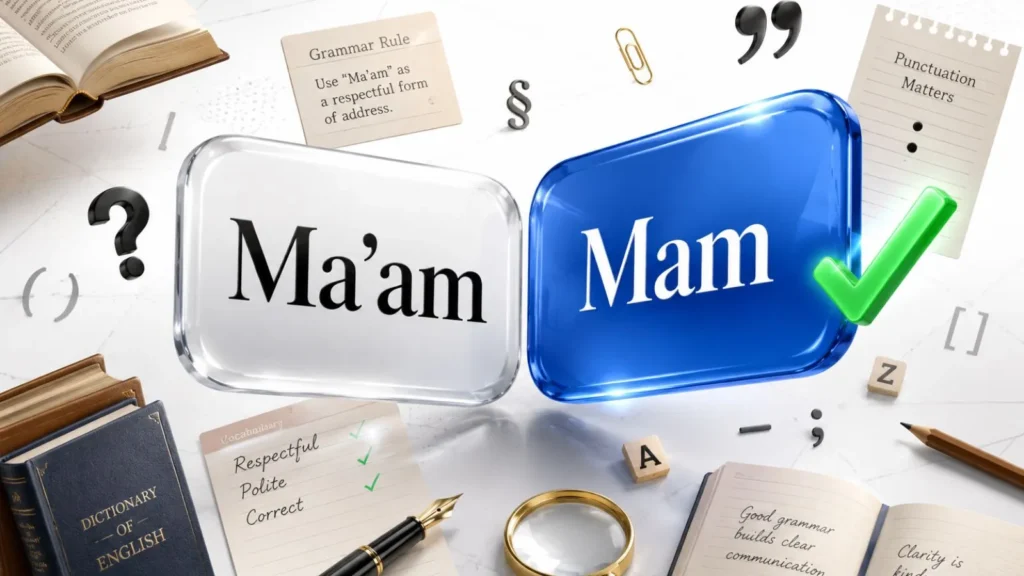
The easiest way to understand the difference is to remember that the two spellings have different linguistic backgrounds.
- Ma’am is the standard American English form derived from madam.
- Mam is a regional English word with different uses.
- Ma’am normally requires an apostrophe in standard US writing.
- Mam does not use an apostrophe when it is being used as the regional word.
- Both words can sound the same or very similar in some accents.
- In American professional writing, ma’am is the appropriate choice for polite address.
- In some British and Irish dialects, mam can mean “mother.”
- The surrounding sentence often tells you which word is intended.
- The apostrophe in ma’am reflects the shortened form of madam.
What Is the Grammar Rule for “Ma’am”?
The basic rule is straightforward:
Use “ma’am” when addressing a woman politely in standard American English.
Because ma’am is a shortened form of madam, the apostrophe marks the omitted letters.
Compare:
- madam
- ma’am
The same general principle appears in other contractions, such as:
- cannot → can’t
- do not → don’t
- I am → I’m
- madam → ma’am
Does “Ma’am” Need an Apostrophe?
Yes, in standard spelling, ma’am is written with an apostrophe.
The apostrophe is not decorative. It represents the letters removed from madam.
Therefore:
Correct: “Thank you, ma’am.”
Nonstandard in US English: “Thank you, mam.”
Should “Ma’am” Be Capitalized?
Usually, ma’am is lowercase when it appears in the middle of a sentence.
Examples:
- “Excuse me, ma’am.”
- “Yes, ma’am.”
- “Thank you, ma’am.”
It may appear with an initial capital letter when it begins a sentence:
- “Ma’am, your appointment is ready.”
The capitalization follows normal sentence capitalization rather than a special rule for the word itself.
Should You Put a Comma Before “Ma’am”?
When ma’am directly addresses someone, it is normally set off with a comma.
Examples:
- “Yes, ma’am.”
- “Excuse me, ma’am, could you help me?”
- “Thank you, ma’am.”
This is an example of direct address. The comma separates the form of address from the rest of the sentence.
When Should You Use “Ma’am”?
Academic Writing
In ordinary academic writing, you generally do not need ma’am unless you are reproducing dialogue or directly addressing someone.
For example:
The student said, “Yes, ma’am.”
In an essay, simply writing ma’am as a general reference to a woman would usually be unnecessary.
Professional Writing
Ma’am can be appropriate in professional communication when you are directly addressing a woman and the context calls for a respectful form of address.
For example:
“Good afternoon, ma’am. How may I assist you?”
However, professional communication often sounds more natural when you use the person’s name:
“Good afternoon, Ms. Carter.”
Formal English
Ma’am is an established polite form of address in American English. It can sound respectful and formal, particularly in customer service, official interactions, and military contexts.
Still, whether it sounds natural depends on the situation and the relationship between the speakers.
Business Writing
In business correspondence, ma’am is grammatically correct, but a person’s professional title and surname may be more appropriate.
For example:
“Dear Ms. Johnson,”
is generally more suitable for a formal business letter than:
“Dear ma’am,”
If you do not know the recipient’s name, however, other neutral greetings may be preferable depending on the context.
Emails
When directly addressing someone, ma’am can be used:
“Thank you for contacting us, ma’am.”
But in a formal email, use the person’s name or title when available:
“Dear Ms. Johnson,”
This usually sounds more professional and personal.
Daily Conversation
Ma’am is very common in spoken American English.
Examples include:
- “Excuse me, ma’am.”
- “Yes, ma’am.”
- “No, ma’am.”
- “Thank you, ma’am.”
Its frequency can vary by region, age, social setting, and personal preference.
American English vs. British and Irish English
Regional usage is one of the most important reasons people encounter mam.
In American English, ma’am is the conventional spelling for the polite form of address derived from madam.
In parts of British and Irish English, mam can have a different function. It may refer to a mother or serve as a regional term of address. Its use is particularly associated with certain dialects.
This means that neither spelling should be judged without considering context.
For example:
American English:
“Yes, ma’am.”
Regional British/Irish usage:
“I asked Mam if I could go.”
The first uses ma’am as a polite form of address. The second uses Mam as a regional term referring to one’s mother.
Common Mistakes With Ma’am and Mam
Mistake 1: Writing “Mam” Instead of “Ma’am”
Incorrect in standard American English:
“Excuse me, mam.”
Correct:
“Excuse me, ma’am.”
The error usually happens because the two forms can sound alike.
Mistake 2: Assuming the Apostrophe Is Optional
The apostrophe is part of the standard spelling of ma’am.
Correct:
“Yes, ma’am.”
Not standard:
“Yes, mam.”
Mistake 3: Thinking “Mam” Is Never a Word
This goes too far in the opposite direction.
Mam is a legitimate word in certain regional varieties of English. It can mean mother or function as a regional form of address.
The key is not simply “one is a word and the other is not.” The real distinction is standard American usage versus regional usage and meaning.
Mistake 4: Using “Ma’am” in Every Formal Situation
Although ma’am is polite, it is not always the best choice.
For example, in a formal business email, addressing someone as Ms. Brown may be more appropriate than repeatedly using ma’am.
Mistake 5: Confusing Spelling With Pronunciation
A person may pronounce ma’am almost exactly like mam. That does not mean the spellings are interchangeable.
Written English follows spelling conventions that are not always obvious from pronunciation.
18 Original Examples of Ma’am and Mam
- The receptionist smiled and said, “Good afternoon, ma’am.”
- “Yes, ma’am, your reservation is confirmed,” the clerk replied.
- The student raised her hand and said, “Excuse me, ma’am.”
- The customer thanked the manager, saying, “I appreciate your help, ma’am.”
- The officer politely asked, “Could you step this way, ma’am?”
- In the novel, the character answered, “No, ma’am, I did not take the letter.”
- The news report quoted the witness as saying, “A woman stopped me and asked, ‘Are you okay, ma’am?’”
- A social media commenter wrote, “Thank you, ma’am, for explaining this so clearly.”
- During the meeting, the employee said, “Yes, ma’am, I’ll send the report today.”
- The teacher reminded the child to say “Yes, ma’am” when responding politely.
- The hotel employee asked, “May I carry your luggage, ma’am?”
- “Excuse me, ma’am, I believe this wallet belongs to you,” the passerby said.
- In a regional British setting, a child might say, “I need to ask Mam first.”
- She grew up calling her mother Mam, a form common in her local dialect.
- The character’s use of Mam reflected the regional speech patterns of the story.
- The customer service representative greeted the caller with, “How can I help you, ma’am?”
- The young employee respectfully said, “Thank you, ma’am, for taking the time to meet with me.”
- The writer used Mam deliberately to preserve the character’s regional voice.
An Easy Memory Trick for Ma’am or Mam
Use this simple rule:
Ma’am = Madam shortened.
If you could replace the word with madam, use ma’am.
For example:
“Yes, ma’am.”
can become:
“Yes, madam.”
Therefore, ma’am is the correct standard American spelling.
If mam means mother in a regional British or Irish context, it is a different word and does not need the apostrophe.
The 3 Second Test
Ask yourself:
“Do I mean madam?”
- Yes → ma’am
- No, I mean mother in a regional dialect → mam
That simple test will prevent most spelling mistakes.
Mini Quiz
1. Which spelling is standard in American English?
A. Mam
B. Ma’am
C. Maam
D. M’am
Answer: B. Ma’am
2. What is “ma’am” shortened from?
A. Madam
B. Mother
C. Madamee
D. Miss
Answer: A. Madam
3. Which sentence is correct in standard American English?
A. “Yes, mam.”
B. “Yes, ma’am.”
C. “Yes maam.”
D. “Yes, m’am.”
Answer: B. “Yes, ma’am.”
4. What can “mam” mean in some British and Irish dialects?
A. Teacher
B. Sister
C. Mother
D. Manager
Answer: C. Mother
5. Why does “ma’am” contain an apostrophe?
A. To show plural possession
B. To indicate omitted letters from “madam”
C. To separate two nouns
D. To show emphasis
Answer: B. To indicate omitted letters from “madam.”
FAQs
Is “ma’am” or “mam” correct in American English?
Ma’am is the standard American English spelling when you are politely addressing a woman. It comes from madam and uses an apostrophe to indicate the shortened form. Mam is used in some British and Irish regional varieties, often meaning “mother,” but it is not the standard US spelling for this polite form of address.
Is “mam” a real word?
Yes, mam is a real word in several regional varieties of English. In parts of Britain and Ireland, it can mean “mother” or function as a regional form of address. Therefore, it should not simply be labeled as a misspelling. Its correctness depends on the variety of English and the meaning intended.
Why does “ma’am” have an apostrophe?
Ma’am has an apostrophe because it is a shortened form of madam. The apostrophe indicates that letters have been omitted from the original word. In standard American English, the apostrophe is part of the conventional spelling, so “Yes, ma’am” is correct while “Yes, mam” is not the standard form.
Can I use “ma’am” in a formal email?
Yes, you can use ma’am in a formal email when directly addressing a woman, but it may not always be the most natural choice. If you know the recipient’s name, a greeting such as “Dear Ms. Smith” is generally more conventional. Ma’am works particularly well in direct, respectful communication.
Is “ma’am” considered polite?
Yes. Ma’am is traditionally used as a respectful form of address for a woman, particularly when speaking to someone whose name or title you do not know. However, preferences vary by region and individual. Some people appreciate the respectful tone, while others may prefer being addressed by their name or professional title.
Do “ma’am” and “mam” sound the same?
They can sound the same or very similar, especially in American English. The main distinction is usually visible in writing and context rather than pronunciation. Ma’am is the standard American form derived from madam, while mam has separate regional uses, particularly in some British and Irish varieties of English.
Key Takeaways
- Ma’am is the standard American English spelling for politely addressing a woman.
- Ma’am is a shortened form of madam.
- The apostrophe in ma’am represents omitted letters.
- Mam is also a legitimate word in some regional varieties of English.
- In parts of Britain and Ireland, mam can mean mother.
- In standard US English, write “Yes, ma’am,” not “Yes, mam.”
- Both forms may sound similar, which causes much of the confusion.
- In formal business writing, a person’s name or title may be more appropriate than ma’am.
- Always consider the regional variety of English and the intended meaning.
Conclusion
When choosing between ma’am or mam, the correct spelling depends on what you mean and which variety of English you are using.
In standard American English, ma’am is the correct form for politely addressing a woman because it is derived from madam. Its apostrophe reflects the omitted letters.
Mam is not simply a universal misspelling, however. It has legitimate regional uses, particularly in parts of British and Irish English, where it can mean “mother” or serve as a regional form of address.
For American writing, though, remember the simple rule: if you mean “madam,” write “ma’am.”

Jack Ellison is an American author at WordsSign. He writes clear and well-researched articles on symbols, meanings, culture, and spiritual insights.