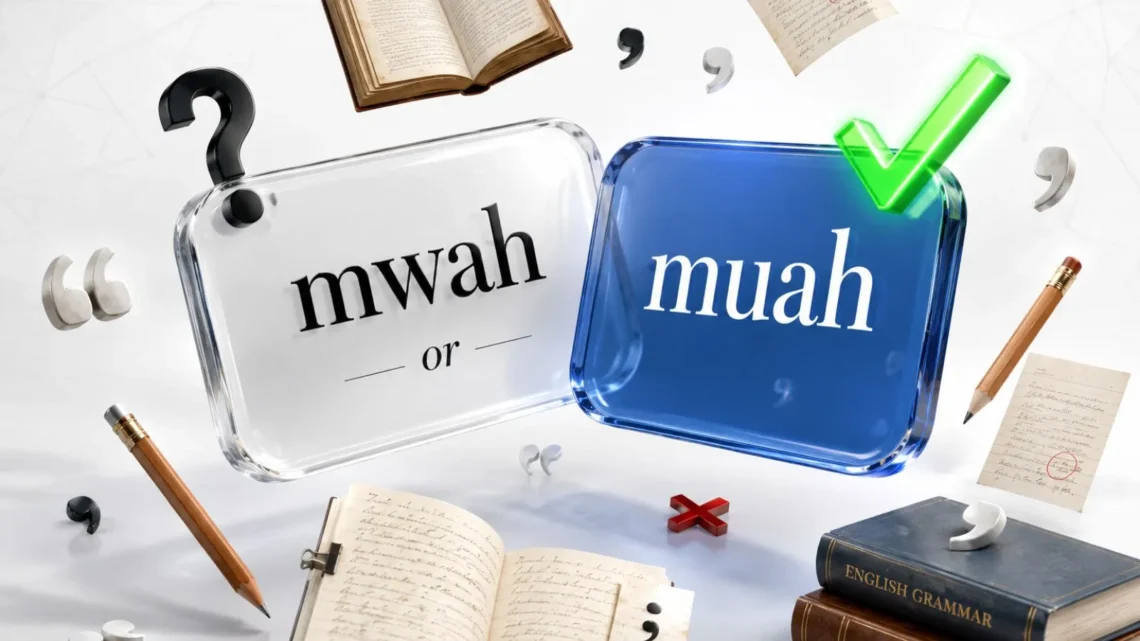
If you have ever wondered if mwah or muah is the better spelling, you are not alone.
Both forms are commonly used in casual writing to represent the sound of a kiss, especially in texts, social media, and friendly messages.
While neither is a formal English word with a strict grammar rule, mwah is generally the more common spelling, while muah is also widely understood and used.
The difference mainly comes down to style, pronunciation, and personal preference rather than meaning.
In this guide, you will learn what mwah and muah mean, how they are pronounced, where each spelling is commonly used, and if one is considered more appropriate in everyday communication.
You will also see clear examples to help you choose the right form confidently.
Quick Answer
Mwah and muah are informal spellings representing the sound or gesture of a kiss.
Both are acceptable in casual communication, but mwah is generally more common.
Neither spelling is appropriate for formal or academic writing.
You may also see variations such as muah, mwah, or mwah! in texts and social media.
Mwah vs. Muah: Comparison Table
| Category | Mwah | Muah |
| Correct Word | Mwah | Muah |
| Incorrect Word | Not inherently incorrect | Not inherently incorrect |
| Meaning | An informal written representation of a kiss or kissing sound | An informal written representation of a kiss or kissing sound |
| Definition | A playful expression representing a kiss | A playful expression representing a kiss |
| Part of Speech | Interjection; sometimes treated as an informal sound word | Interjection; sometimes treated as an informal sound word |
| Grammar Rule | Used mainly as a standalone informal expression | Used mainly as a standalone informal expression |
| Correct Usage | “Thanks for helping me mwah!” | “Goodnight, muah!” |
| Incorrect Usage | Using it in formal academic prose | Using it in formal business or academic prose |
| Pronunciation | Usually approximates “mwah” /mwɑː/ | Usually approximates “mwah” /mwɑː/ |
| Common Mistake | Assuming it is a standard formal English word | Assuming it has a different meaning from mwah |
| Memory Tip | Think of the w as part of the exaggerated kissing sound | Think of the u as another informal spelling of the same sound |
| Example | “Mwah! See you tomorrow.” | “Muah! Take care.” |
What Does “Mwah” Mean?
Mwah is an informal written expression that represents the sound or action of giving a kiss. People commonly use it in text messages, online conversations, social media posts, comments, and playful dialogue.
It can express affection, friendliness, gratitude, romance, or playful approval depending on the context.
For example:
- “Thanks for the flowers mwah!”
- “Goodnight, mwah!”
- “You are the sweetest. Mwah!”
- “I loved your message. Mwah right back!”
The word does not normally describe a physical kiss in a literal grammatical sense. Instead, it imitates or symbolizes the sound associated with a kiss.
Is “Mwah” a Real Word?
Mwah is an established informal expression, but it does not belong to formal standard English vocabulary in the same way as words such as kiss, affection, or greeting.
It functions much like an interjection or written sound effect. Dictionaries and language references may describe it as an informal representation of the sound of a kiss.
Because it is highly conversational, you should consider your audience and the type of writing before using it.
How Do You Pronounce “Mwah”?
Mwah is generally pronounced approximately like “mwah” or a prolonged kissing sound, often represented phonetically as /mwɑː/.
The exact pronunciation can vary because the expression imitates a sound rather than following a conventional pronunciation pattern.
What Does “Muah” Mean?
Muah is another informal spelling used to represent a kiss or kissing sound. It generally carries the same meaning as mwah.
People frequently use muah in casual digital communication:
- “Thank you so much, muah!”
- “Goodnight, muah.”
- “You look amazing, muah!”
- “Sending you a big muah!”
The spelling muah may feel more natural to some writers because the letters visually suggest the sound they want to represent. In practice, however, readers usually understand muah and mwah as essentially the same expression.
How Do You Pronounce “Muah”?
Muah is normally pronounced much like mwah. The spelling does not create a completely different pronunciation.
Since both forms are informal representations of a kissing sound, pronunciation depends somewhat on the writer’s intended tone.
What Is the Difference Between Mwah and Muah?
The main difference is spelling and stylistic preference, not meaning.
- Mwah is a very common spelling for a written kissing sound.
- Muah is an alternative informal spelling with essentially the same meaning.
- Both can express affection, friendliness, romance, gratitude, or playful emotion.
- Neither spelling is normally appropriate for formal academic writing.
- Neither form is a standard replacement for the noun kiss in formal English.
- Mwah often looks more explicitly like an imitation of a kissing sound.
- Muah may appear more phonetic or stylized to some writers.
- Context determines if the expression sounds romantic, friendly, humorous, or affectionate.
For example:
“Thanks for the birthday gift mwah!”
and:
“Thanks for the birthday gift muah!”
Both sentences communicate essentially the same idea.
Grammar Rules for Mwah and Muah
Because mwah and muah imitate a sound, they do not follow the same grammatical rules as ordinary nouns and verbs.
1. Use Them Mainly in Informal Communication
These expressions work best in:
- Text messages
- Social media
- Online chats
- Personal messages
- Informal dialogue
- Playful captions
- Fictional dialogue
Example:
“You made my day, mwah!”
2. They Can Stand Alone
Like many interjections, mwah or muah can appear independently.
“Mwah!”
This can communicate a kiss without requiring a complete grammatical sentence.
3. An Exclamation Mark Can Add Emotion
Because these expressions are emotional, writers often use an exclamation mark:
“Mwah!”
However, punctuation depends on the intended tone.
“Mwah, thank you!”
A comma can separate the expression from the rest of the sentence.
4. They Do Not Need to Be Capitalized in the Middle of a Sentence
If the expression appears in the middle of a sentence, lowercase is usually appropriate:
“She sent me a quick mwah before leaving.”
If it begins a sentence or stands alone as an exclamation, capitalization is natural:
“Mwah! See you later.”
5. Do Not Treat Them as Formal Vocabulary
In formal writing, replace them with a precise expression such as:
- a kiss
- a kiss goodbye
- an affectionate gesture
- a kiss on the cheek
For example:
Informal:
“She gave him a mwah before leaving.”
More formal:
“She gave him a kiss before leaving.”
When Should You Use “Mwah”?
Academic Writing
Avoid mwah in academic essays, research papers, assignments, and formal educational writing.
Instead of:
“The character says mwah before leaving.”
write:
“The character gives the other person a kiss before leaving.”
Professional Writing
Avoid mwah in formal workplace communication unless you have an established, highly informal relationship with the recipient and the context clearly supports playful language.
A professional email should generally use straightforward language.
Instead of:
“Thanks for your help, mwah!”
use:
“Thank you for your help.”
Formal English
Neither mwah nor muah belongs in formal prose when you need a neutral, professional tone.
Use kiss, affection, or another precise expression instead.
Business Writing
Business documents, reports, proposals, contracts, and professional announcements should not normally use either spelling.
For example:
Informal:
“Mwah! Thanks for supporting our launch.”
Professional:
“Thank you for supporting our launch.”
Emails
In a personal email, mwah may be perfectly natural:
“Thanks again for everything. Mwah!”
In a formal business email, it would usually sound inappropriate.
Daily Conversation
These expressions are most natural in casual digital communication.
“Goodnight, mwah!”
“Love you, muah!”
“Thanks, mwah!”
Their meaning depends heavily on the relationship between the people communicating.
Mwah vs. Muah in American and British English
There is no major American versus British grammar distinction that makes one spelling correct and the other incorrect.
Both mwah and muah appear in informal English across varieties of English.
The important distinction is formality, not nationality.
American English speakers may use either spelling, and British English speakers may also use either spelling. Usage can vary from person to person, community to community, and platform to platform.
If you need a neutral standard English expression, kiss is the safer choice.
Why Do People Confuse Mwah and Muah?
The confusion comes from the fact that both spellings attempt to represent a sound rather than a conventional English word.
English does not have one official spelling system for every sound effect or conversational expression. Writers often create spellings that visually communicate how something sounds.
Similar examples include:
- haha
- hmm
- ugh
- oops
- phew
- wow
These expressions can have multiple spellings or stylistic variations.
The same principle applies to mwah and muah.
Common Mistakes to Avoid
Mistake 1: Calling “Muah” Incorrect
It is too simplistic to say that muah is always wrong.
Muah is a recognized informal spelling of a kissing sound and is widely understood.
Mistake 2: Calling “Mwah” Formal English
Although mwah is common online, it remains an informal expression.
Do not assume that frequent use on social media makes it appropriate for formal writing.
Mistake 3: Treating “Mwah” and “Muah” as Different Actions
In ordinary informal usage, they usually represent the same idea.
“Mwah!”
and:
“Muah!”
normally communicate a kiss or kissing sound.
Mistake 4: Using Them in Academic Essays
A grammar assignment, research paper, or academic essay usually requires standard vocabulary.
Use:
“She kissed him goodbye.”
rather than:
“She said mwah goodbye.”
Mistake 5: Ignoring Context
A playful mwah can sound affectionate between friends but romantic between partners.
The word itself does not establish the exact relationship. Context does.
20 Original Examples of Mwah and Muah
- School: “After her friend helped with the project, Maya sent a playful ‘mwah!’”
- Workplace: “Her coworker joked, ‘Great job on the presentation mwah!’”
- Business: “The brand’s playful social media caption ended with ‘Muah!’”
- Casual conversation: “Goodnight, mwah! I’ll call you tomorrow.”
- Text message: “Thanks for remembering my birthday, muah!”
- Social media: “New outfit, new confidence mwah!”
- Everyday English: “She blew a kiss toward the children and whispered, ‘Mwah!’”
- Romantic message: “Sleep well, sweetheart. Muah!”
- Friendly message: “You remembered my favorite snack? Mwah, you are amazing!”
- Online comment: “That hairstyle looks fantastic mwah!”
- Fiction: “The actress smiled at the camera and said, ‘Mwah!’”
- Novel dialogue: “‘I’ll see you after dinner. Muah!’ she said before walking away.”
- News discussion: “The celebrity ended the livestream with a cheerful ‘mwah.’”
- Family message: “Love you, Mom. Muah!”
- Playful response: “You finally finished the project? Mwah! I’m impressed.”
- Social media caption: “Coffee, sunshine, and a little self love. Mwah!”
- Everyday texting: “Thanks for checking on me. Mwah!”
- Friendly farewell: “Take care of yourself, muah!”
- Digital conversation: “You are too kind. Mwah right back at you!”
- Informal dialogue: “‘See you soon!’ she called. ‘Mwah!’ he replied playfully.”
An Easy Memory Trick
Use this simple rule:
Mwah = the classic kissing sound.
Muah = another informal spelling of the same sound.
If you are choosing between the two and want the more familiar looking option, mwah is generally the safer informal choice.
But remember the most important rule:
For formal writing, choose “kiss” instead of either “mwah” or “muah.”
Think of it this way:
Mwah or Muah → informal kiss
Kiss → standard word
Mini Quiz
1. Which spelling is commonly used for a written kissing sound?
A. Mwah
B. Muah
C. Both A and B
D. Neither
Answer: C. Both A and B
Both mwah and muah are used informally to represent a kiss or kissing sound.
2. Which expression is better for a formal academic essay?
A. Mwah
B. Muah
C. Kiss
D. Both A and B
Answer: C. Kiss
Kiss is the standard vocabulary choice and is appropriate for formal contexts.
3. What do “mwah” and “muah” generally express?
A. Anger
B. A kiss or kissing sound
C. Confusion
D. Surprise
Answer: B. A kiss or kissing sound
Both spellings commonly represent the sound or gesture of a kiss.
4. Which sentence is appropriate for a casual text?
A. “Mwah! Goodnight.”
B. “Mwah is required in formal research.”
C. “The report concluded with muah.”
D. “Please insert mwah into the contract.”
Answer: A. “Mwah! Goodnight.”
The first sentence uses the expression naturally in an informal context.
5. Is “muah” simply another informal spelling of “mwah” in many contexts?
A. Yes
B. No
Answer: A. Yes
Although spelling preferences vary, the two forms commonly represent the same kissing sound.
FAQs
Is “mwah” or “muah” correct?
Both mwah and muah are acceptable informal spellings for a kiss or kissing sound. Neither is inherently incorrect. Mwah is generally a more familiar spelling, but muah is also widely understood. In formal writing, however, use the standard word kiss rather than either informal expression.
Is “mwah” a real English word?
Yes, mwah is an established informal expression used in English to represent the sound or gesture of a kiss. It functions more like an interjection or sound based expression than a conventional formal vocabulary word. It is common in texts, social media, informal dialogue, and playful communication, but it is not normally suitable for academic or formal writing.
Is “muah” a correct spelling?
Muah is an accepted informal spelling used to represent a kissing sound. It generally means the same thing as mwah. Because these expressions imitate sounds, spelling can vary. Therefore, calling muah completely incorrect would be misleading. For formal writing, use kiss instead.
Should I write “mwah” or “muah” in a text?
You can use either mwah or muah in a casual text when you want to express a kiss, affection, or playful emotion. Mwah may be the more immediately recognizable choice, but both are understandable. Your choice ultimately depends on your personal writing style and the tone of the conversation.
Is “mwah” formal or informal?
Mwah is informal. It is best suited to texting, social media, personal messages, casual dialogue, and playful communication. Avoid it in academic papers, formal reports, business documents, professional correspondence, and other situations requiring standard formal English. In those contexts, use words such as kiss or affection instead.
What is the difference between “mwah” and “muah”?
The main difference is spelling rather than meaning. Mwah and muah are informal representations of a kissing sound and usually communicate the same idea. Mwah is a particularly common spelling, while muah is an alternative form. Neither should normally be used in place of standard vocabulary in formal writing.
Key Takeaways
- Mwah and muah are both informal expressions for a kiss or kissing sound.
- Mwah is generally the more familiar spelling.
- Muah is also widely understood and commonly used.
- The two forms usually have the same meaning.
- Neither spelling is inherently grammatically wrong in informal communication.
- They can function as interjections or sound based expressions.
- Both are common in texts, social media, and casual conversations.
- Neither form is appropriate for most academic or professional writing.
- Use kiss when you need a standard, formal English word.
- American and British English do not have a major rule requiring one spelling over the other.
- Context determines if the expression sounds friendly, romantic, affectionate, or playful.
Conclusion
When deciding between mwah or muah, you usually do not need to worry about a major difference in meaning.
Both are informal ways to represent a kiss or kissing sound, and both appear in casual digital communication.
Mwah is generally the more familiar choice, while muah is a perfectly understandable alternative.
For formal, academic, or professional writing, however, neither is the best choice to use the standard word kiss instead.
- Ol’ or Ole: Which One Is Correct(2026)?
- Mwah or Muah: Which Spelling Is Correct(2026)?
- Ma’am or Mam: Which Spelling Is Correct(2026)?

Jack Ellison is an American author at WordsSign. He writes clear and well-researched articles on symbols, meanings, culture, and spiritual insights.