If you have ever wondered whether evoke or invoke is the right word to use, you are not alone.
These two verbs look and sound similar, but they have different meanings and are often confused in everyday writing and speech.
Choosing the correct word can make your message clearer and more accurate, if you are writing an essay, giving a presentation, or having a conversation.
In this guide, you shall learn the difference between evoke and invoke, when each one is appropriate, and why mixing them up is such a common mistake.
With simple explanations, practical sentence examples, and easy to remember usage tips, you shall gain the confidence to use both words correctly and avoid this common English grammar error in the future.
Quick Answer
Both evoke and invoke are correct English words.
- Evoke means to bring a feeling, memory, or image into someone’s mind.
- Invoke means to call upon someone or something for help, support, authority, or action.
Examples:
- The old photograph evoked happy childhood memories.
- The lawyer invoked the law to support her argument.
Evoke vs Invoke: Main Difference
| Word | Meaning | Correct? | Best Used For | Example |
| Evoke | To bring memories, emotions, or images to mind | ✅ Yes | Feelings, memories, imagination | The song evoked sadness. |
| Invoke | To call upon, appeal to, or use authority or power | ✅ Yes | Laws, rules, rights, prayers, authority | He invoked his legal rights. |
What Does Evoke Mean?

Evoke means to make someone remember, feel, or imagine something.
It is commonly used when talking about emotions, memories, images, sounds, smells, or experiences.
Examples
- The smell of fresh bread evoked memories of my grandmother is kitchen.
- Her speech evoked hope among the audience.
- The painting evokes peace and calm.
- That old song always evokes happy memories.
- The movie evoked strong emotions.
What Does Invoke Mean?
Invoke means to call upon something for help, support, protection, or authority.
It is often used with laws, rights, rules, powers, traditions, or religious ideas.
Examples
- The lawyer invoked the Constitution.
- You may invoke your right to remain silent.
- She invoked her experience during the discussion.
- The speaker invoked history to support his point.
- They invoked the company’s policy.
How to Use Evoke or Invoke
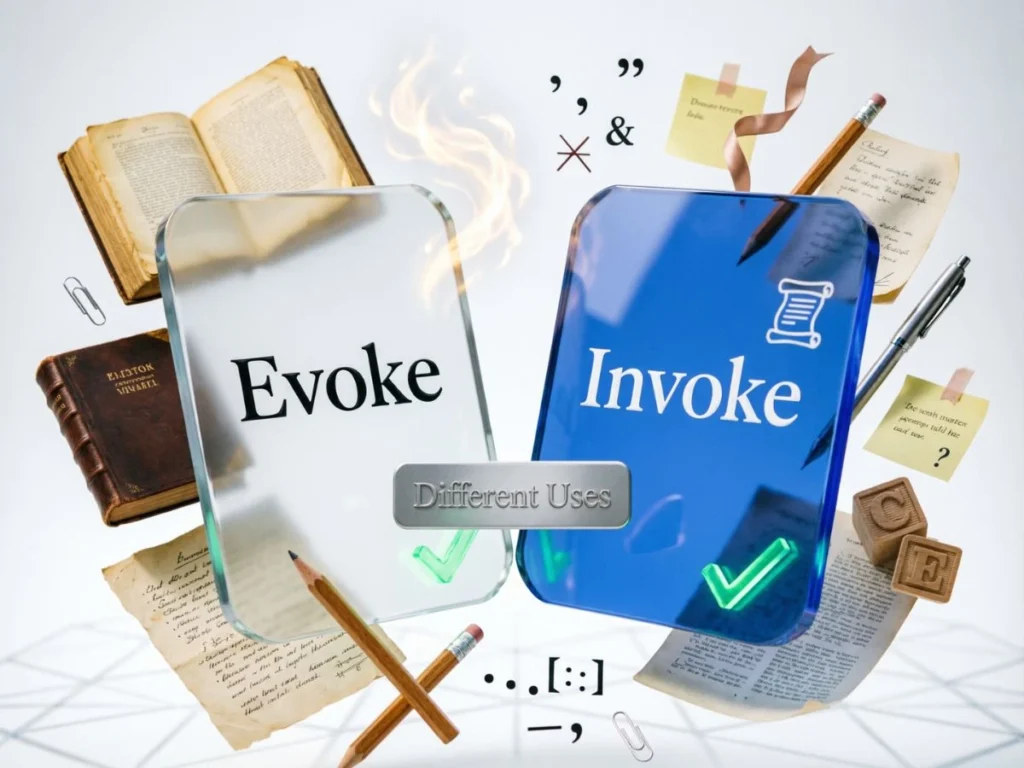
Use evoke when talking about feelings, memories, images, or emotions.
Use invoke when talking about calling upon authority, rules, rights, help, or power.
Simple Rules
- Evoke = bring to mind
- Invoke = call upon
Correct Examples
- The music evoked nostalgia.
- The judge invoked the law.
- The smell evoked childhood memories.
- She invoked her right to privacy.
Incorrect Examples
❌ The smell invoked happy memories.
✅ The smell evoked happy memories.
❌ The lawyer evoked the Constitution.
✅ The lawyer invoked the Constitution.
Where to Use Evoke or Invoke
School Writing
- Use evoke in essays about literature, art, or emotions.
- Use invoke when discussing history, law, or rules.
Formal Writing
Both words are common in formal writing but have different meanings.
Emails
- “Your message evoked many questions.”
- “We invoke clause 5 of the agreement.”
Everyday Conversation
- That smell evokes summer holidays.
- He invoked his experience to explain the problem.
Messages
- This photo evokes so many memories!
- I may invoke the warranty if the product fails.
Professional Communication
- The report evokes concern.
- The company invoked its safety policy.
American and British English
There is no spelling difference between evoke and invoke.
Both American and British English use these words in the same way.
The same is true in Canada, Australia, New Zealand, India, and Pakistan.
Why People Get Confused
People often confuse evoke and invoke because:
- They sound similar.
- Both are common in formal writing.
- Both describe bringing something into a situation.
- Their meanings are related but not the same.
Remember:
- Evoke brings feelings or memories.
- Invoke calls on authority or help.
Common Mistakes to Avoid
Wrong:
The picture invoked memories of my childhood.
Correct:
The picture evoked memories of my childhood.
Explanation: Memories are evoked, not invoked.
Wrong:
The lawyer evoked the law.
Correct:
The lawyer invoked the law.
Explanation: Laws are invoked.
Wrong:
She invoked happiness in everyone.
Correct:
She evoked happiness in everyone.
Explanation: Feelings are evoked.
Wrong:
The teacher evoked the school rules.
Correct:
The teacher invoked the school rules.
Explanation: Rules are invoked.
Real-Life Examples
Meeting
The manager invoked company policy during the discussion.
School
The poem evoked feelings of hope.
Travel
The old village evoked memories of childhood vacations.
Work
The employee invoked the terms of the contract.
Message
Your photo evoked so many wonderful memories.
Conversation
She invoked her experience to explain the issue.
Booking
The customer invoked the refund policy after the cancellation.
Social Situation
The music evoked excitement among the guests.
Easy Trick to Remember
Think of it this way:
- Evoke = Emotion
- Invoke = Involve authority
If you are talking about feelings or memories, use evoke.
If you are calling on a rule, right, law, or power, use invoke.
Mini Quiz
1. Which word means “bring back a memory”?
Answer: Evoke
2. Which word is used with laws and rights?
Answer: Invoke
3. Which sentence is correct?
A. The smell invoked my childhood.
B. The smell evoked my childhood.
Answer: B
4. Which sentence is correct?
A. The lawyer invoked the law.
B. The lawyer evoked the law.
Answer: A
5. Which word fits?
“The painting ______ peaceful feelings.”
Answer: Evoked
6. Which word fits?
“The company ______ its refund policy.”
Answer: Invoked
Related Confusing Words
- affect or effect
- imply or infer
- ensure or insure
- principal or principle
- farther or further
- historic or historical
- compliment or complement
- empathy or sympathy
FAQs
Is evoke correct?
Yes. Evoke is correct when talking about feelings, memories, or images.
Is invoke correct?
Yes. Invoke is correct when referring to laws, rights, authority, or asking for help.
What is the difference between evoke and invoke?
Evoke brings emotions or memories to mind, while invoke calls upon authority, rules, or support.
Which one should I use?
Use evoke for emotions and memories. Use invoke for laws, rights, policies, or authority.
Are evoke and invoke formal words?
Yes. Both are common in formal writing, but they also appear in everyday speech depending on the context.
Conclusion
Both evoke and invoke are correct, but they serve different purposes.
Use evoke when you want to describe bringing feelings, memories, or images to mind
Use invoke when you are calling upon a law, rule, right, authority, or source of support.
Remember this simple rule, and you shall choose the right word with confidence.
Read More Post
- Loose or Lose Meaning: Which Word Is Correct(2026)?
- Surely or Surly: Which Word Is Correct for Your Sentence?
- Curb or Kerb: Which Spelling Is Correct(2026)?

Jack Ellison is an American author at WordsSign. He writes clear and well-researched articles on symbols, meanings, culture, and spiritual insights.