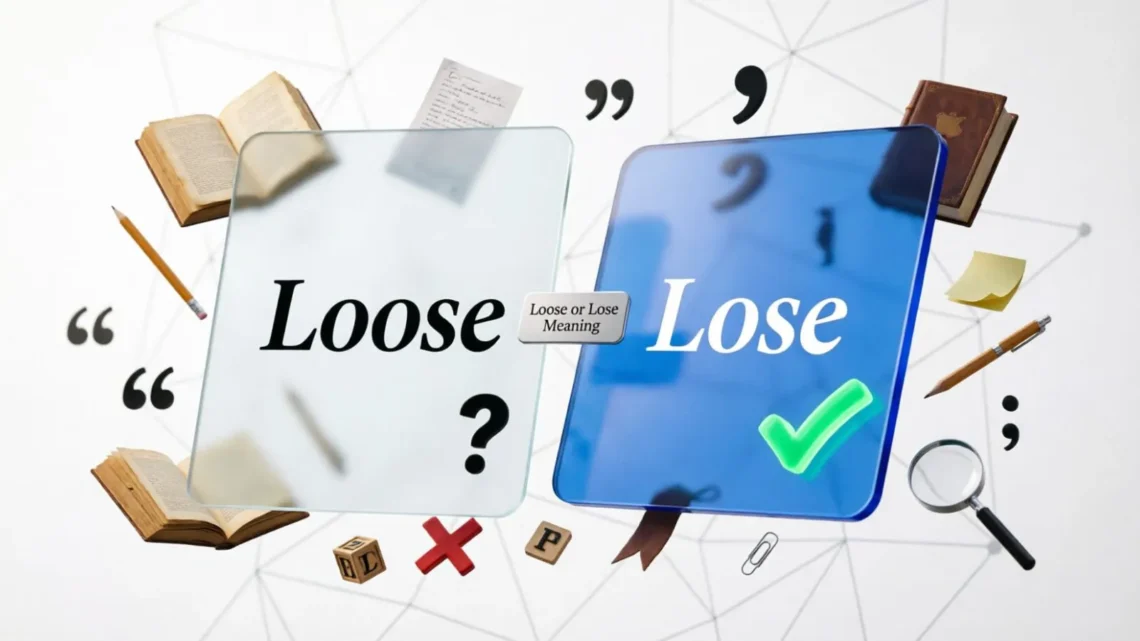
Loose or lose meaning is a common point of confusion in English writing, especially because these two words look and sound similar but have completely different uses.
Understanding the difference between loose and lose meaning will help you choose the correct word and avoid common spelling mistakes.
Many people mix them up in everyday sentences, emails, and online writing, but the grammar rule behind them is simple once you know what to look for.
In this guide, you will learn the proper usage, key differences, and practical sentence examples that show when to use each word. Keep reading to confidently improve your English grammar and write with greater accuracy.
Quick Answer
Loose and lose are both correct words, but they are used in different situations.
- Loose = not tight, free, or not firmly attached.
Example: My shoes are loose. - Lose = to misplace something, fail, or no longer have something.
Example: I do not want to lose my keys.
Remember: Loose has two “o” letters because it describes something that has extra space. Lose has one “o” because it means something is gone.
Loose vs Lose: Main Difference
| Word/Phrase | Meaning | Correct? | Best Used For | Example |
| Loose | Not tight, free, or not firmly held | Correct | Clothing, objects, rules, control | The shirt is too loose. |
| Lose | To misplace, fail, or no longer have something | Correct | Possessions, competitions, opportunities | I do not want to lose my phone. |
What Does Loose Mean?
Loose is an adjective that means something is not tight, attached, or controlled. It can describe objects, clothing, rules, or situations.
It is often used when something has extra space or is not held firmly.
Examples of Loose:
- My jacket is too loose because I bought a bigger size.
- The dog broke free because its collar was loose.
- She likes wearing loose clothes during summer.
- The screw is loose, so the chair feels unstable.
- The company has loose rules about working hours.
Loose can also describe something relaxed or not strict.
Example:
The teacher has a loose approach to homework deadlines.
What Does Lose Mean?
Lose is a verb that means to no longer have something, to fail in a competition, or to miss an opportunity.
It describes something that disappears, is taken away, or is not achieved.
Examples of Lose:
- I always lose my keys when I am in a hurry.
- Our team might lose the game today.
- She does not want to lose her job.
- Do not lose hope during difficult times.
- He lost his wallet while traveling.
The past tense of lose is lost.
Example:
I lost my favorite book yesterday.
How to Use Loose or Lose
Use loose when you are describing something that is:
- Not tight
- Not fixed firmly
- Free or relaxed
- Not strict
Correct:
- These pants are loose.
- The handle is loose.
Incorrect:
- I do not want to loose my phone.
The correct word is lose because you mean you do not want your phone to disappear.
Use lose when you mean:
- Misplace something
- Fail to win
- Miss something
- Stop having something
Correct:
- I do not want to lose my wallet.
- They may lose the match.
Incorrect:
- My shoes are lose.
The correct word is loose because the shoes are not tight.
Where to Use Loose or Lose
Both loose and lose are common English words used in many situations.
School Writing
Use them carefully in essays, assignments, and exams.
Example:
- Correct: The rope became loose.
- Correct: Many students lose marks because of mistakes.
Formal Writing
Both words are acceptable in professional writing when used correctly.
Example:
- The company does not want to lose valuable employees.
- The policy has loose guidelines.
Emails and Professional Communication
Use lose when discussing mistakes, opportunities, or results.
Example:
- We cannot afford to lose this customer.
Use loose when describing physical conditions or flexible rules.
Example:
- The connection is loose and needs repair.
Everyday Conversation and Messages
Both words are frequently used in daily speech.
Examples:
- I think my watch strap is loose.
- I always lose my charger.
Why People Get Confused
People often confuse loose and lose because:
- They have similar spelling.
- They sound almost the same.
- The extra “o” in loose is easy to forget.
- Many learners hear them more often than they see them written.
The pronunciation is slightly different:
- Loose sounds like “looss.”
- Lose sounds like “looz.”
Although they sound similar, their meanings are completely different.
Common Mistakes to Avoid
Wrong:
I do not want to loose my keys.
Correct:
I do not want to lose my keys.
Explanation: You mean your keys might disappear.
Wrong:
My shoes are lose.
Correct:
My shoes are loose.
Explanation: The shoes are not tight.
Wrong:
The team will loose the match.
Correct:
The team will lose the match.
Explanation: A team can lose a competition.
Wrong:
The door handle is lose.
Correct:
The door handle is loose.
Explanation: The handle is not firmly attached.
Real-Life Examples
Meeting
Lose:
We cannot lose this important client.
School
Lose:
Students may lose marks for incorrect answers.
Travel
Lose:
Be careful not to lose your passport.
Work
Loose:
The office has loose rules about dress code.
Message
Loose:
My phone charger cable is loose.
Conversation
Lose:
I always lose my glasses.
Order or Booking
Lose:
You may lose your reservation if you do not confirm it.
Social Situation
Loose:
She prefers loose clothing because it feels comfortable.
Easy Trick to Remember
Remember this simple trick:
Loose = extra space → two O’s look like extra room.
Lose = something is gone → one O means one thing has disappeared.
Loose = not tight.
Lose = no longer have.
Mini Quiz
- My shirt is too ______.
Answer: loose - I do not want to ______ my wallet.
Answer: lose - The team might ______ the final game.
Answer: lose - The screw is ______ and needs tightening.
Answer: loose - Be careful not to ______ your phone.
Answer: lose - She wears ______ clothes at home.
Answer: loose
Related Confusing Words
- Your or You are
- Its or It is
- Affect or Effect
- Accept or Except
- Then or Than
- Their or There
- Advice or Advise
- Breath or Breathe
FAQs About Loose or Lose
Is loose correct?
Yes, loose is correct. It means something is not tight, fixed, or controlled.
Is lose correct?
Yes, lose is correct. It means to misplace something, fail, or no longer have something.
What is the difference between loose and lose?
Loose describes something that is free or not tight. Lose means something is gone or not achieved.
Which one should I use?
Use loose for things that are not tight. Use lose for losing possessions, games, chances, or feelings.
Is loose or lose formal or informal?
Both words are standard English words and can be used in formal and informal situations.
Conclusion
Loose and lose are both correct words, but they have different meanings
Use loose when something is not tight or firmly attached
Use lose when something is misplaced, defeated, or no longer available.
Remember: loose has extra space, while lose means something is gone.
Read More Post
- Is It Cancell or Cancel? Learn the Correct Usage(2026)?
- Braut or Brat: Which Word Is Correct?
- Falter or Faulter: Which Spelling Is Correct?

Alexander Reed is an American author at WordsSign. He writes clear and well-researched articles on symbols, meanings, culture, and spiritual insights.