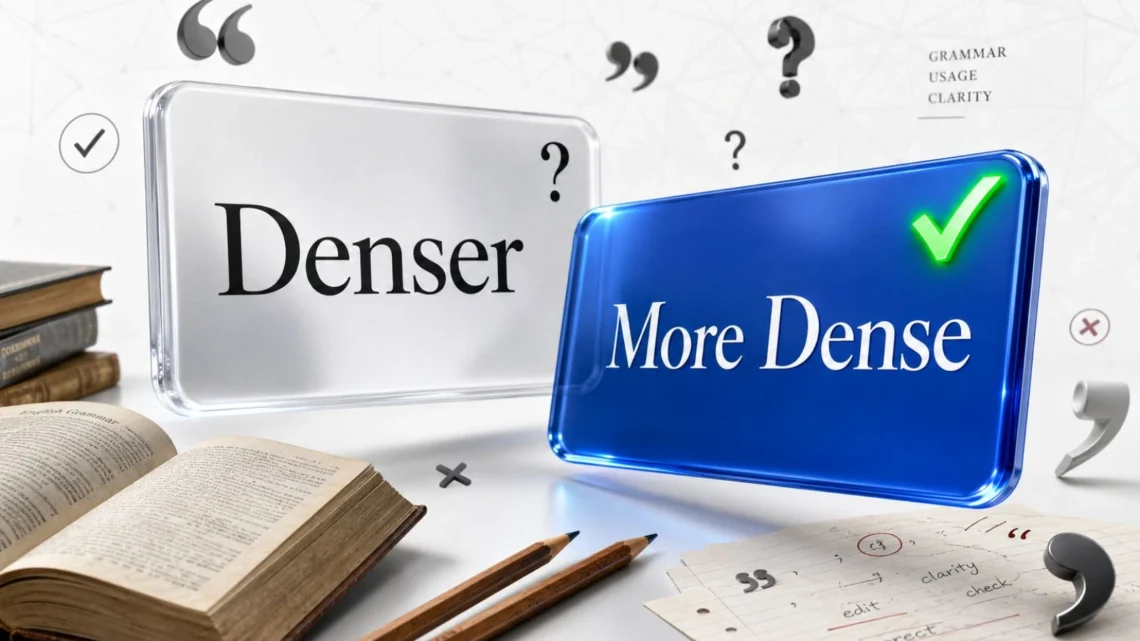
If you have ever wondered whether denser or more dense is the better choice, you are not alone.
The denser or more dense debate often confuses writers because both forms appear in books, articles, and everyday conversation.
In most cases, denser is the preferred comparative form, but more dense is also grammatically correct and may sound more natural in certain contexts or for emphasis.
Understanding the difference can help you choose the right wording for clear, polished writing.
In this article, you shall learn the grammar rule behind both forms, when each one is appropriate, why people mix them up, and how to avoid common mistakes.
You shall also find simple explanations, practical sentence examples, and usage tips to help you write with greater confidence.
Quick Answer
Both denser and more dense are grammatically correct.
- Denser is the standard comparative form and is the best choice in most situations.
- More dense is sometimes used for emphasis or in technical and scientific writing.
Examples:
- This forest is denser than the one near the lake.
- The material became more dense under high pressure.
Denser vs More Dense: Main Difference
| Word/Phrase | Meaning | Correct? | Best Used For | Example |
| Denser | Having a higher density than something else | ✅ Yes | Everyday writing and speech | This cake is denser than the last one. |
| More dense | Having a higher density, with extra emphasis | ✅ Yes | Scientific, technical, or formal contexts | The core became more dense over time. |
What Does Denser Mean?

Denser is the comparative form of dense. It means something has a greater amount of matter, people, or objects packed into the same space than something else.
Examples
- The jungle is denser after the rainy season.
- Gold is denser than aluminum.
- Traffic became denser during rush hour.
- This sponge is denser than the old one.
- The fog grew denser as the evening continued.
What Does More Dense Mean?
More dense has the same meaning as denser. It is also grammatically correct.
Writers sometimes choose more dense to make the comparison sound more formal or to emphasize the change. It is especially common in scientific or technical discussions.
Examples
- The rock became more dense after compression.
- The gas grows more dense as the temperature drops.
- The population is becoming more dense in urban areas.
- The cloud appeared more dense from a distance.
- The material became more dense during the experiment.
How to Use Denser or More Dense
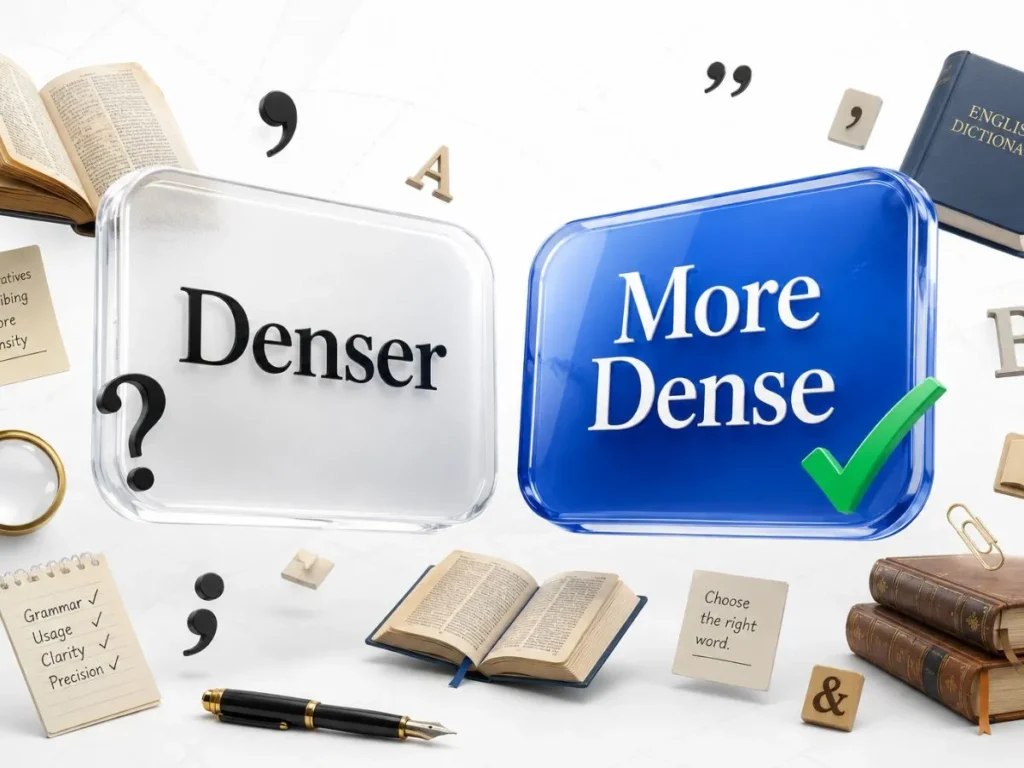
In most situations, choose denser because it is shorter and sounds more natural.
General Rule
- Use denser for everyday English.
- Use more dense when you want extra emphasis or when writing in technical or scientific contexts.
Correct Examples
- This bread is denser than homemade bread.
- The forest became denser over the years.
- The substance became more dense under pressure.
- The atmosphere is more dense near the surface.
Avoid This Mistake
❌ This forest is more denser than that one.
✅ This forest is denser than that one.
✅ This forest is more dense than that one.
Never use both more and er together.
Where to Use Denser or More Dense
School Writing
Use denser unless your teacher prefers technical wording.
Formal Writing
Both are correct. More dense may appear in scientific or academic writing.
Emails
Denser is usually the better choice because it is clear and natural.
Everyday Conversation
People almost always say denser.
Messages
Use denser for quick and natural communication.
Professional Communication
Both forms are acceptable. Choose the one that matches the tone of your writing.
American and British English
There is no regional difference.
- American English: Both are correct, but denser is more common.
- British English: Both are correct, with denser generally preferred.
- Canada, Australia, India, Pakistan, and New Zealand: The same rule applies.
Why People Get Confused
People get confused because English has two ways to make comparisons.
Some adjectives use er.
- small → smaller
- tall → taller
- dense → denser
Others use more.
- beautiful → more beautiful
- careful → more careful
Since both comparison styles exist, some people naturally say more dense even though denser is usually the preferred form.
Common Mistakes to Avoid
Wrong:
This metal is more denser than iron.
Correct:
This metal is denser than iron.
Use either more or er, not both.
Wrong:
The crowd became dense than before.
Correct:
The crowd became denser than before.
Use the comparative form when comparing.
Wrong:
This foam is most denser.
Correct:
This foam is the densest.
Use the superlative form when comparing three or more things.
Wrong:
The solution became more densely.
Correct:
The solution became more dense.
Dense is the adjective needed here.
Real Life Examples
Meeting
“The report is denser than last year is version.”
School
“This textbook is denser than the one we used before.”
Travel
“The traffic became denser as we entered the city.”
Work
“The new material is more dense, making it stronger.”
Message
“The fog is getting denser. Drive carefully.”
Conversation
“I think this pillow feels denser than the old one.”
Order or Booking
“We need a denser packing material to protect the products.”
Easy Trick to Remember
If the adjective is dense, the natural comparison is usually denser.
Think:
Dense → Denser
just like
Tall → Taller
Use more dense only when you want extra emphasis or a more formal style.
Mini Quiz
1. Which is more natural in everyday English?
Answer: Denser
2. Is “more dense” grammatically correct?
Answer: Yes
3. Which sentence is wrong?
A. The forest is denser than before.
B. The forest is more dense than before.
C. The forest is more denser than before.
Answer: C
4. Which form is common in scientific writing?
Answer: More dense (though denser is also correct)
5. Complete the sentence:
Gold is ______ than silver in terms of density.
Answer: denser
6. Can both forms compare two things?
Answer: Yes
Related Confusing Words
- gray or grey
- canceled or cancelled
- farther or further
- less or fewer
- affect or effect
- your or You are
- its or it’s
- then or than
FAQs
Is denser correct?
Yes. It is the standard comparative form of dense and is the preferred choice in most situations.
Is more dense correct?
Yes. It is grammatically correct and often appears in scientific or formal writing.
What is the difference between denser and more dense?
They have the same meaning. Denser is more natural, while more dense may add emphasis or suit technical writing.
Which one should I use?
Use denser for most everyday writing and speaking. Choose more dense if it better fits a formal or scientific style.
Are both forms formal?
Yes. Both are acceptable, but denser is generally the more common and natural choice.
Conclusion
Both denser and more dense are correct, but denser is the form most people use in everyday English.
It is shorter, more natural, and follows the usual rule for one syllable adjectives.
Use more dense when you want extra emphasis or when writing in a technical or scientific context.
Just remember one important rule: never say “more denser.”
Read More Post
- Chock or Choke: Which Word Is Correct(2026)?
- Lose or Loose Meaning: What is the Difference and Which Word Is Correct?
- Slipping or Sliding: What’s the Difference and When to Use Each?

Alexander Reed is an American author at WordsSign. He writes clear and well-researched articles on symbols, meanings, culture, and spiritual insights.