Many people confuse the lose or loose meaning because the words look almost identical, yet they have very different definitions and uses.
If you have ever wondered which one is correct in a sentence, you are in the right place.
Lose is a verb that means to misplace something or fail to win, while loose is usually an adjective that describes something not tight or firmly attached.
Mixing them up is one of the most common spelling mistakes in English writing, but it is easy to avoid once you understand the difference.
In this guide, you shall learn the correct usage, meaning, pronunciation, simple grammar rules, practical sentence examples, and memory tips that will help you choose the right word with confidence every time.
Quick Answer
Lose is a verb that means to fail to keep, misplace, or be defeated. Loose is usually an adjective that means not tight, not firmly attached, or free. A simple way to remember them is that lose refers to losing something, while loose describes how something fits or moves.
Lose vs. Loose Comparison Table
| Feature | Lose | Loose |
| Correct Word | Yes | Yes |
| Meaning | To fail to keep, misplace, or be defeated | Not tight, free, or not securely fastened |
| Definition | To no longer have something or fail to win | Having room to move; not fixed firmly |
| Part of Speech | Verb | Usually an adjective (sometimes a verb) |
| Grammar Rule | Used as an action word | Used to describe a noun |
| Correct Usage | Lose your keys, lose a game | Loose shirt, loose screw |
| Incorrect Usage | “Loose my wallet” | “Lose clothing” (when describing fit) |
| Pronunciation | /luːz/ (“looz”) | /luːs/ (“loos”) |
| Common Mistake | Writing loose instead of lose | Writing lose instead of loose |
| Memory Tip | Lose has one o, just like “lost.” | Loose has two o’s, giving it extra room. |
| Example | I do not want to lose my phone. | These shoes are too loose. |
What Does “Lose” Mean?
Lose is a verb. It describes the action of no longer having something, failing to win, or becoming unable to keep something.
Definition
To lose means:
- To misplace something
- To fail to keep possession of something
- To be defeated
- To decrease or reduce something
Pronunciation
Lose is pronounced /luːz/.
Examples
- Do not lose your passport while traveling.
- We might lose the championship this year.
- She hopes to lose ten pounds before summer.
- I always lose my headphones.
- They could lose an important client.
What Does “Loose” Mean?
Loose is most commonly an adjective. It describes something that is not tight, firmly attached, or securely fastened.
Definition
Loose means:
- Not tight
- Free from restraint
- Not firmly fixed
- Relaxed or flexible
Pronunciation
Loose is pronounced /luːs/.
Examples
- This jacket feels too loose.
- One of the wheels is loose.
- Keep the dog on a leash so it does not run loose.
- Her ponytail became loose during the game.
- Wear loose clothing in hot weather.
Can “Loose” Be a Verb?
Yes, but it is much less common. As a verb, loose means to release or set free.
Examples:
- The commander ordered the soldiers to loose the arrows.
- They loosed the horses into the field.
In modern everyday English, this verb form is rare.
Key Differences Between Lose and Loose
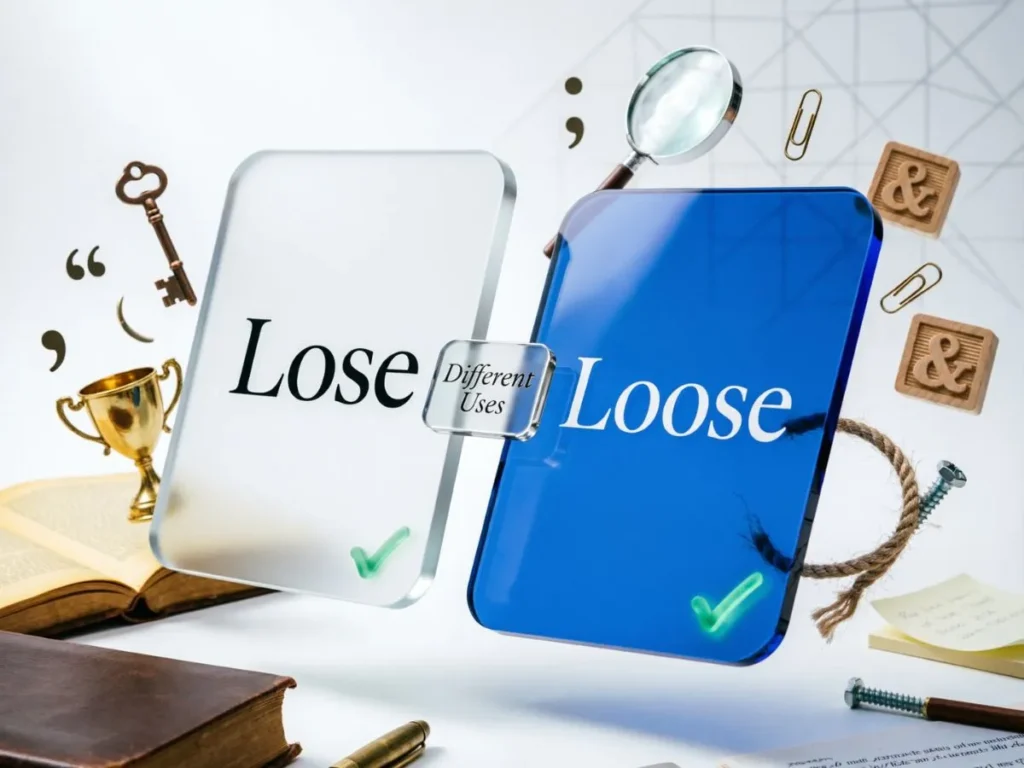
- Lose is a verb; loose is usually an adjective.
- Lose describes an action.
- Loose describes a condition or quality.
- You can lose your wallet.
- Your wallet cannot be loose unless something attached to it is loose.
- Clothes can be loose, but you cannot loose your clothes unless you are using the uncommon verb meaning “release.”
Compare These Examples
✅ I Do not want to lose my job.
❌ I Do not want to loose my job.
✅ These pants are loose.
❌ These pants are lose.
Grammar Rules for Lose and Loose
Rule 1: Use “Lose” as a Verb
Whenever you are talking about an action involving losing something, use lose.
Examples:
- Lose your wallet.
- Lose confidence.
- Lose a race.
- Lose interest.
Rule 2: Use “Loose” as an Adjective
When describing something that is not tight or secure, use loose.
Examples:
- Loose belt
- Loose shoelaces
- Loose pages
- Loose soil
Rule 3: Check the Sentence Structure
Ask yourself:
- Is this an action? → Use lose.
- Is this a description? → Use loose.
Are There Any Exceptions?
There are no exceptions to the basic distinction between lose and loose. The only point worth remembering is that loose can occasionally act as a verb meaning “release,” but that use is uncommon in modern American English.
When to Use Each Word
Academic Writing
Use lose when discussing results, competitions, or reductions.
Example:
- Students may lose marks for incorrect citations.
Use loose when describing physical objects.
Example:
- The experiment failed because of a loose connection.
Professional Writing
Examples:
- We cannot afford to lose valuable customers.
- The cable became loose during installation.
Formal English
Both words are appropriate when used correctly.
Examples:
- The company may lose funding.
- Inspect every loose component carefully.
Informal English
Examples:
- Do not lose your phone again.
- My hoodie is nice and loose.
Business Writing
Examples:
- We could lose market share.
- Tighten any loose screws before shipping.
Emails
Examples:
- Please do not lose the attached document.
- One attachment appears to be loose inside the package.
Daily Conversation
Examples:
- I always lose my keys.
- Your shoelaces are loose.
Common Mistakes
Why Do People Confuse Them?
Several reasons make these words confusing:
- They have similar spellings.
- Their pronunciations are close.
- Spell check does not always catch the mistake because both are real words.
- Fast typing often leads to replacing one with the other.
Incorrect
❌ I always loose my wallet.
Correct
✅ I always lose my wallet.
Incorrect
❌ My shirt is too lose.
Correct
✅ My shirt is too loose.
Incorrect
❌ Do not loose hope.
Correct
✅ Do not lose hope.
Incorrect
❌ The bolt is lose.
Correct
✅ The bolt is loose.
Tips to Avoid Mistakes
- If it is an action, think lose.
- If it is describing something, think loose.
- Remember that loose has two o’s, giving it “extra room.”
Original Example Sentences
- Do not lose your homework before class.
- My backpack strap became loose after the hike.
- Our team might lose the final match.
- The manager noticed a loose wire under the desk.
- If you lose your ID card, report it immediately.
- These jeans are too loose around the waist.
- Investors could lose money during market downturns.
- The handle feels loose and needs tightening.
- Never lose confidence after one mistake.
- Her bracelet became loose while she was shopping.
- Writers sometimes lose their train of thought.
- The mechanic fixed a loose engine cover.
- You may lose followers if you post misleading information.
- The dog slipped out because its collar was too loose.
- I Do not want to lose touch with old friends.
- Several loose pages fell out of the notebook.
- The company could lose an important contract.
- Wear loose clothing during hot weather.
- He almost lost the game but stayed calm until the end.
- A loose button is easy to sew back on.
Memory Trick
Here’s a simple trick you shall remember:
- Lose has one “o.” When you lose something, you have lost one of the letters too.
- Loose has two “o’s.” Those extra letters create extra space, just like something that is loose has extra room.
Another quick reminder:
Lose = Lost
Loose = Not Tight
Mini Quiz
1. Which sentence is correct?
A. I do not want to loose my wallet.
B. I do not want to lose my wallet.
Answer: B
2. Which word describes clothing that is not tight?
A. Lose
B. Loose
Answer: B
3. Which sentence is correct?
A. The screw is loose.
B. The screw is lose.
Answer: A
4. Which word is a verb?
A. Loose
B. Lose
Answer: B
5. Which sentence is correct?
A. We might lose the game.
B. We might loose the game.
Answer: A
FAQs
Is it “lose” or “loose”?
Use lose when referring to failing to keep something, being defeated, or misplacing an item. Use loose when describing something that is not tight or securely attached. Although the words look similar, they serve different grammatical purposes.
Why do people mix up lose and loose?
People confuse them because the spellings differ by only one letter, and their pronunciations are similar. Since both are valid English words, spell check tools may not catch the mistake if the wrong word still fits the sentence grammatically.
Is “loose” ever a verb?
Yes. Loose can be used as a verb meaning “to release” or “set free.” However, this usage is uncommon in modern American English and appears mainly in literary, historical, or formal contexts.
Is “lose” used in both American and British English?
Yes. The meaning and usage of lose are the same in both American and British English. There is no regional difference in its spelling or grammar.
How can I remember the difference between lose and loose?
Remember that lose has one “o” and refers to losing something. Loose has two “o’s,” representing extra space, making it easy to associate with something that is not tight.
Can clothes be “lose”?
No. Clothing can be loose, meaning it fits comfortably or is not tight. Using lose in this context is incorrect because lose is a verb, not an adjective describing how clothes fit.
Key Takeaways
- Lose is a verb that means to misplace, fail to keep, or be defeated.
- Loose is usually an adjective meaning not tight or securely fastened.
- Use lose for actions.
- Use loose for descriptions.
- Both words are correct but have different meanings.
- There is no difference between American and British English in their standard usage.
- Remember: Lose = Lost, Loose = Extra Room.
Conclusion
Understanding the lose or loose meaning is easier once you know their different roles in a sentence.
Lose is always about losing, misplacing, or failing to keep something, while loose describes something that is not tight or securely attached.
By remembering that lose is an action and loose is usually a description, you shall avoid one of the most common English writing mistakes and communicate with greater confidence.

Jack Ellison is an American author at WordsSign. He writes clear and well-researched articles on symbols, meanings, culture, and spiritual insights.