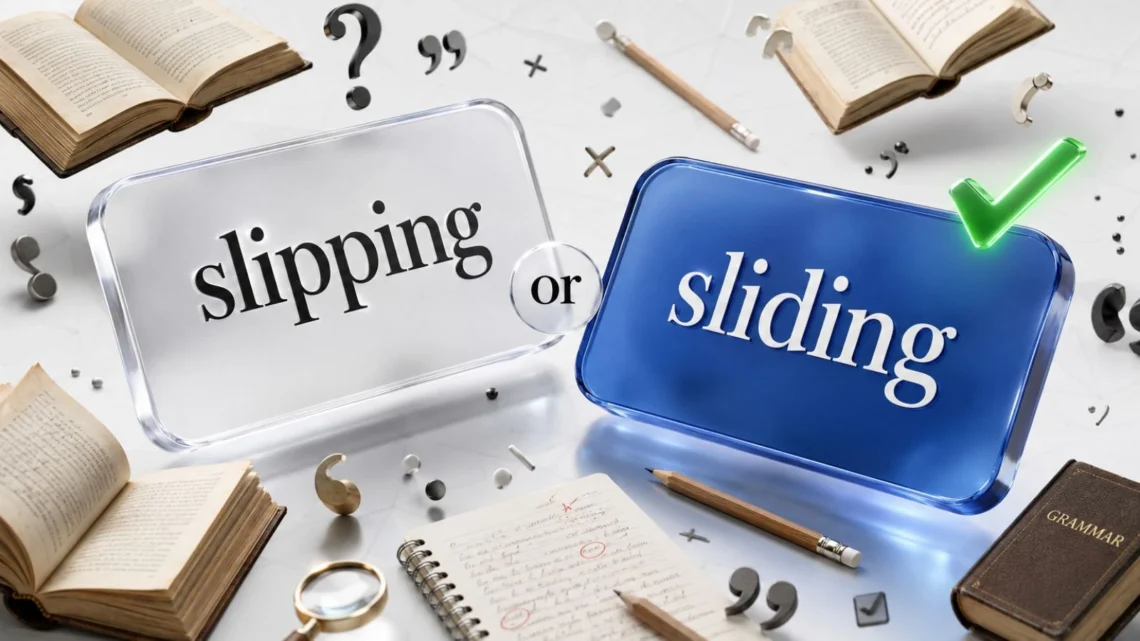
If you have ever wondered whether slipping or sliding is the better word to use, you are not alone.
These two verbs are closely related and often describe movement, but they are not always interchangeable.
Choosing the right one depends on how something moves, why it moves, and the context of your sentence.
In this guide, you shall discover the difference between slipping and sliding, learn the correct usage for everyday writing, and see clear sentence examples that make each meaning easy to understand.
We shall also explain the common mistakes people make, highlight the grammar and meaning behind each word, and help you use both terms confidently in spoken and written English.
Quick Answer
Slipping usually describes an unintentional loss of footing or grip, often caused by a wet, icy, or smooth surface. Sliding refers to moving smoothly across a surface, either intentionally or unintentionally. If someone loses balance on ice, they are slipping. If a child moves down a playground slide, they are sliding.
Slipping vs. Sliding Comparison Table
| Feature | Slipping | Sliding |
| Correct Word | ✅ Yes | ✅ Yes |
| Incorrect Word | ❌ No | ❌ No |
| Meaning | Losing grip or balance unexpectedly | Moving smoothly across a surface |
| Definition | An accidental movement caused by reduced friction | Movement while remaining in contact with a surface |
| Part of Speech | Present participle/gerund of slip | Present participle/gerund of slide |
| Grammar Rule | Used when describing accidental loss of footing or grip | Used for smooth movement over a surface |
| Correct Usage | She is slipping on the ice. | The box is sliding across the floor. |
| Incorrect Usage | The child was slipping down the playground slide. | He was sliding because he lost his footing on the wet floor. (Possible, but slipping is more precise.) |
| Pronunciation | /ˈslɪpɪŋ/ | /ˈslaɪdɪŋ/ |
| Common Mistake | Using it for intentional movement | Using it for accidental loss of balance |
| Memory Tip | Slip = Lose grip | Slide = Smooth movement |
| Example | I kept slipping on the wet sidewalk. | The puck was sliding across the ice. |
What Does “Slipping” Mean?
Slipping is the present participle of slip.
It describes losing your footing, grip, or position unexpectedly. The movement is usually accidental and often happens because a surface is slippery or because something loses traction.
Grammar Role
- Present participle
- Gerund
- Used in continuous verb tenses
- Can function as a noun
Pronunciation
/ˈslɪpɪŋ/
Examples
- She kept slipping on the icy sidewalk.
- My phone is slipping out of my hand.
- The climber avoided slipping on the wet rocks.
- His concentration was slipping during the lecture.
- We’re slipping behind schedule.
Notice that slipping can also describe figurative situations, such as losing control, falling behind, or gradually declining.
What Does “Sliding” Mean?
Sliding is the present participle of slide.
It means moving smoothly along a surface while staying in contact with it. The movement may be intentional or accidental.
Grammar Role
- Present participle
- Gerund
- Used in continuous verb tenses
- Can function as a noun
Pronunciation
/ˈslaɪdɪŋ/
Examples
- The children are sliding down the playground slide.
- The chair is sliding across the hardwood floor.
- The hockey puck is sliding across the ice.
- She enjoys sliding into home plate.
- The drawer keeps sliding open.
Unlike slipping, sliding often emphasizes the movement itself rather than losing balance.
Key Differences Between Slipping and Sliding
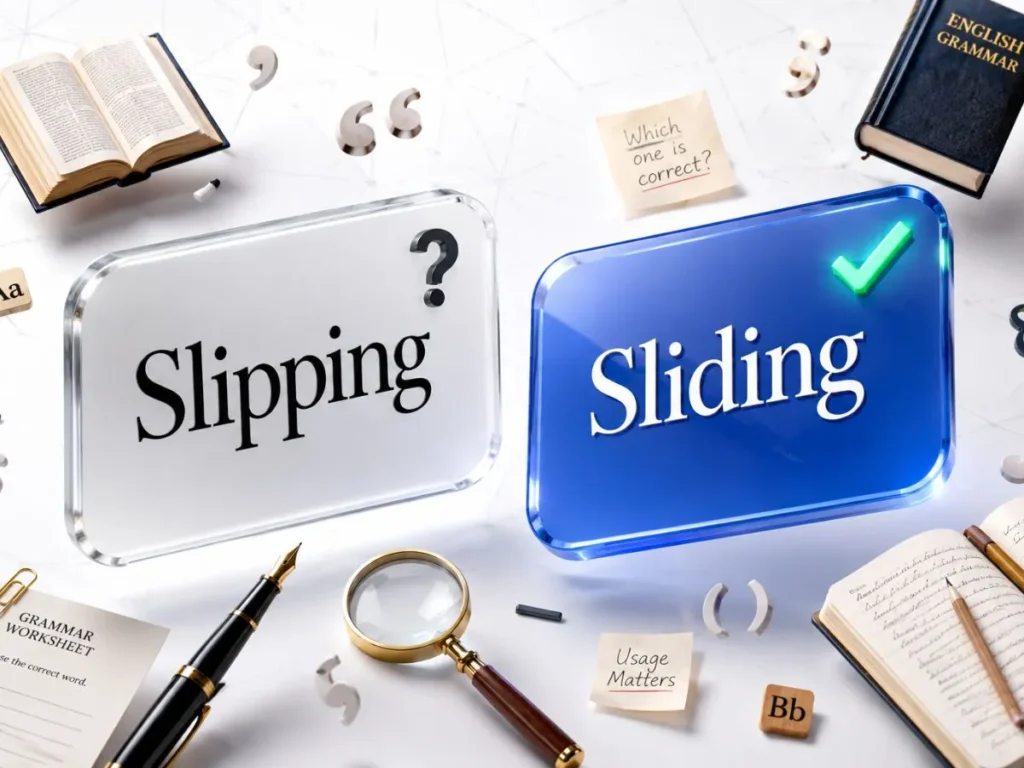
- Slipping usually happens by accident.
- Sliding can be intentional or accidental.
- Slipping often involves losing balance or grip.
- Sliding focuses on smooth movement across a surface.
- Slipping frequently suggests danger or lack of control.
- Sliding is usually neutral and simply describes motion.
Compare These Examples
- He was slipping on the wet floor. ✔️ (Lost his footing.)
- He was sliding across the dance floor. ✔️ (Intentional movement.)
- The package is sliding off the table. ✔️
- My shoe keeps slipping off my foot. ✔️
Grammar Rules for Slipping and Sliding
Both slipping and sliding are present participles formed by adding ing to their base verbs.
- slip → slipping
- slide → sliding
Rule 1: Use slipping for accidental loss of grip or footing.
Correct:
- She is slipping on the ice.
Incorrect:
- She is sliding on the ice because she lost her balance. (Possible in some contexts, but slipping better describes the loss of footing.)
Rule 2: Use sliding for movement across a surface.
Correct:
- The sled is sliding downhill.
Rule 3: Both words can be used metaphorically.
Examples:
- Sales are slipping this quarter.
- The deadline is sliding into next month.
Are There Exceptions?
Yes. Sometimes a person who slips may also slide after losing balance.
Example:
- He slipped on the ice and started sliding down the hill.
Here, both verbs describe different stages of the movement.
When to Use Each Word
Academic Writing
Use slipping when discussing loss of grip, traction, or performance.
Use sliding when describing physical movement or scientific motion.
Professional Writing
- Employee performance is slipping.
- The mechanism uses a sliding panel.
Formal English
Both words are appropriate when used according to their meanings.
Examples:
- The patient’s condition is slipping.
- The sliding door closed automatically.
Informal English
- I’m slipping behind on my homework.
- The kids are sliding down the hill.
Business Writing
- Market share is slipping.
- The sliding scale adjusts pricing automatically.
Emails
Correct:
“Our delivery schedule is slipping.”
Correct:
“The drawer should be sliding more smoothly after lubrication.”
Daily Conversation
- Be careful—you might be slipping on the wet floor.
- Look at the kids sliding across the snow.
Common Mistakes
Mistake 1
❌ She was sliding because she stepped on a banana peel.
✔️ She was slipping because she stepped on a banana peel.
Mistake 2
❌ The children were slipping down the playground slide.
✔️ The children were sliding down the playground slide.
Mistake 3
❌ The hockey puck was slipping across the ice.
✔️ The hockey puck was sliding across the ice.
Mistake 4
❌ My grades are sliding.
✔️ My grades are slipping.
Although both may appear in some contexts, slipping is the more common and natural choice for gradual decline.
Tips to Avoid Mistakes
- Think loss of balance → slipping.
- Think movement across a surface → sliding.
- If someone falls unexpectedly, choose slipping.
- If something glides smoothly, choose sliding.
Original Example Sentences
- I nearly started slipping when I stepped onto the wet tiles.
- The librarian noticed the heavy book sliding off the shelf.
- Our team’s performance has been slipping over the last month.
- The suitcase kept sliding across the airport floor.
- She avoided slipping by holding the handrail.
- The soccer player came sliding to block the shot.
- The presentation schedule is slipping because of unexpected delays.
- The dog enjoyed sliding across the frozen pond.
- My glasses keep slipping down my nose.
- The drawer is sliding much better after being repaired.
- Investors worried that profits were slipping again.
- The child laughed while sliding down the snowy hill.
- I caught the cup before it finished sliding off the counter.
- His attention was slipping during the long meeting.
- The moving truck’s ramp made loading easier by allowing boxes to keep sliding smoothly.
- She almost fell after slipping on loose gravel.
- The athlete practiced sliding safely into second base.
- Our deadline is slipping, so we need a new plan.
- The phone was sliding across the dashboard during the drive.
- He prevented himself from slipping by wearing shoes with better grip.
Memory Trick
Remember this simple phrase:
Slip = Lose Grip
Slide = Smooth Glide
If someone unexpectedly loses balance, use slipping.
If something moves smoothly across a surface, use sliding.
Mini Quiz
1. Which sentence is correct?
A. The child was slipping down the playground slide.
B. The child was sliding down the playground slide.
Answer: B
2. Which word describes losing balance?
A. Sliding
B. Slipping
Answer: B
3. Which sentence is correct?
A. My phone is slipping out of my pocket.
B. My phone is sliding out of my pocket.
Answer: A
4. Which word best describes a hockey puck moving across ice?
A. Slipping
B. Sliding
Answer: B
5. Which sentence sounds most natural?
A. Our sales are slipping.
B. Our sales are sliding.
Answer: A
FAQs
Is it slipping or sliding on ice?
If someone loses balance, the best word is slipping. If they continue moving across the ice after losing balance, they may then be sliding. The first describes the loss of footing, while the second describes the movement afterward.
Can slipping and sliding mean the same thing?
Sometimes they describe parts of the same event, but they usually emphasize different actions. Slipping focuses on the accidental loss of grip or balance, while sliding focuses on moving across a surface. In many contexts, one word is more precise than the other.
Which word is more common in everyday English?
Both are common, but they appear in different situations. People often use slipping when talking about falls, mistakes, or gradual decline. Sliding commonly describes physical movement, sports, machinery, doors, and objects moving smoothly.
Is there a difference between American and British English?
No significant difference exists. American and British English use slipping and sliding with the same meanings and grammar rules. Only individual expressions or regional preferences may vary slightly.
Can slipping be used figuratively?
Yes. Slipping often describes gradual decline, loss of control, or falling behind. Examples include slipping grades, slipping standards, or slipping from first place. These figurative uses are common in both formal and informal English.
Can sliding be used figuratively?
Yes. Sliding can describe gradual movement toward a condition or situation, such as sliding into debt or sliding toward recession. However, figurative uses of slipping are generally more common when referring to declining performance or losing position.
Key Takeaways
- Slipping means losing grip or balance unexpectedly.
- Sliding means moving smoothly across a surface.
- Slipping is usually accidental.
- Sliding may be intentional or accidental.
- Both are correct but describe different actions.
- Think Slip = Lose Grip.
- Think Slide = Smooth Movement.
- Use the word that best matches the type of movement.
Conclusion
Understanding the difference between slipping or sliding helps you choose the most accurate word for every situation.
Use slipping when someone or something unexpectedly loses grip, balance, or position.
Use sliding when describing smooth movement across a surface, whether intentional or accidental.
Once you remember that slip means lose grip and slide means smooth movement, selecting the correct word becomes simple.

Alexander Reed is an American author at WordsSign. He writes clear and well-researched articles on symbols, meanings, culture, and spiritual insights.