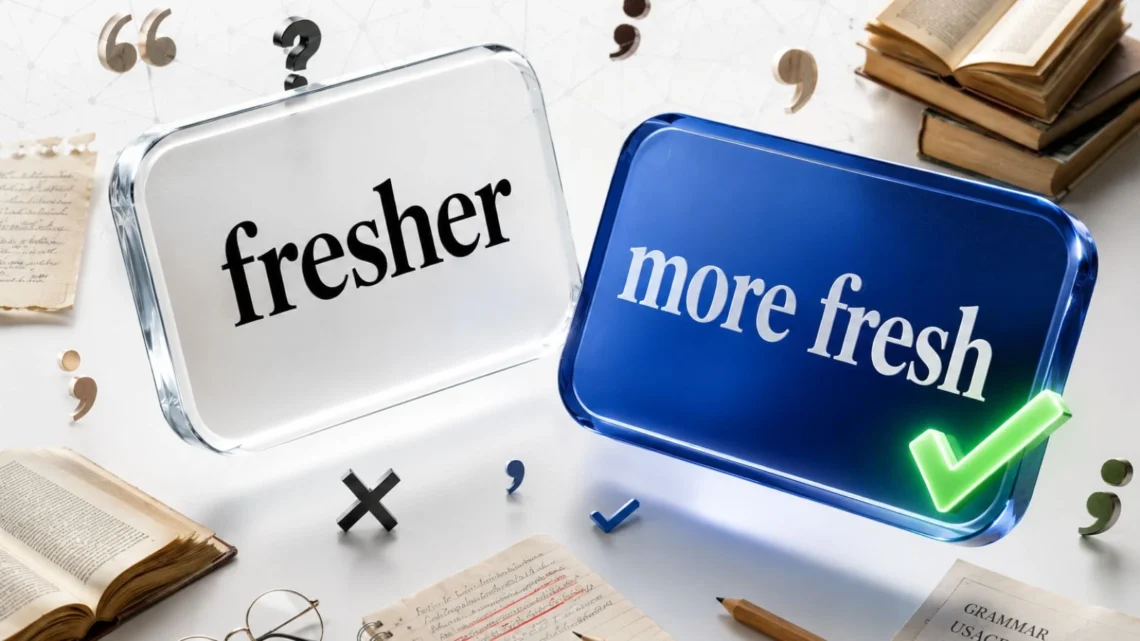
Many English learners and native speakers wonder if fresher or more fresh is the correct way to compare something.
The short answer is that fresher is the standard comparative form in most situations, while more fresh is only used occasionally for emphasis or stylistic effect.
If you are unsure which form sounds more natural, you are not alone; this is a common point of confusion in English grammar and everyday writing.
In this guide, you shall learn the difference between these two forms, the grammar rules behind them, when each is appropriate, and how to avoid common mistakes.
With clear explanations, practical sentence examples, and easy to follow tips, you shall be able to choose the correct usage confidently in both spoken and written English.
Featured Snippet (Quick Answer)
Fresher is the standard comparative form of fresh and is the correct choice in almost all situations. More fresh is grammatically possible but uncommon. It may appear when a writer wants extra emphasis or is comparing freshness in a very specific context. In everyday American and British English, fresher is the preferred form.
Fresher vs. More Fresh: Comparison Table
| Feature | Fresher | More Fresh |
| Correct Word | ✅ Yes | ✅ Grammatically possible but uncommon |
| Meaning | Having a greater degree of freshness | Having a greater degree of freshness |
| Definition | Comparative form of fresh | Comparative phrase using more + adjective |
| Part of Speech | Comparative adjective | Comparative adjective phrase |
| Grammar Rule | Add er to short adjectives | Use more mainly with longer adjectives |
| Correct Usage | Everyday speech and writing | Rare, used for emphasis or style |
| Incorrect Usage | None | Using it where fresher sounds more natural |
| Pronunciation | FRESH er /ˈfrɛʃər/ | more fresh |
| Common Mistake | None | Choosing it because it sounds more formal |
| Memory Tip | One syllable adjectives usually take er | Reserve for unusual emphasis |
| Example | This bread is fresher than yesterday’s. | This bread feels more fresh after refrigeration. (Less common) |
What Does “Fresher” Mean?
Fresher is the comparative form of the adjective fresh. It means something has a higher degree of freshness than something else.
Grammar Role
- Comparative adjective
- Used to compare two people, places, things, or ideas
Pronunciation
/ˈfrɛʃər/
Examples
- These strawberries are fresher than the ones from last week.
- I feel fresher after getting eight hours of sleep.
- Today’s coffee tastes fresher.
- The morning air feels fresher after the rain.
- This version looks fresher and more modern.
What Does “More Fresh” Mean?
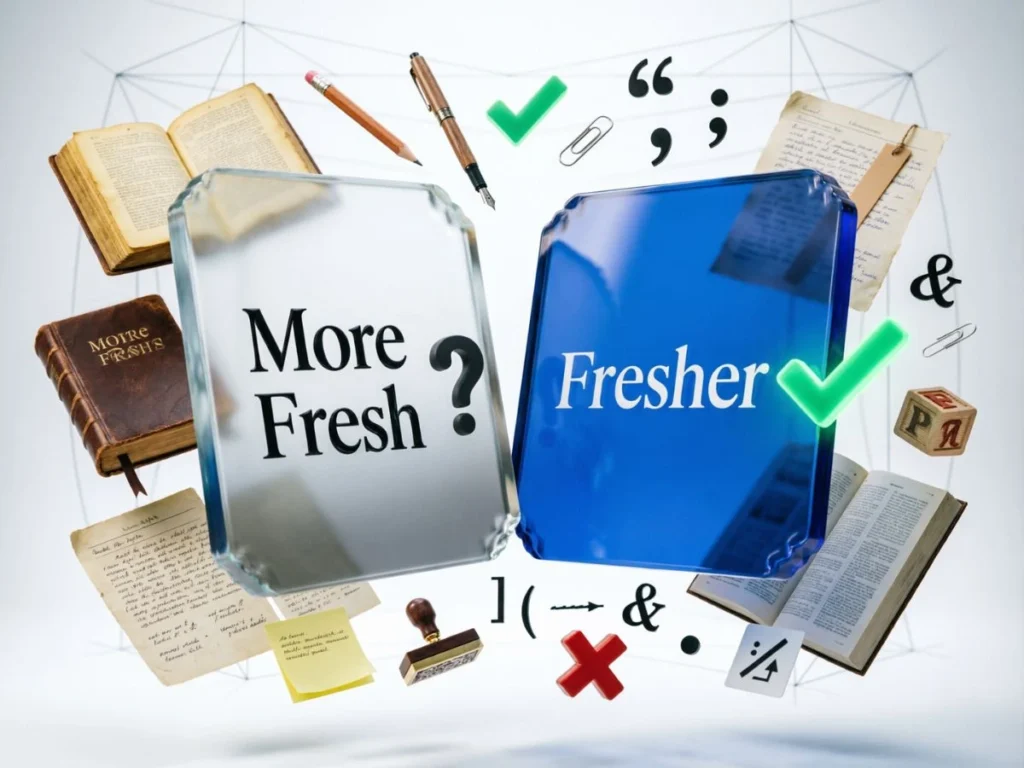
More fresh also expresses a higher degree of freshness, but it uses more instead of the ending.
Although it is grammatically acceptable, native speakers rarely choose it because fresh is a short adjective that normally forms its comparative with er.
Grammar Role
- Comparative adjective phrase
Examples
- The flowers seemed more fresh after being placed in water. (Acceptable but less natural.)
- The vegetables looked more fresh under better lighting. (Possible but uncommon.)
- Some writers use more fresh for emphasis in advertising or creative writing.
Fresher vs. More Fresh: Key Differences
- Fresher is the normal comparative form.
- More fresh is grammatically possible but uncommon.
- Native speakers overwhelmingly prefer fresher.
- One syllable adjectives usually take er, not more.
- More fresh may appear when a writer wants extra emphasis or a particular style.
- Both American and British English generally prefer fresher.
Compare These Examples
✅ This juice is fresher than yesterday’s.
❌ This juice is more fresh than yesterday’s. (Not wrong, but unnatural.)
✅ I feel fresher after my vacation.
Less natural:
I feel more fresh after my vacation.
Grammar Rules
The adjective fresh has one syllable.
Rule 1: Use er with Most Short Adjectives
Most one syllable adjectives form the comparative by adding er.
Examples:
- fresh → fresher
- small → smaller
- tall → taller
- fast → faster
- young → younger
Rule 2: Use More with Longer Adjectives
Adjectives with two or more syllables usually use more.
Examples:
- more comfortable
- more beautiful
- more interesting
- more expensive
Rule 3: Some Two Syllable Adjectives Allow Both
Certain two syllable adjectives may use either form.
Examples:
- friendlier / more friendly
- simpler / more simple
However, fresh is not one of these because it is already a one syllable adjective.
Are There Exceptions?
Yes. Writers occasionally use more fresh for rhetorical emphasis, poetic style, or marketing language. Even then, fresher usually sounds more natural.
When Should You Use Each One?
Academic Writing
Use fresher.
Example:
- Researchers used fresher samples for the second experiment.
Professional Writing
Choose fresher.
Example:
- Customers prefer fresher ingredients.
Formal English
Fresher is the preferred comparative.
Example:
- The revised proposal presents a fresher perspective.
Informal English
Native speakers naturally say fresher.
Example:
- I feel fresher today.
Business Writing
Use fresher.
Example:
- Our stores deliver fresher produce every morning.
Emails
Example:
- Could you send a fresher copy of the report with the latest edits?
Daily Conversation
Examples:
- This milk tastes fresher.
- The air feels fresher outside.
- I look fresher after a haircut.
Common Mistakes
Mistake 1: Using “More Fresh” Automatically
❌ The fruit is more fresh today.
✅ The fruit is fresher today.
Mistake 2: Thinking “More” Sounds More Formal
Many learners believe more fresh sounds are more sophisticated.
Actually, native speakers usually say:
✅ The vegetables are fresher.
Mistake 3: Ignoring Standard Comparative Rules
Remember:
Short adjective → er
Long adjective → more
Since fresh is short, choose fresher.
Original Example Sentences
- The bakery delivers fresher bread every morning.
- After a weekend break, I felt fresher at work.
- The market sells fresher vegetables than the supermarket.
- Her new ideas brought a fresher approach to the project.
- The mountain air felt fresher than the city air.
- This orange juice tastes fresher than the bottled one.
- Students produced fresher ideas during the brainstorming session.
- The updated website has a fresher design.
- The flowers looked fresher after being watered.
- The second draft sounded fresher and more engaging.
- I always choose fresher ingredients when cooking.
- Today’s newspaper offers a fresher perspective on the story.
- The café serves fresher pastries before noon.
- The renovated office has a fresher atmosphere.
- She woke up feeling fresher after a good night’s sleep.
- The company introduced a fresher marketing strategy.
- This classroom feels fresher with the windows open.
- The revised lesson includes fresher examples for students.
Memory Trick
Think of this simple rule:
Fresh is short, so add er.
Just remember:
- fresh → fresher
- fast → faster
- tall → taller
If the adjective has only one syllable, the er ending is usually your best choice.
Mini Quiz
1. Which is the standard comparative form?
A. More fresh
B. Fresher
C. Most fresh
D. Freshest
Answer: B
2. Which sentence sounds most natural?
A. This salad is more fresh.
B. This salad is fresher.
C. This salad is fresherest.
D. This salad is fresher.
Answer: B
3. Which grammar rule applies to “fresh”?
A. Always use more.
B. Never compare it.
C. Add er because it is a one syllable adjective.
D. Use most.
Answer: C
4. Which sentence is preferred in everyday English?
A. I feel more fresh today.
B. I feel fresher today.
C. I feel fresher today than yesterday.
D. I am most fresh today.
Answer: B
5. Which option is uncommon but grammatically possible?
A. Fresher
B. More fresh
C. Fresh
D. Freshest
Answer: B
FAQs
Is “fresher” grammatically correct?
Yes. Fresher is the standard comparative form of fresh. It follows the normal English rule for one syllable adjectives by adding er. It is the preferred choice in both American and British English for nearly every situation.
Is “more fresh” wrong?
Not necessarily. More fresh is grammatically possible, but it sounds less natural because fresh normally forms its comparative as fresher. Most native speakers and style guides recommend using fresher in everyday writing and conversation.
Why do people say “more fresh”?
Some speakers use more fresh for emphasis, in advertising, or because they apply the more + adjective pattern too broadly. Although understandable, it is much less common than fresher in standard English.
Is “fresher” used in American English?
Yes. American English strongly prefers fresher. It appears in everyday conversation, newspapers, academic writing, business communication, and professional publications whenever two levels of freshness are compared.
Is there any difference in meaning between “fresher” and “more fresh”?
Both express a greater degree of freshness. The difference lies mainly in style and naturalness. Fresher is the conventional comparative form, while more fresh is an uncommon alternative used only in limited contexts.
Can I use “more fresh” in formal writing?
You can, but it is generally better to use freshers. Formal writing usually follows standard comparative adjective rules, making fresher the clearer and more idiomatic choice for readers.
Key Takeaways
- Fresher is the standard comparative form of fresh.
- More fresh is grammatically possible but uncommon.
- One syllable adjectives usually take the ending.
- American and British English both prefer fresher.
- Use fresher in academic, business, professional, and everyday writing.
- Choose more fresh only for rare stylistic or rhetorical purposes.
Conclusion
When choosing between fresher or more fresh, fresher is almost always the better option.
It follows the standard grammar rule for one syllable adjectives, sounds more natural, and is widely accepted in both American and British English.
While more fresh is not strictly incorrect, it is uncommon and usually unnecessary.
If you want your English to sound fluent and natural, fresher should be your default choice.

James Holloway is an American author at WordsSign. He writes clear and well-researched articles on symbols, meanings, culture, and spiritual insights.