Have you ever wondered if “great uncle or grand uncle” is the correct way to refer to your parent’s uncle?
Both expressions may appear in everyday English, but they are not equally common or standard in all varieties of English.
In this guide, you shall learn which form is generally preferred, what each expression means, and how regional usage can affect your choice.
We shall also look at the correct grammar rule, common mistakes, and clear sentence examples so you can use the term confidently in conversation and writing.
If you are writing about a family relationship, describing a relative, or simply checking your spelling and word choice, understanding the difference between great uncle and grand uncle will help you choose the most natural expression.
Quick Answer
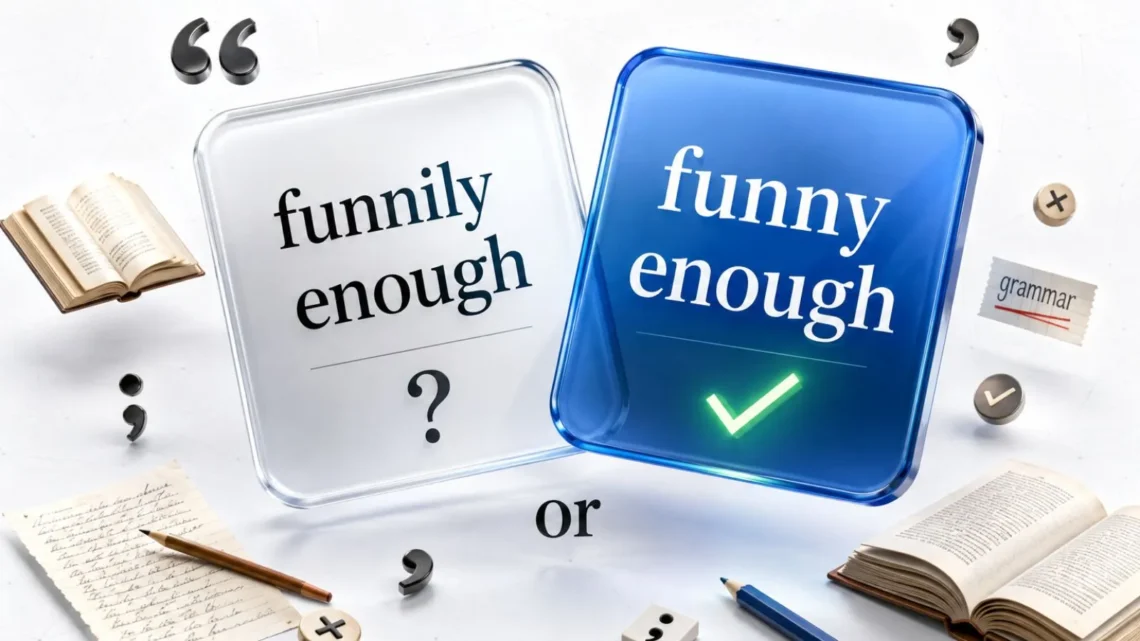
Both funnily enough and funny enough are correct English expressions.
- Funnily enough is slightly more traditional and grammatically complete.
- Funny enough is more common in everyday speech and informal writing.
Examples:
- Funnily enough, we arrived at the same time.
- Funny enough, I was just thinking about you.
Funnily Enough vs Funny Enough: Main Difference
| Word/Phrase | Meaning | Correct? | Best Used For | Example |
| Funnily enough | Surprisingly or oddly enough | ✅ Yes | Formal and informal writing, speech | Funnily enough, we chose the same answer. |
| Funny enough | Surprisingly or oddly enough | ✅ Yes | Everyday conversation and informal writing | Funny enough, I met her yesterday. |
What Does Funnily Enough Mean?
Funnily enough means surprisingly, oddly enough, or interestingly. It does not usually mean that something is humorous.
It introduces a surprising fact or coincidence.
Examples
- Funnily enough, I was about to call you.
- Funnily enough, they both wore the same color.
- Funnily enough, nobody noticed the mistake.
- Funnily enough, we grew up in the same town.
- Funnily enough, the weather changed right after we left.
What Does Funny Enough Mean?
Funny enough has the same meaning in most modern English. It also introduces something surprising or unexpected.
Many people think it is incorrect because funnily is an adverb. However, funny enough has become a well-accepted expression, especially in spoken English.
Examples
- Funny enough, I saw him this morning.
- Funny enough, we had the same idea.
- Funny enough, the bus arrived early.
- Funny enough, she remembered my birthday.
- Funny enough, we ended up at the same restaurant.
How to Use Funnily Enough or Funny Enough
Use either phrase at the beginning of a sentence to introduce an unexpected fact.
Good examples
- Funnily enough, we became friends later.
- Funny enough, I already knew the answer.
- Funnily enough, nobody complained.
- Funny enough, it worked perfectly.
Simple rules
- Use funnily enough if you want a slightly more formal style.
- Use funny enough in everyday conversation or casual writing.
- Both usually mean surprisingly, not humorously.
Avoid this mistake
If you mean that something is actually humorous, choose different wording.
Instead of:
- Funny enough, the joke was funny.
You could write:
- The joke was very funny.
- Interestingly, the joke made everyone laugh.
Where to Use Funnily Enough or Funny Enough
School writing
Funnily enough is often the safer choice because it sounds slightly more formal.
Formal writing
Funnily enough fits well in reports, essays, and articles.
Emails
Both phrases work, depending on the tone.
Everyday conversation
Funny enough is extremely common.
Messages
Both are natural in texts and chats.
Professional communication
Use funnily enough if you want a polished tone.
American English
Both expressions are common. Funny enough is especially popular in casual speech.
British English
Both are accepted, although funnily enough may appear more often in formal writing.
Canada, Australia, New Zealand, India, and Pakistan
Both phrases are understood and used. Informal speech often favors funny enough, while formal writing may prefer funnily enough.
Why People Get Confused
There are a few reasons why these phrases cause confusion.
- They have nearly the same meaning.
- They sound very similar.
- One uses an adverb (funnily) while the other uses an adjective (funny).
- Native speakers regularly use both.
- Grammar learners often expect only one form to be correct.
Common Mistakes to Avoid
Wrong:
Funny enough, it means something was hilarious.
Correct:
Funny enough, it means something was surprising.
Explanation: The phrase usually means surprisingly, not humorously.
Wrong:
Funnily enough I didn’t add a comma.
Correct:
Funnily enough, I didn’t add a comma.
Explanation: A comma after the introductory phrase makes the sentence easier to read.
Wrong:
I was funnily enough happy.
Correct:
I was happy.
or
Funnily enough, I was happy.
Explanation: The phrase works best as an introduction, not in the middle of a sentence without a clear purpose.
Wrong:
Only funnily enough is correct.
Correct:
Both funnily enough and funny enough are correct.
Explanation: Both expressions are accepted in modern English.
Real-Life Examples
Meeting
- Funnily enough, we’ve worked together before.
School
- Funny enough, everyone chose the same answer.
Travel
- Funnily enough, our flights landed at the same time.
Work
- Funny enough, my manager had the same suggestion.
Message
- Funny enough, I was just texting you.
Conversation
- Funnily enough, that’s exactly what I was thinking.
Booking
- Funny enough, there was one room left when we arrived.
Easy Trick to Remember
Think of it this way:
- Funnily enough = a slightly more formal choice.
- Funny enough = a more casual, everyday choice.
Both usually mean surprisingly enough.
Mini Quiz
1. Which phrase is correct?
Answer: Both.
2. Which one sounds slightly more formal?
Answer: Funnily enough.
3. Which phrase is common in everyday conversation?
Answer: Funny enough.
4. What do these phrases usually mean?
Answer: Surprisingly or oddly enough.
5. Is “funny enough” incorrect?
Answer: No.
6. Which sentence is correct?
A. Funny enough, we met again.
B. Funnily enough, we met again.
Answer: Both A and B.
Related Confusing Words
- canceled or cancelled
- gray or grey
- your or You are
- its or it’s
- affect or effect
- farther or further
- compliment or complement
- than or then
FAQs
Is funnily enough correct?
Yes. It is a correct and widely accepted English expression.
Is funny enough correct?
Yes. It is also correct and very common, especially in informal speech.
What is the difference between funnily enough and funny enough?
The meaning is almost identical. Funnily enough sounds slightly more formal, while funny enough is more conversational.
Which one should I use?
Use funnily enough for formal writing and funny enough for everyday conversation. Either is acceptable in most situations.
Are these phrases formal or informal?
Both can be used in everyday English. Funnily enough generally sounds a little more formal.
Conclusion
Both funnily enough and funny enough are correct English expressions. In most situations, they mean surprisingly or oddly enough, not humorously.
If you want a slightly more formal tone, choose funnily enough. For casual conversations and everyday writing, funny enough sounds perfectly natural.

James Holloway is an American author at WordsSign. He writes clear and well-researched articles on symbols, meanings, culture, and spiritual insights.