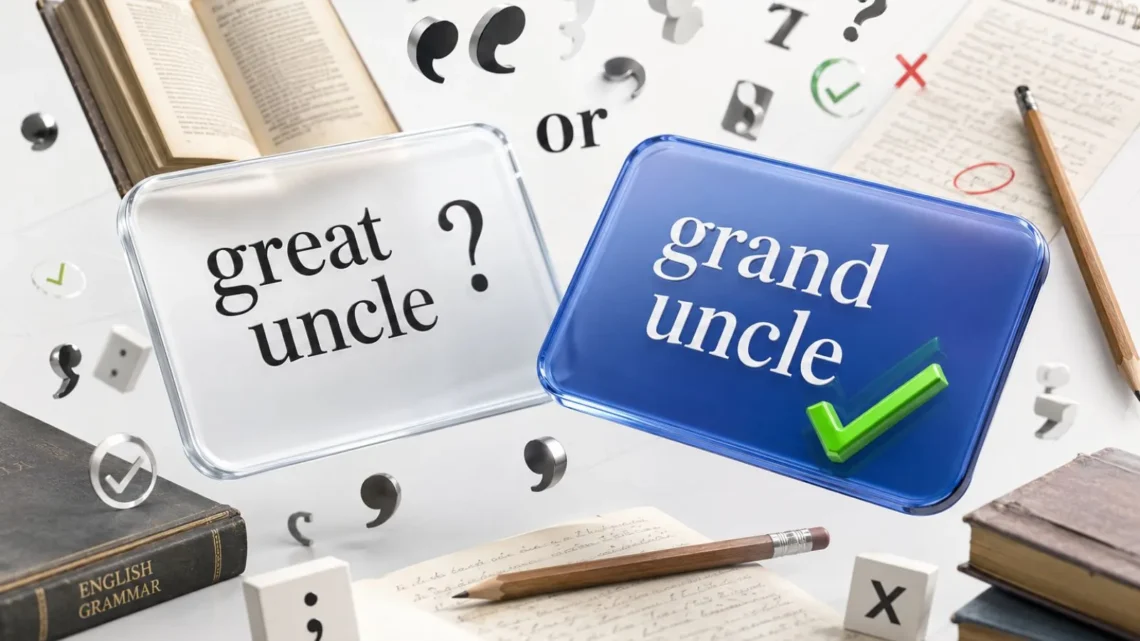
Have you ever wondered If “great uncle or grand uncle” is the correct way to refer to your parent’s uncle?
Both expressions may appear in everyday English, but they are not equally common or standard in all varieties of English.
In this guide, you shall learn which form is generally preferred, what each expression means, and how regional usage can affect your choice.
We shall also look at the correct grammar rule, common mistakes, and clear sentence examples so you can use the term confidently in conversation and writing.
If you are writing about a family relationship, describing a relative, or simply checking your spelling and word choice, understanding the difference between great uncle and grand uncle will help you choose the most natural expression.
Quick Answer
Great uncle is the most common and generally preferred spelling for your grandparent’s brother in American English. Granduncle is also correct and means the same thing, while grand uncle as two separate words is less common as a fixed kinship term. Use great uncle when you want the clearest choice.
Great Uncle vs. Grand Uncle: Comparison Table
| Feature | Great uncle | Granduncle | Grand uncle |
| Correct Word | Great uncle | Granduncle | Grand uncle |
| Standard spelling | Yes | Yes | Less standard as a fixed kinship term |
| Meaning | Your grandparent’s brother | Your grandparent’s brother | Usually intended to mean your grandparent’s brother |
| Definition | An uncle of one’s parent; specifically, a grandparent’s brother | A grandparent’s brother | An open two word version sometimes used for the same relationship |
| Part of Speech | Noun | Noun | Noun phrase |
| Grammar Rule | Use the hyphenated compound noun for the kinship relationship | Use it as a closed compound noun | Usually avoid it when referring to the established kinship term |
| Correct Usage | “My great uncle lives in Texas.” | “My granduncle lives in Texas.” | “My grand uncle lives in Texas.” is understandable but less conventional |
| Incorrect Usage | “My greatuncle lives in Texas.” in standard general usage | “My grand uncle lives in Texas.” | Treating it as the preferred standard form |
| Pronunciation | GRAYT UNG kul | GRAND UNG kul | GRAND UN kul |
| Common Mistake | Leaving out the hyphen | Assuming it is incorrect because it is one word | Assuming the open form is the usual spelling |
| Memory Tip | Great uncle = grandparent’s brother | Granduncle = same relationship, closed spelling | Think of it as a less common open form |
| Example | “Her great uncle served in the Navy.” | “Her granduncle served in the Navy.” | “Her grand uncle served in the Navy.” |
What Does “Great Uncle” Mean?
Great uncle is a noun that refers to the brother of one of your grandparents. In other words, your mother’s or father’s uncle is your great uncle.
For example, imagine this family relationship:
Your great grandparents → their child (your grandparent) → your parent → you
Your grandparent may have had a brother. That brother is your great uncle.
Examples of “Great Uncle”
- My great uncle visits us every Thanksgiving.
- I found an old photograph of my great uncle as a young man.
- Her great uncle owns a farm in Ohio.
- My father told me stories about his great uncle.
- We named the family scholarship after my great uncle.
Is “Great Uncle” Correct?
The words great uncle can appear as an ordinary combination of an adjective and noun, but when they form the established kinship term, great uncle is the clearest conventional spelling.
The hyphen helps show that great modifies uncle as part of a single compound relationship term.
Compare:
- My great uncle lives nearby. — established kinship term
- He was a great uncle to his nieces. — “great” means excellent or admirable
That second sentence has a completely different meaning.
What Does “Granduncle” Mean?
Granduncle is a noun meaning the brother of one’s grandparent. Therefore, it refers to the same family relationship as the great uncle.
The important point is that granduncle is written as one word when used as the established kinship noun.
Examples of “Granduncle”
- My granduncle lives in California.
- She remembers visiting her granduncle during summer vacations.
- His granduncle gave him the family photograph.
- Our granduncle was known for telling wonderful stories.
- I recently learned more about my granduncle’s childhood.
Although my granduncle is correct, many speakers are more familiar with my great uncle.
Great Uncle vs. Granduncle: What Is the Main Difference?
The biggest difference is form and usage, not family relationship.
- Great uncle and granduncle can refer to the same person.
- Great uncle is generally the more familiar choice in American English.
- Granduncle is a recognized alternative.
- Grand uncle as two separate words is less conventional as a fixed kinship term.
- Great uncle should not be confused with great uncle, where “great” means excellent or admirable.
The Simple Rule
If you are writing about your grandparent’s brother, use:
great uncle
You can also use:
granduncle
Both can describe the same family relationship.
Great Uncle vs. Granduncle: Grammar Rules
1. Use “great uncle” as a compound noun
When a great uncle identifies a particular family relationship, the hyphenated form makes the compound easy to recognize.
Correct:
- My great uncle lives in Boston.
- I called my great uncle yesterday.
2. “Granduncle” is written as one word
Granduncle functions as a single noun.
Correct:
- Her granduncle attended the wedding.
- I never met my granduncle.
Do not automatically change granduncle to grand uncle. The closed form is the established spelling.
3. “Great uncle” can have a different meaning
Without the hyphen, great uncle can be interpreted as an adjective plus noun rather than a family relationship.
For example:
- He was a great uncle.
This could mean he was an excellent or loving uncle, not necessarily your grandparent’s brother.
Compare:
- My great uncle gave me the watch. → a specific family relationship
- He was a great uncle to the children. → he was an excellent uncle
4. Capitalization depends on context
Family relationship terms are normally lowercase when preceded by a possessive or article:
- My great uncle lives in Florida.
- Her granduncle called yesterday.
They may be capitalized when used as a name like title before a person’s name in a particular context:
- Great Uncle Robert gave us the letter.
In ordinary writing, however, lowercase is the safe default when the term is not being used as a proper name or title.
When Should You Use “Great Uncle”?
Academic Writing
Use great uncle when describing family relationships in essays, genealogy assignments, historical writing, or biographical work.
Example:
The author dedicated the book to her great uncle, who had inspired her interest in history.
Professional Writing
In professional documents, clarity matters more than choosing an unusual variant. Great uncle is usually the most immediately recognizable option.
Example:
The estate originally belonged to my great uncle.
Formal English
Great uncle works naturally in formal English.
Example:
According to the family records, her great uncle emigrated to the United States in 1924.
Informal English
You can use great uncle in casual conversation as well.
Example:
My great uncle is coming over for dinner tonight.
Business Writing
Business documents rarely need family terms, but when they do, great uncle provides a clear and familiar description.
Example:
The company was founded by my great uncle in the 1950s.
Emails
Use whichever form fits the tone, but great uncle is usually the clearest choice.
Example:
My great uncle passed the old family business down to my father.
Daily Conversation
In everyday speech, great uncle is natural and widely understood.
Example:
I’m going to visit my great uncle this weekend.
When Should You Use “Granduncle”?
Granduncle is appropriate when you want the established one word alternative for the same relationship.
It can appear in:
- Family histories
- Genealogy writing
- Biographical writing
- Formal documents
- Books
- Everyday conversation
- Personal correspondence
For example:
My granduncle was one of the first people in our family to move west.
There is no need to avoid a granduncle simply because a great uncle is more familiar. The main consideration is consistency and clarity.
Is “Grand Uncle” Two Words Correct?
Grand uncle is understandable, but it is generally not the preferred spelling when you mean the specific family relationship.
If you are choosing between:
- great uncle
- great uncle
- grand uncle
- granduncle
the clearest choices are:
Great uncle — preferred and widely familiar
Granduncle — accepted alternative
Grand uncle — understandable but less conventional as a fixed kinship term
For polished American English, a great uncle is usually the best choice.
Why Do People Confuse Great Uncle and Granduncle?
The confusion comes partly from the way English forms extended family terms.
For example:
- parent → grandparent → great grandparent
- uncle → great uncle
- aunt → great aunt
- nephew → grandnephew
- niece → grandniece
English uses both great and grand in different family terms, so learners may reasonably wonder if great uncle and granduncle have different meanings.
In this case, they can refer to the same relationship.
Common Mistakes to Avoid
Mistake 1: Writing “greatuncle”
Incorrect or nonstandard in ordinary American English:
My great uncle lives in Arizona.
Better:
My great uncle lives in Arizona.
Mistake 2: Assuming “granduncle” is wrong
Some writers think granduncle must be a mistake because great uncle is more familiar.
Better:
Granduncle is a legitimate alternative for the same family relationship.
Mistake 3: Always writing “grand uncle”
Although readers will understand it, the open form is not the clearest choice for the established kinship term.
Better:
My great uncle sent me a letter.
or
My granduncle sent me a letter.
Mistake 4: Confusing “great uncle” with “great uncle”
These expressions can communicate different ideas.
My great uncle is visiting us.
This identifies a family relationship.
He was a great uncle.
This may mean he was an excellent uncle.
Mistake 5: Thinking “great uncle” means your grandparent
It does not.
Your grandparent is your parent’s parent.
Your great uncle is your grandparent’s brother.
18 Original Examples of “Great Uncle” and “Granduncle”
- School: Maya wrote a report about her great uncle’s experiences during the 1940s.
- Workplace: Daniel mentioned that his great uncle had started the family business.
- Business: The company remained in the family after its founder’s great uncle retired.
- Conversation: “Have you ever met your great uncle?” Sarah asked.
- Books: The novel describes a young woman who inherits a house from her great uncle.
- News: The community honored a local resident who had recently celebrated his hundredth birthday with his great uncle.
- Social Media: I finally found a photograph of my great uncle from his college years.
- Everyday English: My great uncle always brings homemade cookies when he visits.
- Genealogy: The family tree lists William as the great uncle of the children.
- History: The historian discovered that the soldier’s great uncle had served in the same regiment.
- Family Conversation: My grandmother told me that her granduncle owned a small bookstore.
- Travel: We stopped in Ohio to visit my great uncle during our road trip.
- Personal Writing: My great uncle taught me how to repair old radios.
- Biography: The writer credits her granduncle with encouraging her to pursue journalism.
- Email: I’m sending you the photograph that belonged to my great uncle.
- Celebration: Everyone gathered at the house to celebrate my great uncle’s birthday.
- Family History: According to the records, my granduncle moved to Chicago in 1910.
- Everyday Conversation: I only met my great uncle a few times, but I remember his stories.
An Easy Memory Trick
Use this simple rule:
Great uncle = grandparent’s brother.
Think of the family tree:
Grandparent → grandparent’s brother → your great uncle
For spelling, remember:
Great + uncle = great uncle
The hyphen keeps the two words together as one family relationship.
For the alternative:
Grand + uncle = granduncle
Here, the two parts combine into one word.
If you are unsure which form to choose, great uncle is the safest and most familiar option in American English.
Mini Quiz
Which word can also mean your grandparent’s brother?
A. Granduncle
B. Grandparent
C. Great nephew
D. Grandfather
Answer: B. Your grandparent’s brother
Which sentence uses “great uncle” correctly?
A. My great uncle lives in Denver.
B. My great uncle lives in Denver.
C. My great uncle lives in Denver.
D. My great uncle is always my grandparent.
Answer: A. My great uncle lives in Denver.
Which form is generally the clearest choice in American English?
A. Grand uncle
B. Great uncle
C. Great uncle
D. Greatuncle
Answer: C. Great uncle
FAQs
Is “great uncle” or “grand uncle” correct?
Great uncle is the clearest and most familiar form for the brother of your grandparent. Granduncle is also a correct alternative with the same basic meaning. The open form grand uncle is understandable but less conventional as a fixed kinship term. In polished American English, great uncle is generally the safest choice.
Is “granduncle” a real word?
Yes. Granduncle is a legitimate English noun referring to the brother of one’s grandparent. It can be used interchangeably with great uncle when describing that family relationship. The important spelling distinction is that granduncle is normally written as one word, while the more familiar alternative great uncle uses a hyphen.
Should “great uncle” have a hyphen?
Yes, great uncle is conventionally hyphenated when it functions as the compound kinship term for your grandparent’s brother. The hyphen helps distinguish the family relationship from the separate phrase great uncle, where “great” can simply describe an uncle as excellent or admirable.
What is the difference between a great uncle and a granduncle?
In ordinary family terminology, great uncle and granduncle can refer to the same relationship: your grandparent’s brother. The main difference is spelling and familiarity. Great uncle is generally more familiar to American English readers, while granduncle is a recognized one word alternative.
Is “grand uncle” grammatically correct?
Grand uncle is understandable, but it is less conventional when used as the established name for a family relationship. Granduncle is the standard closed compound alternative, while great uncle is the more familiar choice for many American English speakers. For formal or polished writing, choosing a great uncle avoids unnecessary ambiguity.
Is “great uncle” the same as “grandfather”?
No. A grandfather is your parent’s father. A great uncle is your grandparent’s brother. For example, your mother’s father is your maternal grandfather, while your mother’s father’s brother is your great uncle. Understanding the family tree relationship makes the terminology much easier to remember.
Key Takeaways
- Great uncle is the most familiar and generally preferred form in American English.
- A great uncle is your grandparent’s brother.
- Granduncle is also a legitimate word for the same relationship.
- Great uncle is normally written with a hyphen.
- Granduncle is written as one word.
- Grand uncle is understandable but less conventional as a fixed kinship term.
- Great uncle without a hyphen can have a different meaning, such as “an excellent uncle.”
- When in doubt, use great uncle for clarity and familiarity.
Conclusion
When choosing between great uncle or grand uncle, the clearest answer is great uncle.
It refers to your grandparent’s brother and is the familiar choice in American English.
Granduncle is also correct and can describe the same relationship, while grand uncle is less conventional as a fixed kinship term.
For clear, natural, and polished writing, great uncle is usually your best choice.
Related More Post
- Champing at the Bit or Chomping: Which Is Correct?
- Fix Your Heart or Die: Which Phrase Is Correct(2026)?
- Trist or Tryst: Which Word Is Correct(2026)?

Jack Ellison is an American author at WordsSign. He writes clear and well-researched articles on symbols, meanings, culture, and spiritual insights.