When talking about small snacks or appetizers, you may wonder if the correct phrase is “lite bites” or “light bites.”
Both expressions appear in menus, advertisements, and everyday writing, but they are not always used in exactly the same way.
If you are unsure which form is correct, this guide will clarify the difference, meaning, and proper usage of each phrase.
You shall learn when to use “light bites,” why “lite bites” appears in certain contexts, and how spelling and style can affect the meaning.
We shall also look at practical sentence examples and common mistakes so you can choose the right expression with confidence.
If you are writing a menu, describing food, or simply checking your English grammar, understanding this subtle difference will help you use the phrase naturally and accurately.
Quick Answer
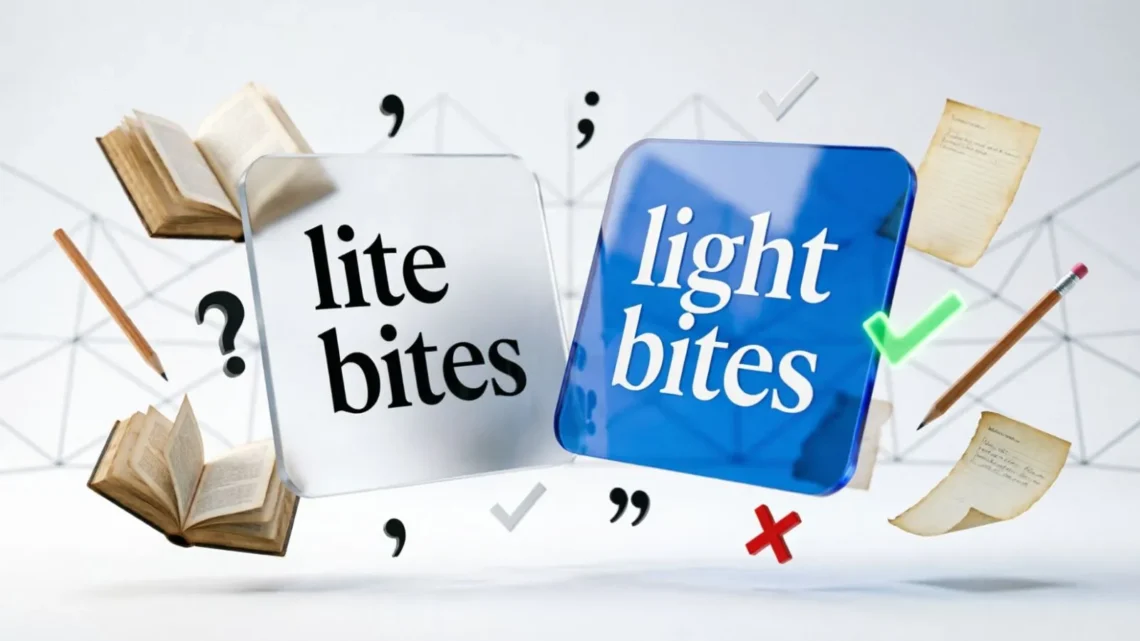
Light bites is the standard English expression for small, simple, or relatively light portions of food. Lite bites is an informal or marketing spelling that may suggest lower calories or a lighter nutritional option. Use light bites in standard, formal, academic, and professional English unless Lite is intentionally part of a brand or product name.
Lite Bites vs. Light Bites: Comparison Table
| Feature | Light Bites | Lite Bites |
| Standard English? | Yes | No, not usually |
| Meaning | Small, simple, or not heavy foods | Usually a marketing style version of “light bites” |
| Definition | Small portions or lighter foods | A stylized expression often suggesting reduced calories or a lighter product |
| Part of Speech | Light = adjective; bites = plural noun | Lite = adjective like marketing spelling; bites = plural noun |
| Grammar Rule | Uses the standard adjective light | Uses lite, an informal/nonstandard spelling in ordinary prose |
| Correct Usage | “We served light bites before dinner.” | “Lite Bites” may be acceptable as a brand name |
| Incorrect Usage | Rarely incorrect when the intended meaning is food | Generally inappropriate in formal writing when used simply to mean “light” |
| Pronunciation | Usually /laɪt baɪts/ | Usually /laɪt baɪts/ |
| Common Mistake | Assuming lite is the standard spelling | Treating lite as interchangeable with standard light |
| Memory Tip | Light is the normal English spelling | Lite is mainly a stylized or commercial spelling |
| Example | “The café offers light bites in the afternoon.” | “Lite Bites” could be the name of a snack brand |
What Does “Light Bites” Mean?
Light bites is the standard English expression. It generally refers to small portions of food, snacks, appetizers, or food that is not especially heavy or filling.
The word light has several meanings in English. When it describes food, it can indicate that the food is:
- Small in quantity
- Easy or pleasant to eat
- Not very filling
- Less rich or heavy than a full meal
- Suitable as a snack or appetizer
The word bites is the plural form of bite. In this expression, it does not necessarily mean literal individual bites. Instead, it refers broadly to small servings or snack sized foods.
Examples of “Light Bites”
- We ordered some light bites before the movie.
- The hotel serves light bites throughout the afternoon.
- Would you like some light bites with your coffee?
- The conference will offer light bites during the afternoon break.
- We prepared a few light bites for our guests.
Is “Light Bites” Grammatically Correct?
Yes. Light bites are grammatically correct and natural in standard English.
Here, light functions as an adjective modifying the plural noun bites.
light + bites = light bites
The adjective describes the type or character of the food being offered.
What Does “Lite Bites” Mean?
Lite bites uses lite, a simplified or stylized spelling of light. In ordinary standard English, lite is not normally the spelling you should choose when you simply mean light.
However, lite does appear in specific contexts, particularly:
- Advertising
- Product names
- Brand names
- Food packaging
- Restaurant marketing
- Informal commercial language
In these contexts, lite often suggests that a product has fewer calories, less fat, less sugar, or some other reduced characteristic.
For example:
Lite Bites may be used as the name of a snack product marketed as a lighter option.
The important point is that lite does not automatically mean the same thing as every meaning of light.
Examples of “Lite”
You may encounter lite in expressions such as:
- A lite version of an app
- A lite snack product
- A lite menu
- A brand called Lite Bites
These uses are often intentionally stylized rather than examples of ordinary formal English spelling.
Lite Bites or Light Bites: What Is the Difference?
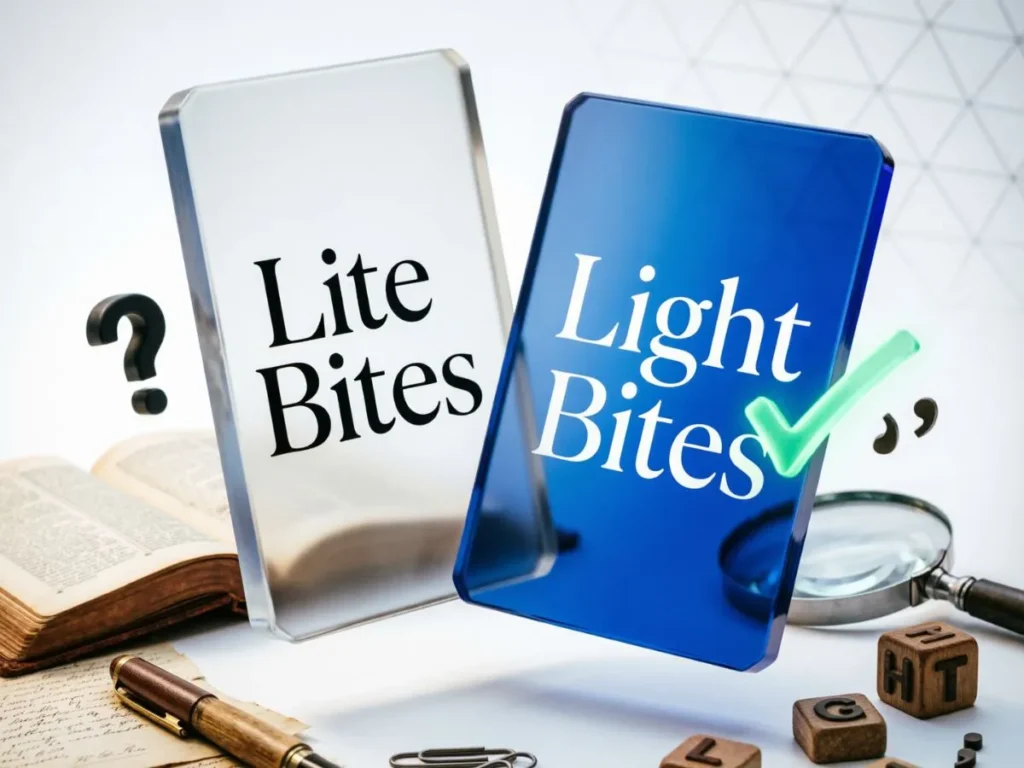
The main difference is standard spelling and intended meaning.
- Light bites is the normal English expression.
- Lite bites is generally a commercial, informal, or stylized spelling.
- Both expressions are usually pronounced the same way.
- Light is appropriate in formal and professional writing.
- Lite may be appropriate when it is deliberately used in a brand or product name.
- Lite can sometimes suggest a reduced calorie or otherwise modified product.
- Using lite simply because it sounds modern or shorter does not make it standard English.
Compare These Sentences
Standard:
The restaurant offers light bites between lunch and dinner.
Marketing style:
Try our Lite Bites snack range.
The first sentence uses standard English. The second may be perfectly acceptable if Lite Bites is an intentional product or menu name.
Grammar Rules for “Light Bites” and “Lite Bites”
The standard grammatical choice is light bites when you are describing small or relatively light foods.
Rule 1: Use “Light” in Standard English
When the adjective has its ordinary meaning, use light.
We prepared light bites for the meeting.
Not:
We prepared lite bites for the meeting.
Rule 2: “Lite” Is Usually a Stylized Spelling
Lite is commonly used as an informal or commercial spelling rather than the standard spelling of the adjective light.
Therefore, it should not normally replace light in formal prose.
Rule 3: Brand Names Can Use “Lite”
A company can intentionally choose Lite as part of a product or brand name.
For example:
The package was labeled Lite Bites.
If Lite Bites is the official name of the product, changing it to Light Bites would change the name.
Rule 4: Context Determines the Intended Meaning
The word light can describe more than calorie content.
For example:
We had light bites before dinner.
This normally means small or less substantial foods.
By contrast, a product described as lite may be marketed as having reduced calories or another reduced characteristic. However, the exact meaning depends on the product’s labeling and claims.
When Should You Use “Light Bites”?
Academic Writing
Use light bites if you need to describe small portions of food in an academic context.
Participants were offered light bites during the scheduled break.
Avoid lite unless you are referring to a specific product or brand name.
Professional Writing
Light bites work naturally in workplace communication.
Light bites will be available before the presentation.
Formal English
Use light bites in formal writing, reports, event descriptions, and official communications.
Refreshments and light bites will be served following the ceremony.
Informal English
Light bites are also completely natural in casual conversation.
I’m not hungry enough for dinner. I’ll just have some light bites.
Business Writing
Restaurants, hotels, event planners, and catering companies commonly use light bites when describing small food selections.
The package includes coffee, tea, and light bites.
Emails
For a professional email, write:
We will provide light bites during the networking session.
If Lite Bites is the actual name of a product, restaurant, or package, preserve the official spelling.
Daily Conversation
In everyday speech, light bites are the natural choice.
Let’s grab some light bites before we head home.
Why Do People Confuse “Lite Bites” and “Light Bites”?
The confusion mainly comes from the fact that lite and light are pronounced the same in this context.
They are therefore homophones: words or forms that sound alike but differ in spelling and, in some contexts, meaning.
Modern advertising also contributes to the confusion. Businesses often use shortened or stylized spellings to make product names look distinctive.
Examples include:
- light → lite
- night → nite
However, seeing a stylized spelling in advertising does not mean that it has become the standard spelling for ordinary writing.
Common Mistakes to Avoid
Mistake 1: Using “Lite” in Formal Writing
Incorrect:
The hotel provides lite bites during the conference.
Better:
The hotel provides light bites during the conference.
Mistake 2: Assuming “Lite” Is Always Wrong
That is also too broad.
If Lite Bites is a registered or official product name, brand name, restaurant name, or menu title, its spelling can be intentional.
We purchased Lite Bites, the snack brand.
Here, Lite is part of the name.
Mistake 3: Assuming “Lite” Always Means Low Calorie
Not necessarily. Lite is often used to suggest something reduced or less substantial, but the exact claim depends on the context and product.
Do not automatically interpret every use of lite as a nutritional claim.
Mistake 4: Changing a Brand Name
If a company’s official product is called Lite Bites, do not “correct” it to Light Bites when referring to the name.
Names follow their creators’ chosen spelling.
18 Original Examples of “Light Bites” and “Lite Bites”
- The teacher arranged light bites for the students after the afternoon workshop.
- We ordered a few light bites while waiting for our table.
- The conference schedule includes coffee, tea, and light bites at noon.
- She prefers light bites when she works late rather than eating a full meal.
- The café introduced a new menu featuring sandwiches, fruit, and other light bites.
- The hotel offers complimentary light bites in its executive lounge.
- After the meeting, everyone gathered in the lobby for light bites and conversation.
- The article recommends choosing light bites when you only need a small snack.
- We packed several light bites for the road trip.
- The bookstore hosted an evening event with refreshments and light bites.
- The company advertised light bites as part of its networking reception.
- He wasn’t hungry, so he chose a few light bites instead of ordering dinner.
- The news report mentioned that guests were served light bites before the ceremony.
- The chef prepared elegant light bites for the opening reception.
- A social media post invited followers to enjoy light bites at the weekend event.
- The package includes Lite Bites as a branded snack selection.
- The supermarket displayed a product labeled Lite Bites near the checkout area.
- Our catering proposal recommends light bites for the first hour of the event.
Light Bites in American English vs. British English
Light bites are understandable and acceptable in both American and British English.
There is no major spelling difference between American and British English for this particular expression.
The word light is spelled the same in both varieties.
You may also encounter related expressions such as:
- Light snacks
- Light refreshments
- Small bites
- Appetizers
- Nibbles
- Finger foods
The preferred expression can depend on the setting. In American English, appetizers are common for food served before a meal, while British English often uses starters. However, light bites remain understandable in both varieties.
“Light Bites” vs. “Small Bites”
These expressions are similar but not identical.
Light bites usually emphasize that the food is not heavy, substantial, or filling.
Small bites emphasize portion size.
For example:
We served light bites before dinner.
This suggests modest or relatively light food.
We served small bites at the reception.
This emphasizes small portions.
Sometimes both descriptions can apply to the same food.
“Light Bites” vs. “Light Snacks”
Light snacks are another natural alternative.
I usually have a light snack in the afternoon.
Light bites can sound slightly more event oriented or menu oriented.
For example:
The hotel provides light bites during happy hour.
Both expressions are grammatically correct, but the best choice depends on context and tone.
Easy Memory Trick
Remember this simple rule:
LIGHT = standard English
LITE = stylized or commercial spelling
Think of light as the normal word you would write in a sentence.
If you are describing food in an ordinary sentence, choose:
light bites
If you see Lite Bites on a package, advertisement, menu, or product label, it may be an intentional name or marketing spelling.
One Second Test
Ask yourself:
“Am I writing normal English or copying a name?”
- Normal English → light bites
- Official brand/product name → Lite Bites may be correct
Mini Quiz
1. Which sentence uses the standard expression?
A. The restaurant serves lite bites every afternoon.
B. The restaurant serves light bites every afternoon.
C. The restaurant serves lite byte every afternoon.
D. The restaurant serves light bites every afternoon.
Answer: B.
“Light bites” is the standard expression.
2. Which spelling may be appropriate for a product name?
A. Lightt
B. Lighte
C. Lite
D. Lyt
Answer: C.
“Lite” can be intentionally used in brand and product names.
3. What does “light bites” usually refer to?
A. Heavy meals
B. Small or relatively light foods
C. Cooking equipment
D. A type of dessert only
Answer: B.
“Light bites” generally means small, simple, or relatively light food selections.
4. Which sentence is best for formal writing?
A. Refreshments and lite bites will be available.
B. Refreshments and light bites will be available.
C. Refreshments and light bites will be available.
D. Refreshments and light bytes will be available.
Answer: B.
5. Why might “Lite Bites” still be correct in some contexts?
A. It is always the formal spelling.
B. It is always grammatically superior.
C. It may be an intentional brand or product name.
D. It is the British spelling.
Answer: C.
FAQs
Is “light bites” grammatically correct?
Yes. Light bites is grammatically correct and is the standard English expression for small, simple, or relatively light portions of food. Here, light functions as an adjective modifying the plural noun bites. It works naturally in formal writing, professional communication, menus, event descriptions, emails, and everyday conversation.
Is “lite bites” correct English?
Lite bites is not normally the standard spelling in ordinary English prose. Lite is generally a stylized or commercial spelling of light. However, it can be correct when it appears as an intentional brand name, product name, menu name, or other official title.
Should I write “light bites” or “lite bites”?
In ordinary writing, choose light bites. It is the standard spelling and works in both formal and informal English. Use lite bites only when you intentionally refer to a brand, product, business, or other name that uses Lite as its official spelling.
Does “lite” mean low calorie?
Not necessarily. Lite is often used in marketing to suggest that something has a reduced characteristic, such as fewer calories, less fat, or less sugar. However, the word itself does not provide a universal definition. The specific meaning depends on the product, context, and claims associated with it.
Are “light bites” and “lite bites” pronounced the same?
Usually, yes. Light and lite are pronounced /laɪt/, so light bites and lite bites normally sound identical. Their difference appears in spelling and usage rather than pronunciation. This identical pronunciation is one reason writers and speakers sometimes confuse the two forms.
Is “light bites” used in American English?
Yes. Light bites are natural and widely understandable in American English. It can describe small portions, snacks, appetizers, or relatively light foods. American English also commonly uses expressions such as light snacks, small bites, and appetizers, depending on the situation and the type of food being described.
Key Takeaways
- Light bites is the standard English expression.
- Lite bites is generally a stylized or commercial spelling.
- Use light bites in formal, academic, professional, and everyday writing.
- Light can describe food that is small, simple, less rich, or not very filling.
- Lite may appear in product names, brands, advertisements, and packaging.
- Light and lite are normally pronounced the same.
- Do not change an official brand or product name from Lite to Light.
- American and British English both use light bites.
- When in doubt, choose light bites for standard English.
Conclusion
When deciding between lite bites or light bites, choose light bites for standard English.
The expression naturally describes small, simple, or relatively light foods and works in formal writing, business communication, menus, emails, and everyday conversation.
Lite bites may still be appropriate when Lite is deliberately used in a brand, product, or marketing name.
The easiest rule to remember is simple: use “light bites” in ordinary writing, and use “lite” only when the context specifically calls for that stylized spelling.

Jack Ellison is an American author at WordsSign. He writes clear and well-researched articles on symbols, meanings, culture, and spiritual insights.