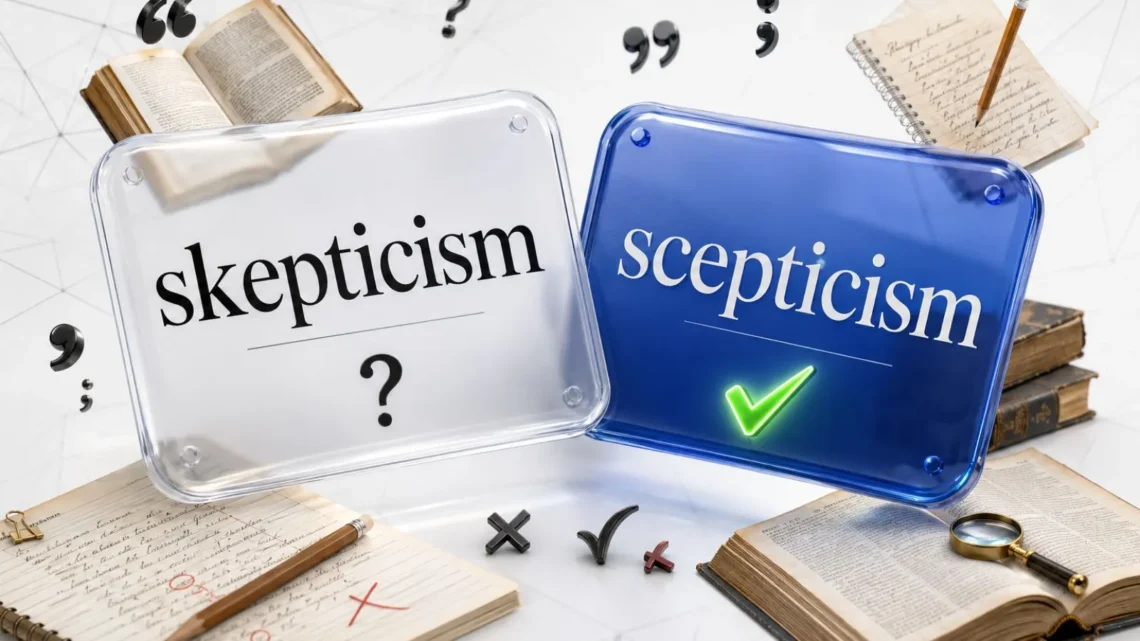
People often wonder if skepticism or scepticism is the correct spelling, especially when switching between American and British English.
The good news is that both forms are correct, but they follow different English spelling conventions.
In this guide, you shall learn the key difference between skepticism and scepticism, when to use each spelling, and why the two versions are so often confused.
We shall also look at their meaning, proper usage, pronunciation, and clear sentence examples to help you use them confidently in everyday writing.
If you are writing for an American or British audience, understanding this simple spelling difference can help you avoid common mistakes and choose the form that fits your English variety.
Featured Snippet: Skepticism or Scepticism?
Skepticism and scepticism are both correct spellings of the same noun meaning doubt or a questioning attitude. Skepticism is preferred in American English, while scepticism is standard in British English. The words have the same meaning, pronunciation, and grammatical role; only the spelling differs.
Skepticism vs. Scepticism: Comparison Table
| Feature | Skepticism | Scepticism |
| Correct Word | Yes | Yes |
| Incorrect Word | Not incorrect | Not incorrect |
| Meaning | Doubt or a questioning attitude | Doubt or a questioning attitude |
| Definition | An attitude of questioning if a claim, idea, or belief is true | An attitude of questioning if a claim, idea, or belief is true |
| Part of Speech | Noun | Noun |
| Grammar Rule | Standard American English spelling | Standard British English spelling |
| Correct Usage | Primarily American English | Primarily British English |
| Incorrect Usage | Usually not incorrect, but may conflict with a chosen style guide | Usually not incorrect, but may conflict with a chosen style guide |
| Pronunciation | /ˈskɛptɪˌsɪzəm/ | /ˈskɛptɪˌsɪzəm/ |
| Common Mistake | Assuming the British spelling is the only correct form | Assuming the American spelling is a misspelling |
| Memory Tip | Think skeptic → skepticism | Think sceptic → scepticism |
| Example | Her skepticism about the claim was understandable. | Her scepticism about the claim was understandable. |
What Does “Skepticism” Mean?
Skepticism is a noun that describes a tendency to question claims, ideas, beliefs, or information rather than accepting them immediately.
In American English, skepticism is the standard spelling.
For example:
- The scientist expressed skepticism about the results.
- His skepticism encouraged the team to examine the evidence more carefully.
- Consumers often approach unfamiliar products with skepticism.
- A healthy level of skepticism can help people recognize misleading claims.
Skepticism does not necessarily mean refusing to believe something. A skeptical person may simply want evidence, reasoning, or reliable information before accepting a claim.
Skepticism in Different Contexts
The word can describe doubt in many situations:
Science:
Scientific skepticism encourages researchers to test claims carefully.
Business:
Investors showed skepticism about the company’s ambitious forecast.
Everyday conversation:
I listened to her explanation with some skepticism.
Media:
Readers should approach sensational headlines with healthy skepticism.
The adjective is skeptical in American English:
- She is skeptical of the explanation.
- The audience remained skeptical.
The noun formed from it is skepticism.
What Does “Scepticism” Mean?
Scepticism has the same meaning as skepticism. It is the standard spelling in British English and is also used in many other English varieties influenced by British spelling.
For example:
- The scientist expressed scepticism about the results.
- His scepticism encouraged the team to examine the evidence more carefully.
- Consumers often approach unfamiliar products with scepticism.
- A healthy level of scepticism can help people evaluate questionable claims.
The British spelling also uses sceptical as the adjective:
- She is sceptical of the explanation.
- The audience remained sceptical.
Therefore:
- American English: skeptic → skeptical → skepticism
- British English: sceptic → sceptical → scepticism
What Is the Main Difference Between Skepticism and Scepticism?
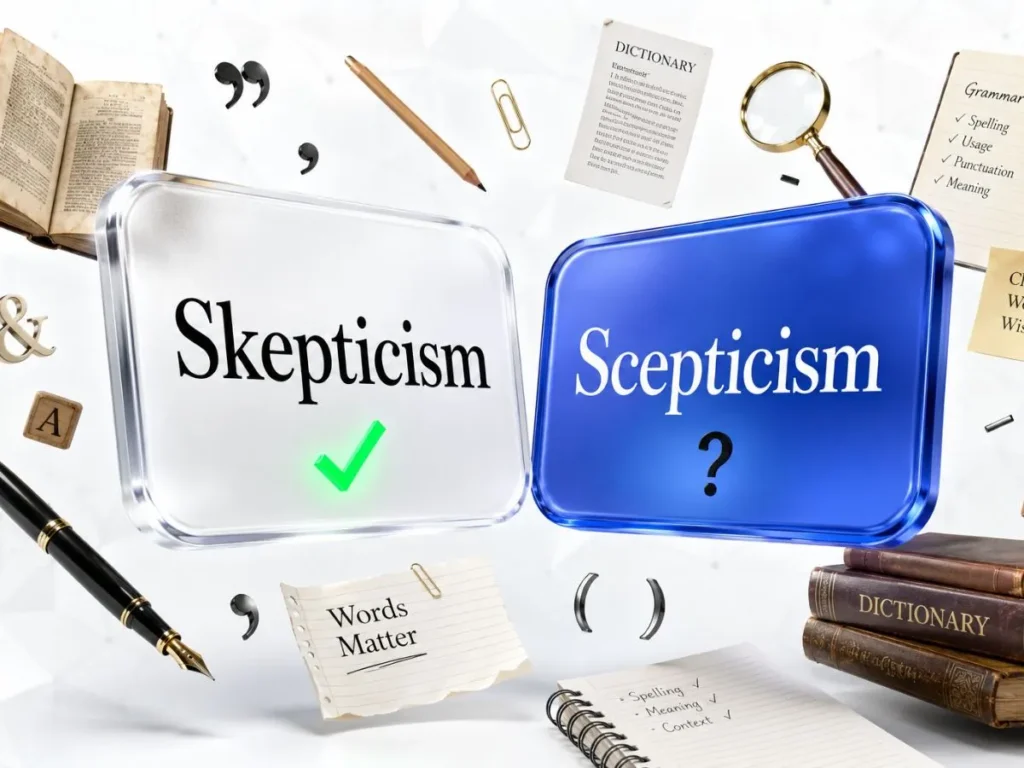
The difference is spelling, not meaning.
Here are the key differences:
- Skepticism is the preferred spelling in American English.
- Scepticism is the preferred spelling in British English.
- Both words mean a questioning attitude or doubt.
- Both are nouns.
- Both are pronounced the same in standard varieties.
- Neither spelling is inherently wrong.
- The related adjectives follow the same regional pattern: skeptical in American English and sceptical in British English.
- Your choice should normally match the variety of English used throughout your document.
Compare These Sentences
American English:
The journalist approached the claim with skepticism.
British English:
The journalist approached the claim with scepticism.
The meaning remains exactly the same.
Is Skepticism or Scepticism Correct?

Both are correct. The appropriate spelling depends on the variety of English you are using.
If you are writing for an American audience, use skepticism.
If you are writing for a British audience, use scepticism.
For example:
- US: There was considerable skepticism about the proposal.
- UK: There was considerable scepticism about the proposal.
Neither sentence is grammatically wrong.
The important rule is consistency. If a document follows American English, use American spellings throughout. If it follows British English, use British spellings throughout.
American English vs. British English
The difference between skepticism and scepticism is part of a broader spelling pattern.
| American English | British English |
| skeptic | sceptic |
| skeptical | sceptical |
| skepticism | scepticism |
This pattern differs from some other British American spelling differences where the ending changes, such as color/colour or organize/organise. In this case, the main distinction is the presence of k versus c in the word family.
Which Spelling Should You Use?
Choose skepticism when:
- You are writing for readers in the United States.
- Your publication follows American English.
- Your organization’s style guide uses American spelling.
- You are preparing American academic or business material.
Choose scepticism when:
- You are writing for readers in the United Kingdom.
- Your publication follows British English.
- Your organization uses British spelling.
- You are following a British style editorial guide.
Grammar Rules for Skepticism and Scepticism
There is no difference in grammar between the two forms.
Both skepticism and scepticism are uncountable nouns when they refer generally to an attitude or state of doubt.
For example:
- There is growing skepticism about the proposal.
- There is growing scepticism about the proposal.
You can also use the words with modifiers:
- healthy skepticism
- deep skepticism
- reasonable skepticism
- scientific skepticism
- public skepticism
- widespread scepticism
- considerable scepticism
Using the Word With “About”
One common construction is:
skepticism about + noun
- There is skepticism about the new policy.
- Her skepticism about the claim was justified.
In British English:
- There is scepticism about the new policy.
- Her scepticism about the claim was justified.
Using the Word With “Toward” or “Towards”
Both toward and towards can be used depending on regional preference and style.
- His skepticism toward the proposal was obvious.
- Her scepticism towards the explanation was understandable.
The spelling of skepticism/scepticism remains the same according to the variety of English being used.
“Skepticism” Is Not the Same as Cynicism
These words are related but not identical.
Skepticism generally involves questioning if something is true or reliable.
Cynicism often involves assuming that people or institutions are motivated by self interest, dishonesty, or bad intentions.
For example:
- Her skepticism led her to ask for evidence.
- His cynicism made him assume that the company was deliberately misleading customers.
A skeptical person wants proof. A cynical person may already suspect a negative motive.
When Should You Use Skepticism?
Academic Writing
Use skepticism in American academic writing when discussing critical evaluation, evidence, scientific claims, philosophy, or research.
Example:
Researchers should approach extraordinary claims with appropriate skepticism.
In British academic writing, use scepticism instead.
Professional Writing
In American professional documents, skepticism is appropriate and natural.
Example:
The proposal initially faced skepticism from senior managers.
For a British audience:
The proposal initially faced scepticism from senior managers.
Formal English
Both forms are suitable for formal English. The correct choice depends on the regional variety.
Neither word is informal or slang.
Business Writing
American business writing normally uses skepticism.
Example:
The company’s new strategy was met with some skepticism by investors.
British business writing normally uses scepticism.
Emails
The appropriate spelling depends on your audience and your organization’s preferred style.
American:
I understand your skepticism, but the latest figures support the proposal.
British:
I understand your scepticism, but the latest figures support the proposal.
Daily Conversation
Both forms can describe doubt in ordinary conversation.
American:
I’m a little skeptical about that story.
British:
I’m a little sceptical about that story.
The noun versions are also common:
She listened with skepticism.
She listened with scepticism.
Why Do People Confuse Skepticism and Scepticism?
The confusion usually comes from differences between American and British spelling conventions.
Many learners encounter skeptic, skeptical, and skepticism in American media, books, websites, and software. At the same time, British textbooks and publications commonly use sceptic, sceptical, and scepticism.
Because the pronunciation is the same, the spelling difference can be easy to overlook when learning English through speech.
Another source of confusion is that people sometimes assume one spelling must be a simple misspelling of the other. That is not the case. Both forms are established standard spellings.
Common Mistakes to Avoid
Mistake 1: Calling “Scepticism” Incorrect
Incorrect assumption:
Scepticism is a misspelling.
Better understanding:
Scepticism is the standard British spelling.
Mistake 2: Calling “Skepticism” Incorrect
Incorrect assumption:
Skepticism is wrong because British English uses scepticism.
Better understanding:
Skepticism is the standard American spelling.
Mistake 3: Mixing Regional Spellings
A document should normally follow one consistent variety of English.
For example, an American style document might use:
- skeptic
- skeptical
- skepticism
A British style document might use:
- sceptic
- sceptical
- scepticism
Mixing varieties is not always a grammatical error, but it can make formal writing look inconsistent.
Mistake 4: Assuming the Words Have Different Meanings
They do not.
Skepticism and scepticism refer to the same concept. The difference is regional spelling.
Mistake 5: Changing the Pronunciation
The words generally have the same pronunciation. The difference is written rather than spoken.
20 Original Examples of Skepticism and Scepticism
School
- The students approached the surprising historical claim with healthy skepticism.
- Her scepticism encouraged the class to check the source before accepting the information.
Workplace
- The manager initially expressed skepticism about changing the company’s reporting system.
- Several employees viewed the proposed schedule with scepticism.
Business
- Investors responded with skepticism when the startup announced unusually high growth projections.
- Customer scepticism declined after the company published independent test results.
Everyday Conversation
- I have some skepticism about that online review because it seems too enthusiastic.
- His scepticism disappeared after he saw the results for himself.
Books
- The novel’s narrator treats every strange event with skepticism.
- The historian’s scepticism gives the book a careful and analytical tone.
News
- The report was met with skepticism because it provided little supporting evidence.
- Public scepticism grew after officials changed their explanation several times.
Social Media
- A little skepticism is useful when a post makes an extraordinary claim.
- She responded to the viral story with scepticism and asked for a reliable source.
Science
- Scientific skepticism encourages researchers to test explanations rather than accept them automatically.
- His scepticism led him to examine the experimental data more closely.
Everyday Life
- With some skepticism, Maya agreed to try the unfamiliar recipe.
- Tom listened with scepticism when his friend described the supposedly effortless investment strategy.
Formal Writing
- The committee expressed skepticism about if the proposed deadline was realistic.
- The article examines public scepticism toward the government’s new policy.
Easy Memory Trick: K for American, C for British
A simple way to remember the difference is:
American English → skepticism → K
British English → scepticism → C
You can also remember the entire word family:
American:
- skeptic
- skeptical
- skepticism
British:
- sceptic
- sceptical
- scepticism
Think of the K in skeptic as a clue to the American forms.
If your document uses American English, choose skepticism. If it uses British English, choose scepticism.
Mini Quiz
1. Which spelling is standard in American English?
A. Scepticism
B. Skepticism
C. Sceptisism
D. Skeptisism
Answer: B. Skepticism
2. Which spelling is standard in British English?
A. Skepticism
B. Skeptisism
C. Scepticism
D. Sceptisizm
Answer: C. Scepticism
3. What is the main difference between skepticism and scepticism?
A. Their meanings
B. Their pronunciation
C. Their grammatical function
D. Their regional spelling
Answer: D. Their regional spelling
4. Which sentence follows American English spelling?
A. She expressed scepticism about the claim.
B. She expressed skepticism about the claim.
C. She expressed sceptisism about the claim.
D. She expressed skeptisism about the claim.
Answer: B. She expressed skepticism about the claim.
5. Are skepticism and scepticism both correct?
A. No, only skepticism is correct.
B. No, only scepticism is correct.
C. Yes, but they belong to different spelling conventions.
D. No, one is a verb.
Answer: C. Yes, but they belong to different spelling conventions.
FAQs
Is “skepticism” or “scepticism” correct?
Both skepticism and scepticism are correct. Skepticism is the standard American English spelling, while scepticism is the standard British English spelling. They have the same meaning, pronunciation, and grammatical role. The best choice depends on the variety of English and style guide you are following.
Is skepticism American or British English?
Skepticism is primarily the standard American English spelling. British English generally uses scepticism. The related adjective follows the same distinction: American English uses skeptical, while British English uses sceptical. Both forms are standard, so neither should automatically be considered a spelling mistake.
Is scepticism a British spelling?
Yes. Scepticism is the standard British English spelling of the noun. British English also uses sceptic and sceptical. American English generally replaces the c with k, producing skeptic, skeptical, and skepticism.
Do skepticism and scepticism have the same meaning?
Yes. Skepticism and scepticism have the same meaning: an attitude of questioning, doubt, or reluctance to accept a claim without sufficient evidence. The difference is spelling rather than meaning. Your choice should reflect if you are writing in American English, British English, or another English variety.
How do you spell skepticism in the UK?
In British English, the standard spelling is scepticism, with a c rather than a k. The related words are sceptic and sceptical. For example: The journalist approached the claim with scepticism. In American English, the corresponding spelling is skepticism.
Can I use skepticism in British English?
You may encounter skepticism in British English, especially in international publications or contexts influenced by American English, but scepticism is the conventional British spelling. If you are writing specifically for a British audience or following a British style guide, scepticism is generally the better choice.
Key Takeaways
- Skepticism and scepticism are both correct.
- Skepticism is the standard American English spelling.
- Scepticism is the standard British English spelling.
- Both words mean doubt or a questioning attitude.
- Both are nouns.
- They generally have the same pronunciation.
- The related American forms are skeptic and skeptical.
- The related British forms are sceptic and sceptical.
- Neither spelling is inherently incorrect.
- Match the spelling to your audience, regional variety, or style guide.
- Consistency matters more than choosing one form as universally “correct.”
Conclusion
The choice between skepticism or scepticism depends on the variety of English you are using.
Skepticism is the standard American spelling, while scepticism is the standard British spelling. Both words have the same meaning, pronunciation, and grammatical function.
If you are writing in US English, choose skepticism.
If you are following British English conventions, choose scepticism.
Once you remember K for the American form and C for the British form, the difference becomes easy to remember.

Alexander Reed is an American author at WordsSign. He writes clear and well-researched articles on symbols, meanings, culture, and spiritual insights.