If you’ve ever wondered whether “in the same vein” or “in the same vain” is correct, you’re not alone.
This commonly confused phrase trips up many English writers because the two words sound identical but have very different meanings.
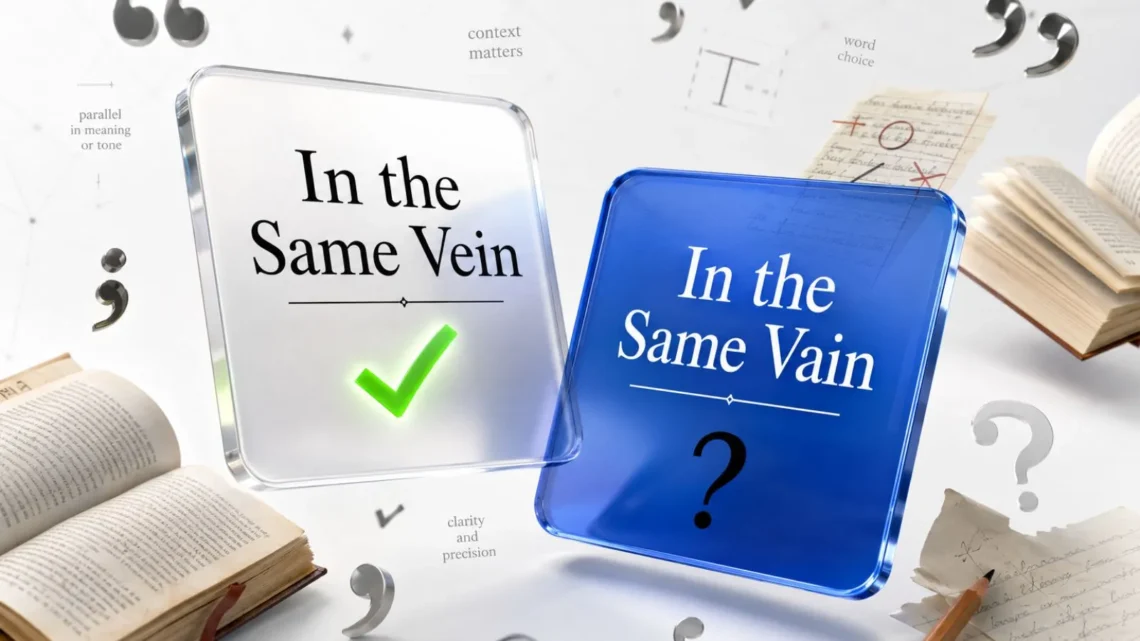
The short answer is that “in the same vein” is the correct expression, while “in the same vain” is almost always a spelling mistake.
In this guide, you’ll learn the difference in meaning, why people mix them up, and how to use the correct phrase with confidence.
We’ll also cover the grammar rule, real sentence examples, common writing mistakes, and simple tips to help you remember the proper usage in everyday English.
Quick Answer
In the same vein is the correct English expression. It means in a similar style, manner, or idea.
In the same vain is incorrect because vain has a completely different meaning.
Examples:
- We continued the discussion in the same vein.
- Her second novel was written in the same vein as the first.
In the Same Vein vs In the Same Vain: Main Difference
| Word/Phrase | Meaning | Correct? | Best Used For | Example |
| In the same vein | In a similar style, idea, or approach | ✅ Yes | Writing, speaking, discussions | The sequel is written in the same vein as the original. |
| In the same vain | No accepted meaning in this expression | ❌ No | Avoid using it | She spoke in the same vain. (Incorrect) |
What Does “In the Same Vein” Mean?
In the same vein means following the same style, theme, tone, or way of thinking.
The phrase comes from the idea of a vein as a channel or line running through something. In writing and speech, it refers to continuing along the same line of thought.
Examples
- The teacher continued the lesson in the same vein.
- His latest movie is in the same vein as his earlier comedies.
- She answered my question in the same vein.
- The second article was written in the same vein as the first.
- Our conversation stayed in the same vein throughout dinner.
What Does “In the Same Vain” Mean?
In the same vain is not a correct English expression.
The word vain usually means:
- Too proud of your appearance or abilities.
- Having no result or success (as in in vain, meaning “without success”).
Because vain sounds exactly like vein, many people accidentally replace one with the other.
Incorrect Examples
- ❌ We continued the discussion in the same vain.
- ❌ Her speech was delivered in the same vain.
- ❌ The report followed in the same vain.
Correct Versions
- ✅ We continued the discussion in the same vein.
- ✅ Her speech was delivered in the same vein.
- ✅ The report followed in the same vein.
How to Use “In the Same Vein”
Use in the same vein whenever you want to describe something that continues a similar idea, style, tone, or approach.
Use it when talking about:
- books
- movies
- conversations
- speeches
- articles
- presentations
- ideas
- jokes
Correct Examples
- The new policy follows in the same vein as the previous one.
- Let’s continue in the same vein.
- His comments were in the same vein as earlier remarks.
Avoid
❌ In the same vain
Remember that vain does not fit this expression.
Where to Use “In the Same Vein”
You can use in the same vein in many situations.
School Writing
- The second paragraph develops the argument in the same vein.
Formal Writing
- The report continues in the same vein as last year’s analysis.
Emails
- I’d like to continue our discussion in the same vein.
Everyday Conversation
- The conversation stayed in the same vein all evening.
Messages
- Let’s keep the discussion in the same vein.
Professional Communication
- The proposal follows in the same vein as our previous recommendations.
Regional Usage
Unlike spelling differences such as gray/grey or canceled/cancelled, in the same vein is the standard phrase in:
- American English
- British English
- Canadian English
- Australian English
- New Zealand English
- Indian English
- Pakistani English
The phrase is the same across these varieties of English.
Why People Get Confused
There are several reasons why people mix these phrases up.
- Vein and vain sound exactly the same.
- People often hear the phrase before seeing it written.
- Spell check may not catch the mistake because vain is a real word.
- Many people know the phrase in vain, which makes the confusion even easier.
Common Mistakes to Avoid
Wrong:
We discussed the topic in the same vain.
Correct:
We discussed the topic in the same vein.
Why: The expression always uses vein.
Wrong:
Her speech continued in the same vain.
Correct:
Her speech continued in the same vein.
Why: The phrase means “in a similar style.”
Wrong:
The movie is in the same vain as the original.
Correct:
The movie is in the same vein as the original.
Why: Use vein when comparing style or theme.
Wrong:
Let’s stay in the same vain.
Correct:
Let’s stay in the same vein.
Why: Vain changes the meaning and makes the phrase incorrect.
Real-Life Examples
Meeting
Let’s continue the discussion in the same vein.
School
Your second paragraph should follow in the same vein as your introduction.
Travel
The rest of our trip went in the same vein, with plenty of sightseeing.
Work
The new project is in the same vein as last year’s campaign.
Message
Your latest text was in the same vein as your earlier message.
Conversation
Everyone kept speaking in the same vein.
Booking
The hotel recommendations were in the same vein as the ones you shared earlier.
Social Situation
The evening stayed in the same vein, with everyone enjoying light conversation.
Easy Trick to Remember
Think of vein as a line running through something.
If you’re talking about continuing the same line of thought, use vein.
Same line = same vein.
Mini Quiz
1. Which phrase is correct?
Answer: In the same vein.
2. Which word means “similar style or approach”?
Answer: Vein.
3. Is “in the same vain” correct?
Answer: No.
4. Which sentence is correct?
A. The article is in the same vain.
B. The article is in the same vein.
Answer: B.
5. Are “vein” and “vain” pronounced the same?
Answer: Yes.
6. Which phrase should you use in formal writing?
Answer: In the same vein.
Related Confusing Words
- gray or grey
- canceled or cancelled
- your or you’re
- its or it’s
- there or their
- affect or effect
- bare with me or bear with me
- then or than
FAQs
Is in the same vein correct?
Yes. It is the standard and correct English expression.
Is in the same vain correct?
No. It is a common spelling mistake.
What is the difference between vein and vain?
Vein refers to a channel or is used in the expression in the same vein, meaning a similar style. Vain means overly proud or without success in the phrase in vain.
Which one should I use?
Use in the same vein whenever you mean in a similar way, style, or idea.
Is in the same vein formal or informal?
It works well in both formal and informal English.
Conclusion
The correct phrase is in the same vein.
It means in a similar style, manner, or line of thought.
In the same vain is a common spelling mistake because the two words sound alike.
Whenever you’re comparing ideas, writing, conversations, or themes, always choose in the same vein.
Discover More Post
- Is It Alternately or Alternatively? The Correct Word Explained?
- Impressed With or By: Which Is Correct to Use(2026)?
- When to Use Compare To or With in English Grammar(2026)?

James Holloway is an American author at WordsSign. He writes clear and well-researched articles on symbols, meanings, culture, and spiritual insights.