If you’ve ever wondered whether to use Compare To or With, you’re not alone.
These two expressions often cause confusion because both are correct, but they serve slightly different purposes in English grammar and writing.
Knowing the difference can make your comparisons clearer, more natural, and better suited to your audience.
In this guide, you’ll discover when to use each phrase, why writers sometimes choose one over the other, and whether the choice depends on style or regional preference.
We’ll also cover the grammar rule, common mistakes, and practical sentence examples so you can confidently use the correct form in everyday writing without second-guessing yourself.
Quick Answer
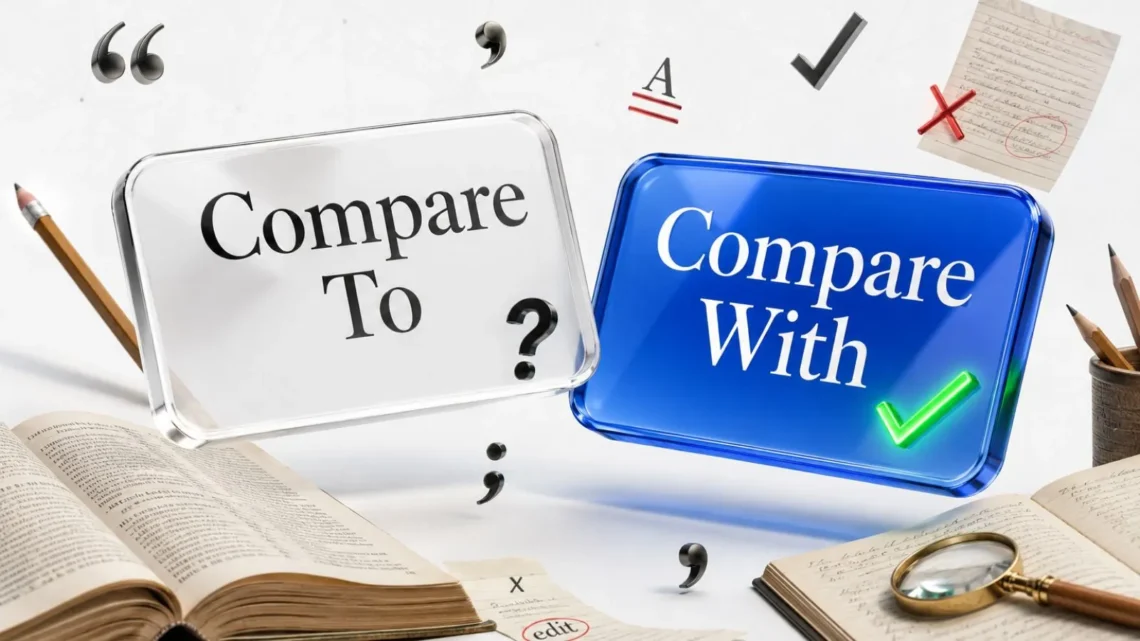
Both compare to and compare with are correct.
- Compare is usually used to show that two different things are similar.
- Compare with is usually used to examine the similarities and differences between two things.
Examples:
- She compared her teacher to a superhero.
- Let’s compare this phone with the older model.
Compare To vs Compare With: Main Difference
| Word/Phrase | Meaning | Correct? | Best Used For | Example |
| Compare to | Shows similarity between different things | ✅ Yes | Making comparisons or using figures of speech | He compared life to a journey. |
| Compare with | Examines similarities and differences | ✅ Yes | Careful analysis or evaluation | Compare this report with last year’s report. |
What Does Compare To Mean?
Compare to means to say that one thing is similar to another, even if they are different.
It often appears in writing, speeches, poetry, and everyday conversation.
Examples
- She compared her brother to a lion because he is brave.
- Many people compare the internet to a huge library.
- The coach compared the team to a family.
- His voice was compared to silk.
- People often compare successful leaders to great teachers.
What Does Compare With Mean?
Compare with means to examine two or more things to find their similarities and differences.
It is common in school, business, research, reviews, and shopping.
Examples
- Compare this year’s sales with last year’s.
- We compared our answers with the teacher’s.
- Compare the prices with other stores.
- Students compared the two poems with each other.
- Before buying, compare this laptop with similar models.
How to Use Compare To or With
Use compare when you want to highlight a similarity.
Correct:
- She compared her son to a young Einstein.
- The movie was compared to a classic film.
Use compare when you want to study or evaluate two things.
Correct:
- Compare the two essays with each other.
- We compared the results with previous data.
Avoid These Mistakes
❌ Compare this phone to the previous model before buying.
✅ Compare this phone with the previous model before buying.
❌ The poet compared love with the ocean.
✅ The poet compared love to the ocean.
Where to Use Compare To or With
School Writing
- Compare with is common when analyzing books, essays, or subjects.
- Compare to is used for creative writing and literary comparisons.
Formal Writing
Both are acceptable when used correctly.
Emails
- Compare prices with other suppliers.
- The manager compared our progress with last month’s results.
Everyday Conversation
Both phrases are common depending on the meaning.
Messages
- Compare it with mine.
- You always compare me to my brother!
Professional Communication
Reports and business documents are usually used compared with for analysis.
American English
American English generally follows the same distinction, although many writers use the two phrases interchangeably.
British English
British English also uses both forms with the same general meanings.
Canada, Australia, India, Pakistan, and New Zealand
English speakers in these regions generally follow the same usage:
- Compared to similarity.
- Compare with for detailed comparison.
Why People Get Confused
People confuse these phrases because both involve comparing things.
Other reasons include:
- They look very similar.
- Many people use them interchangeably in casual speech.
- Some dictionaries accept both in certain contexts.
- The difference is based more on meaning than grammar.
Common Mistakes to Avoid
Wrong:
Compare this camera to the old model before buying.
Correct:
Compare this camera with the old model before buying.
Explanation: You are evaluating two cameras.
Wrong:
The writer compared hope with a bright star.
Correct:
The writer compared hope to a bright star.
Explanation: This expresses similarity.
Wrong:
Please compare your homework to your partner’s answers.
Correct:
Please compare your homework with your partner’s answers.
Explanation: You are checking differences.
Wrong:
Teachers compared the two students to each other.
Correct:
Teachers compared the two students with each other.
Explanation: They are being examined side by side.
Real Life Examples
Meeting
Let’s compare this proposal with last month’s plan.
School
Compare your answers with the answer key.
Travel
Compare hotel prices with different websites.
Work
The manager compared this quarter’s sales with last year’s.
Message
Don’t compare yourself to others.
Conversation
People often compare siblings to each other.
Shopping
Always compare products with similar models before buying.
Social Situation
She compared her best friend to a sister.
Easy Trick to Remember
Think of this simple rule:
- Compare to = Similarity
- Compare with = Examination
If you are showing likeness, use it.
If you are checking differences, use with.
Mini Quiz
1. Which sentence is correct for analyzing two books?
Answer: Compare the two books with each other.
2. Which sentence shows similarity?
Answer: He compared his father to a hero.
3. Which preposition is better for checking prices?
Answer: With
4. Which phrase is often used in poetry?
Answer: Compare to
5. Which phrase is common in reports?
Answer: Compare with
6. Fill in the blank:
Please compare your answer ___ mine.
Answer: with
Related Confusing Words
- Different from or Different than
- Like or As
- Among or Between
- Affect or Effect
- Your or you are
- Its or it is
- Fewer or Less
- Then or Than
FAQs
Is this correct?
Yes. Use it to show that two different things are similar.
Is this correct?
Yes. Use it when examining similarities and differences.
What is the difference between compare to and compare with?
Compare to highlight similarity, while comparing with analyzes or evaluating two things.
Which one should I use?
Choose compare to for resemblance and compare with for careful comparison.
Are both formal?
Yes. Both are correct in formal and informal English when used appropriately.
Conclusion
Both compare to and compare with are correct, but they serve different purposes.
Use compared to when pointing out similarities, especially in creative or figurative language.
Use compare when examining two things side by side to find similarities and differences. Remember this simple rule, and choosing the right phrase becomes much easier.
Discover More Post
- In the Same Vein or Vain: Which Phrase Is Correct?
- Womens or Women’s: Correct Explain with Examples(2026)
- Upward or Upwards: Correct Usage Explained(2026)

Jack Ellison is an American author at WordsSign. He writes clear and well-researched articles on symbols, meanings, culture, and spiritual insights.