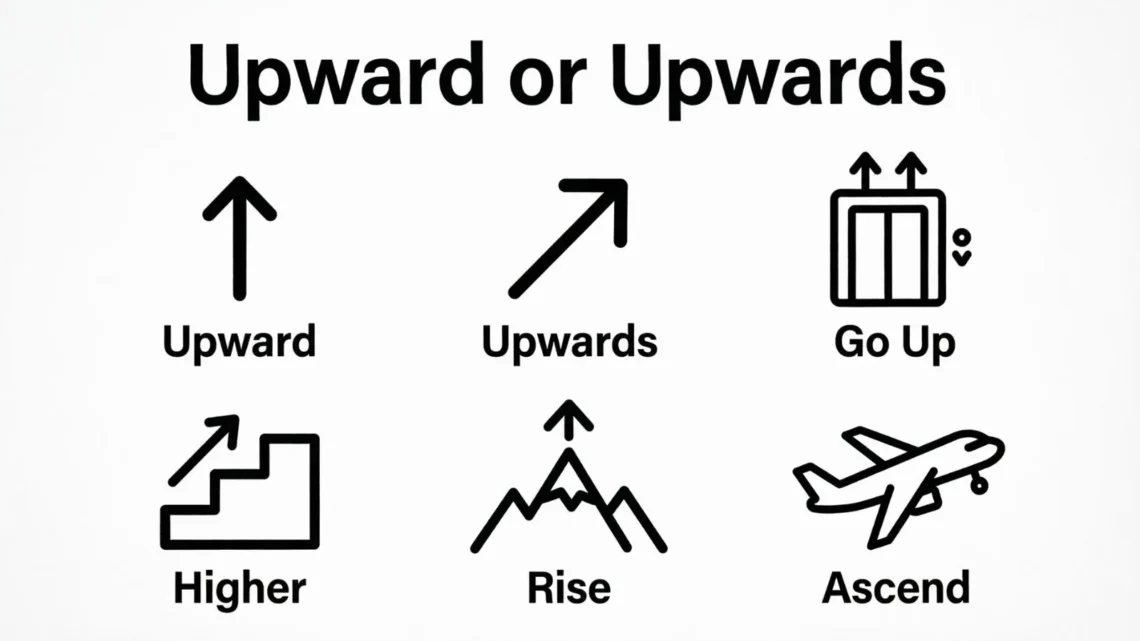
If you’ve ever wondered whether Upward or Upwards is the correct choice, you’re not alone.
These two words look almost identical and often appear in the same contexts, making it easy to question which one sounds more natural or follows standard grammar.
The good news is that you’re in the right place. While both forms are correct, their usage can vary depending on style, region, and sentence structure.
In this guide, you’ll discover when each word is appropriate, why the difference exists, and how to choose the right option with confidence in everyday writing and speech.
Quick Answer
Both upward and upwards are correct.
- Upward is more common in American English.
- Upwards is more common in British English.
In most sentences, you can use either one without changing the meaning.
Examples:
- The balloon floated upward.
- The balloon floated upwards.
Upward vs Upwards: Main Difference
| Word | Meaning | Correct? | Best Used For | Example |
| Upward | Toward a higher place or position | ✅ Yes | American English, formal writing, adjective or adverb | Smoke drifted upward. |
| Upwards | Toward a higher place or position | ✅ Yes | British English, everyday conversation | Smoke drifted upwards. |
What Does Upward Mean?
Upward means toward a higher place, level, or direction. It can be used as an adverb or an adjective.
As an adverb, it describes movement.
As an adjective, it describes something that points or moves higher.
Examples
- The bird flew upward into the sky.
- Prices have moved upward this year.
- She looked upward at the stars.
- The company showed an upward trend in sales.
- The elevator continued upward.
What Does Upwards Mean?
Upwards also means toward a higher place or direction. It is mainly used as an adverb.
It has the same meaning as upward, but it is more common in British English.
Examples
- The child climbed upwards.
- The smoke drifted upwards.
- We looked upwards at the mountain.
- The kite moved upwards with the wind.
- Interest rates could move upwards next year.
How to Use Upward or Upwards
In most cases, you can choose either word.
Use upward when:
- Writing in American English.
- Using it as an adjective.
- Writing formal reports or academic work.
Correct:
- The graph shows an upward trend.
- The bird flew upward.
Use upwards when:
- Writing in British English.
- Speaking naturally in everyday conversation.
Correct:
- The plane climbed upwards.
- She glanced upwards.
Avoid This Mistake
Incorrect:
- An upwards trend
Correct:
- An upward trend
Why?
Upwards is almost always an adverb, while upward can be both an adjective and an adverb.
Where to Use Upward or Upwards
School Writing
Either is acceptable, but stay consistent throughout your work.
Formal Writing
Upward is often preferred, especially in American English.
Emails
Both are natural.
Everyday Conversation
Use whichever sounds more natural in your region.
Messages
Both are common and easily understood.
Professional Communication
Choose the form that matches your audience and writing style.
American English
- Upward is more common.
- Upwards is still understood but less frequent.
British English
- Upwards is more common.
- Upward is also correct, especially before nouns.
Canada
Both forms are used, though upward is slightly more common in formal writing.
Australia and New Zealand
Upwards is often preferred in everyday English.
India and Pakistan
Both forms are understood. Many writers follow British English, so upwards appears more often in everyday writing.
Why People Get Confused
People often confuse these words because:
- They have the same meaning.
- They differ by only the letters -s.
- American and British English prefer different forms.
- Many similar words work the same way, such as toward/towards and forward/forwards.
Common Mistakes to Avoid
Wrong:
The company has an upwards trend.
Correct:
The company has an upward trend.
Explanation: Use upward before a noun.
Wrong:
He looked upwardly.
Correct:
He looked upward.
Explanation: Upwardly has a different meaning and is rarely used to describe physical direction.
Wrong:
The balloon moved upwardsly.
Correct:
The balloon moved upward.
Explanation: Do not add extra endings.
Wrong:
She made an upwards movement.
Correct:
She made an upward movement.
Explanation: Use upward as an adjective before a noun.
Real-Life Examples
Meeting
- Sales are moving upward this quarter.
School
- The students looked upwards at the flag.
Travel
- The cable car moved upward along the mountain.
Work
- We expect an upward trend in profits.
Text Message
- Look upwards! The fireworks have started.
Conversation
- The balloon floated upward until it disappeared.
Shopping
- Prices have been moving upwards recently.
Easy Trick to Remember
Think of it this way:
- Upward = American favorite
- Upwards = British favorite
If you’re describing a noun, such as upward trend, choose upward.
Mini Quiz
1. Which word is more common in American English?
Answer: Upward
2. Which sentence is correct?
A. An upwards trend
B. An upward trend
Answer: B
3. Which form is more common in British English?
Answer: Upwards
4. Fill in the blank:
The smoke drifted ________.
Answer: Upward or upwards
5. Which word can be used as an adjective?
Answer: Upward
6. True or False:
Upward and upwards always have different meanings.
Answer: False
Related Confusing Words
- toward or towards
- forward or forwards
- afterward or afterwards
- backward or backwards
- gray or grey
- canceled or cancelled
- its or it’s
- your or you’re
FAQs
Is upward correct?
Yes. It is completely correct and is especially common in American English.
Is upwards correct?
Yes. It is also correct and is more common in British English.
What is the difference between upward and upwards?
The meaning is the same. The main difference is regional preference and that upward can also be used as an adjective.
Which one should I use?
Use upward for American English or before nouns. Use upwards if you prefer British English in adverb form.
Is either one more formal?
Both are acceptable in formal writing, but upward is slightly more common in formal and academic contexts.
Conclusion
Upward and upwards both mean toward a higher place or direction.
The main difference is usage rather than meaning.
Upward is more common in American English and works as both an adjective and an adverb.
Upwards is more common in British English and is mainly used as an adverb.
Choose the form that matches your audience, and stay consistent throughout your writing.
Discover More Post
- Is It Alternately or Alternatively? The Correct Word Explained?
- Impressed With or By: Which Is Correct to Use(2026)?
- When to Use Compare To or With in English Grammar(2026)?

Jack Ellison is an American author at WordsSign. He writes clear and well-researched articles on symbols, meanings, culture, and spiritual insights.